

A little after 8:00 a.m. on a Monday, the owner of a specialty home organization business opened Ads Manager and stared at a campaign that had spent $312 over two weeks. The account had generated clicks and traffic, but not enough sales to answer the only question that mattered: should the business keep investing in Facebook ads or stop altogether?
Across the table sat the company's only marketer. No agency. No design team. No dedicated media buyer. Just one person responsible for content, email, analytics, and acquisition.
The campaign was not the real problem. The team had no reliable system for learning.
Over the next 90 days, they built one.
Why Most Small Businesses Fail Before They Reach Useful Data
Many small businesses treat Facebook ads as a sequence of fresh starts. A campaign struggles, so they change the audience. Three days later they rewrite the copy. The next week they swap the offer.
It feels productive because something is always changing. In practice, the account never stays stable long enough to reveal what is actually working.
The opportunity remains significant. According to Meta's Q4 2024 earnings report, Meta's family of apps reached approximately 3.29 billion daily active people worldwide. According to Meta investor reporting, advertising revenue represented more than 97% of the company's total revenue during the same reporting period. Those numbers matter because they reinforce how large and commercially important the Meta advertising ecosystem remains for businesses of every size.
The marketer realized the business was evaluating campaigns emotionally instead of operationally. One bad day triggered panic. One good day triggered overconfidence. Weekly reviews replaced hourly reactions.
Instead of asking how to scale immediately, the team focused on learning velocity.
For a deeper look at structural account mistakes, see Why Most Facebook Ad Accounts Are Broken (And How I’d Fix Them).
The Starting Budget Problem

The company allocated $1,500 per month.
That budget was not large enough to test every audience, creative angle, and offer imaginable. It was large enough to run a focused experiment.
The marketer simplified everything:
- One purchase-focused campaign
- One primary audience
- Two offers
- Multiple creative variations
- Weekly review cycles
The owner expected targeting to drive results. The marketer believed creative mattered more.
That belief was supported by published research. Nielsen and Meta have reported that creative quality can account for up to 56% of campaign sales lift in digital advertising environments. For lean teams, that statistic changes priorities. Better messaging and stronger creative workflows often create larger gains than endlessly tweaking audience settings.
The team stopped searching for perfect targeting and started searching for better messaging.
They also used benchmarks carefully. WordStream benchmark research reported an average Facebook advertising click-through rate near 0.90% across industries and an average cost per click around $0.94. These numbers were not treated as guarantees. They served as directional context for spotting unusual performance swings and diagnosing inefficient campaigns.
For additional budgeting context, see How Much Do Facebook Ads Cost? A Real Scenario and Facebook Ads Cost Playbook: Benchmarks & Budgeting Checklist.
Another realization appeared quickly.
The team did not need hundreds of ads. They needed a manageable testing structure that generated useful insights.
That distinction reduced stress immediately.
Mini Example: Testing Two Offers With Limited Spend
Instead of launching ten ideas and hoping one worked, the team selected two.
Offer A focused on convenience.
Offer B focused on saving time.
Each offer received three creative variations.
Six ads. Nothing more.
The marketer established a rule: no declaring winners after a single day.
They reviewed:
- CTR
- Cost per click
- Landing page engagement
- Add-to-cart activity
- Purchases
Two weeks later, a pattern emerged. The convenience-focused offer consistently attracted more engagement.
However, the deeper insight came from customer behavior. The strongest ads were not selling storage products. They were selling relief from clutter and frustration.
The campaign was not suddenly profitable. It was finally understandable.
The marketer documented every observation in a spreadsheet:
- Which hook generated the highest CTR
- Which image style reduced CPC
- Which headline improved add-to-cart rate
- Which landing page caused users to exit
Over time, those notes became more valuable than any individual ad.
The marketer also reviewed landing-page behavior instead of focusing exclusively on ad metrics. A surprising percentage of visitors abandoned the site before product pages fully loaded on mobile devices. That operational issue mattered more than minor targeting adjustments.
For additional creative testing frameworks, see Scaling Facebook Ad Testing: Why AI Is the Key to Breaking Through Your Creative Bottleneck.
The team also reviewed The Landing Page Bottleneck: How One Team Fixed Their Facebook Ads Performance by Changing What They Analyzed to better understand why weak post-click experiences distort campaign performance.
How the Team Built a Weekly Creative Engine

Once messaging became clearer, another constraint appeared.
The team needed more creative production capacity.
Many small businesses assume budget is the primary limitation. In reality, lean teams often run out of ideas, time, or production resources before they run out of advertising opportunities.
The marketer created a simple operating rhythm.
Monday: review performance and identify recurring themes.
Tuesday: collect customer questions and review feedback.
Wednesday: draft new concepts and variations.
Thursday: prepare assets.
Friday: launch fresh tests.
The goal was not to make every ad successful. The goal was to generate enough thoughtful experiments that successful ideas could surface.
To expand creative throughput, the team reviewed Breaking the Creative Bottleneck: How One Growth Team Scaled Facebook Ads Throughput with AI and later explored Automate Creative Testing for Meta Ads.
The marketer also noticed that simple UGC-inspired creative often outperformed highly polished assets because it felt more authentic and relatable.
That observation aligned with themes discussed in Why UGC Video Ads Are Crushing Polished Creatives on Facebook.
Another important shift occurred during this phase.
Instead of debating whether an ad was "good" or "bad," the team began asking operational questions:
- Did the hook stop scrolling?
- Did the landing page reinforce the promise?
- Did the offer reduce friction?
- Did the creative explain the product clearly?
Those questions improved decision-making faster than emotional reactions ever could.
Publishing Faster Without Adding Headcount
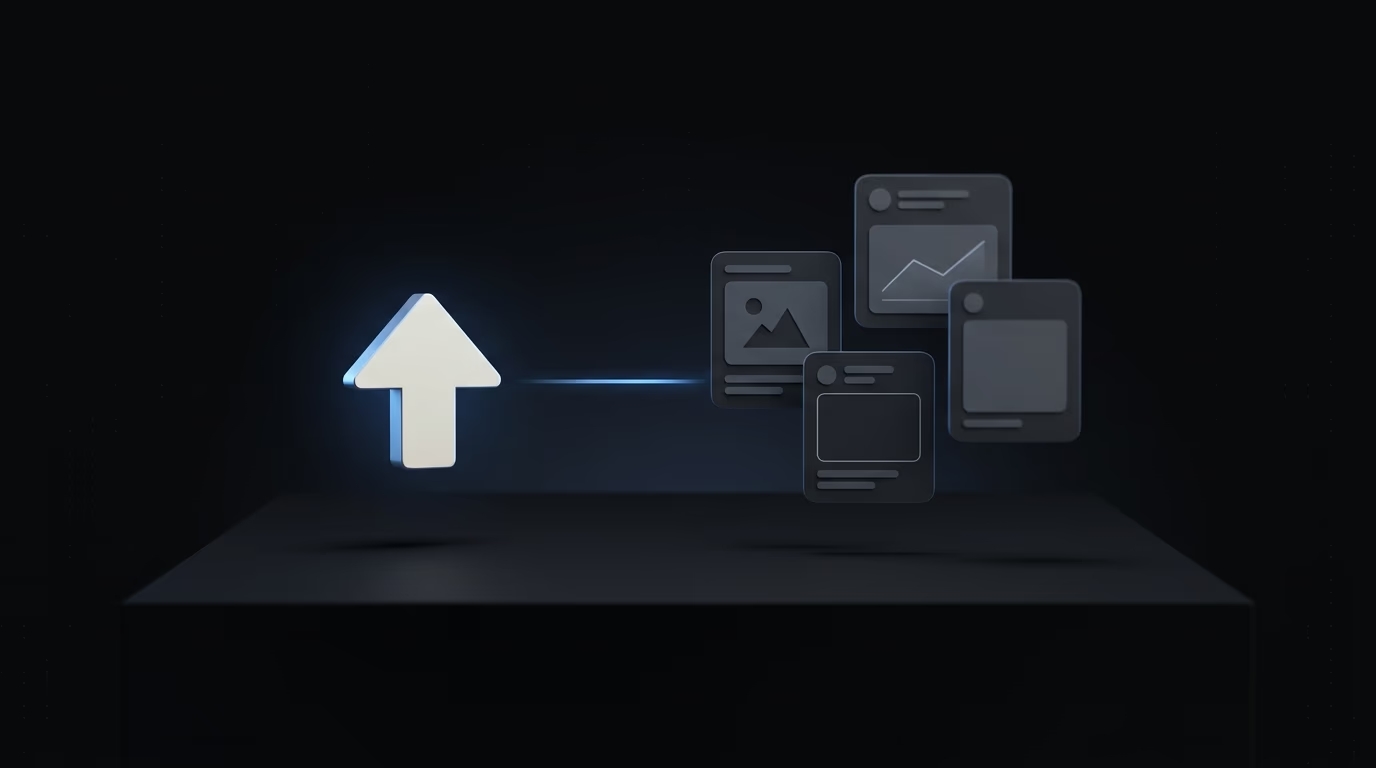
By day 45, the team encountered a different bottleneck.
They finally had enough creative ideas. Now they needed a faster way to publish them.
Launching ads manually required repetitive work:
- Naming conventions
- Asset attachment
- URL validation
- Tracking parameter checks
- Campaign duplication
The marketer evaluated several workflow options.
AdEspresso simplified campaign creation and testing workflows for smaller teams that needed a more approachable interface.
Revealbot offered automation and rule-based campaign management capabilities that supported scaling processes and repetitive optimization tasks.
AdManage.ai focused on AI-assisted campaign management and optimization support designed to reduce manual oversight.
Each platform addressed a different operational challenge.
After reviewing the process, the marketer concluded that optimization was not the primary constraint. Publishing was.
The team adopted a Facebook ads uploader workflow using Instrumnt.
Instead of creating every ad manually inside Ads Manager, campaigns could be prepared in structured batches and uploaded together. The improvement occurred before ads ever went live.
The marketer spent less time on repetitive setup work and more time creating experiments.
For teams evaluating bulk publishing processes, see Meta Ads Bulk Upload Workflow: A Step-by-Step Operations Guide.
The team also explored How to Scale Meta Ads with Bulk Uploading to better understand how operational efficiency affects creative velocity.
Workflow improvements reduced mistakes.
Broken URLs, inconsistent naming conventions, and tracking errors became less common.
More importantly, launching ads stopped feeling exhausting.
The Workflow Shift That Changed Everything
The biggest improvement was not faster publishing.
It was a change in behavior.
When launching ads became easier, each experiment stopped feeling expensive.
Testing became routine.
New concepts entered the account weekly. Weak ideas were removed quickly. Winning themes received additional budget.
After roughly three months, the team had increased creative output, shortened launch times, improved documentation, and built confidence in the process.
No secret targeting tactic created the improvement. The team simply removed friction and increased learning velocity.
The owner also noticed campaign discussions becoming more strategic. Instead of asking why one ad failed, the team asked broader questions about customer pain points, creative formats, landing pages, and offer strategy.
For more operational thinking around scaling processes, see The Execution Bottleneck: Why Manual Facebook Ads Creation Is Killing Your ROAS.
The marketer later admitted that the company had initially underestimated how much operational discipline matters in Facebook ads management.
The difference between random activity and repeatable growth was process consistency.
The 90-Day System: AI, Claude Code, Reporting Discipline, and Creative Velocity
By the third month, another layer was added.
AI was not making campaign decisions. Instead, it handled support tasks that consumed time.
Claude Code helped organize creative notes, summarize recurring findings, maintain naming conventions, identify landing-page issues, and suggest future experiments.
The marketer reviewed every output manually.
Combined with disciplined reporting, the process created a feedback loop:
- Performance data influenced creative development
- Creative results influenced future tests
- Tests informed budget decisions
- Budget decisions influenced growth
The team also used AI to accelerate reporting preparation. Instead of spending hours formatting spreadsheets, the marketer generated summarized performance reviews before weekly meetings.
This did not replace strategic thinking. It reduced administrative drag.
For a deeper operational walkthrough, see Automated Facebook Ads Learning Loops with Instrumnt and Claude Code.
The marketer later reflected that the biggest competitive advantage was not targeting sophistication.
It was consistency.
Consistent testing.
Consistent documentation.
Consistent review cycles.
Consistent publishing workflows.
That operational discipline turned Facebook ads from a stressful gamble into a measurable growth system.
What Other Small Businesses Can Learn From This Scenario
The lesson is not that one tool fixed everything.
The lesson is that Facebook ads for small business become more predictable when a team builds a system around learning.
Most small businesses do not fail because they lack audience access. They struggle because they test too few ideas, document too little, or abandon experiments before useful patterns emerge.
A modest budget can still generate valuable insight.
A weekly creative process can outperform occasional bursts of activity.
A Facebook ads uploader can remove operational friction that slows experimentation.
Tools such as Instrumnt, AI systems, Claude Code, AdEspresso, Revealbot, and AdManage.ai become useful when they support a repeatable process rather than replace one.
The most important shift is psychological. When campaigns become easier to launch, measure, and document, marketers stop fearing experimentation.
More tests create more learnings. More learnings improve decision-making.
By the end of the 90 days, the company had not discovered a secret targeting trick. What they built was more practical: a system that generated ideas, tested them consistently, captured lessons, and fed those lessons into the next round of Facebook ads.
Common Questions About Facebook Ads for Small Business
What is a realistic Facebook Ads budget for a small business starting from scratch?
Many small businesses begin with budgets between $1,000 and $2,000 per month because that level often provides enough spend to test offers, messaging, and creative variations while keeping risk manageable.
How many ad creatives should a small business test each month?
A practical starting point is 10 to 20 creative variations per month. The objective is not volume alone but consistent learning and documentation.
Can AI and tools like Claude Code help manage Facebook Ads with a small team?
Yes. AI can support documentation, reporting summaries, naming conventions, creative analysis, experiment planning, landing-page audits, and workflow management. Claude Code can reduce administrative workload while keeping humans responsible for final decisions.
Sources and Attribution
Statistics referenced in this article include Meta Q4 2024 earnings reporting indicating approximately 3.29 billion daily active people across Meta's family of apps and advertising revenue representing more than 97% of Meta's total revenue during the reporting period. Nielsen and Meta research has also reported that creative quality can account for up to 56% of campaign sales lift. WordStream benchmark research additionally reported average Facebook advertising click-through rates near 0.90% and average cost per click figures around $0.94 across industries. These statistics are included for educational benchmarking context rather than performance guarantees.
For more context, see WebFX Meta benchmarks.
For more context, see Meta Advertising Standards.
For more context, see Revealbot.