
Why “How Much Do Facebook Ads Cost?” Is the Wrong First Question
When teams ask how much Facebook ads cost, they usually expect a clean number: a CPC benchmark, a CPM range, maybe an average CPA.
But a three-person growth team at a mid-market ecommerce brand discovered something different.
They were spending $5,000 per month and seeing wildly inconsistent results. Some weeks looked profitable. Others didn’t. Yet when they compared their metrics to benchmarks, nothing seemed off.
The issue wasn’t cost—it was execution.
Cost in Facebook ads is an output, not an input. It reflects how efficiently you test creatives, allocate budget, and respond to performance signals.
Once they reframed the question from “how much do Facebook ads cost?” to “what drives cost efficiency?”, their strategy changed entirely.
The Budget Dilemma: Small Team, Big Goals

With $5,000 per month (about $166/day), their budget wasn’t tiny—but their time was.
They initially split spend like this:
- Prospecting: 70%
- Retargeting: 20%
- Creative testing: 10%
On paper, it looked reasonable.
In reality, execution broke down.
Each ad took 15–30 minutes to build manually in Ads Manager. Testing 10 variations per week consumed hours. Under time pressure, they reduced testing volume.
That’s when performance dropped.
Fewer ads meant fewer chances to find winners. CPA increased—not because CPC or CPM changed, but because they weren’t iterating fast enough.
This insight became foundational: budget allocation matters less than testing velocity.
What Facebook Ads Actually Cost in 2026 (Real Benchmarks Across CPC, CPM, CPA)
To ground their thinking, they pulled external benchmarks and compared them to internal data.
- Average CPC: $0.94 (WordStream, 2025)
- Median CPM: $13–14 (Meta for Business, 2025)
- Average CTR: 0.90% (Meta Ads Guide)
These aligned closely with their account.
They also found a key statistic: creative quality accounts for over 50% of performance variance (Meta & Nielsen, 2025). That meant the biggest lever wasn’t bidding strategy—it was creative output.
Another widely cited benchmark reinforces this: most industries see Facebook CPMs fluctuate within a relatively stable band, but CPA can vary by 2–5x depending on creative effectiveness and funnel alignment (WordStream, 2025).
This explained their volatility.
Their costs weren’t unstable—their execution was.
Mini Example: Allocating $5k Across 15 Ads Efficiently
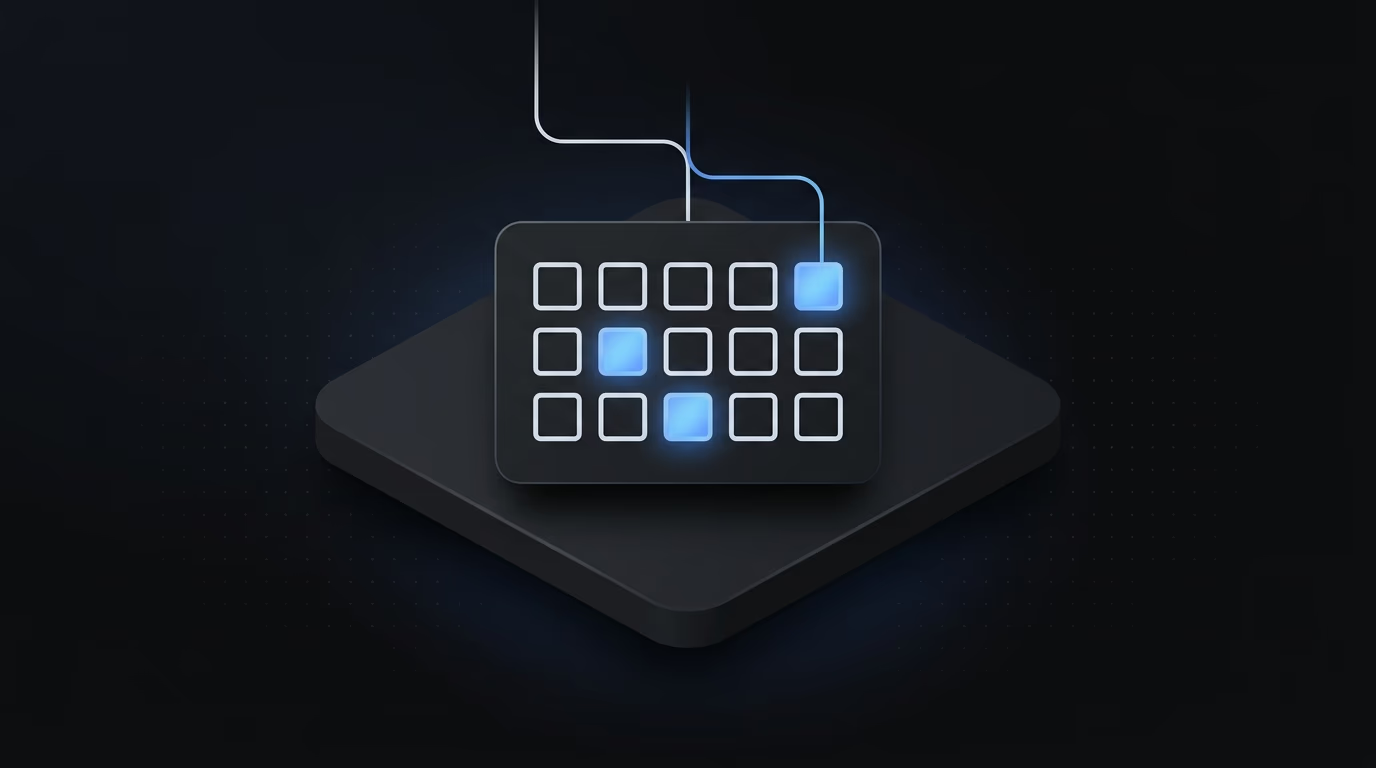
Instead of structuring campaigns, they structured experiments.
Here’s how they reallocated their $5k budget:
| Allocation Type | Budget | Purpose |
|---|---|---|
| Prospecting Core | $2,500 | Scale proven creatives |
| Structured Testing | $1,500 | Run 15–20 variations |
| Retargeting | $1,000 | Capture demand |
The key change wasn’t budget—it was density.
They launched 15 variations at once instead of 3–5.
Each variation tested a different:
- Hook
- Creative format
- Value proposition
This increased the probability of finding winners early.
Instead of waiting weeks to identify strong performers, they got directional signals within days.
Uploader Workflow: Reducing Manual Entry Errors and Tracking Spend
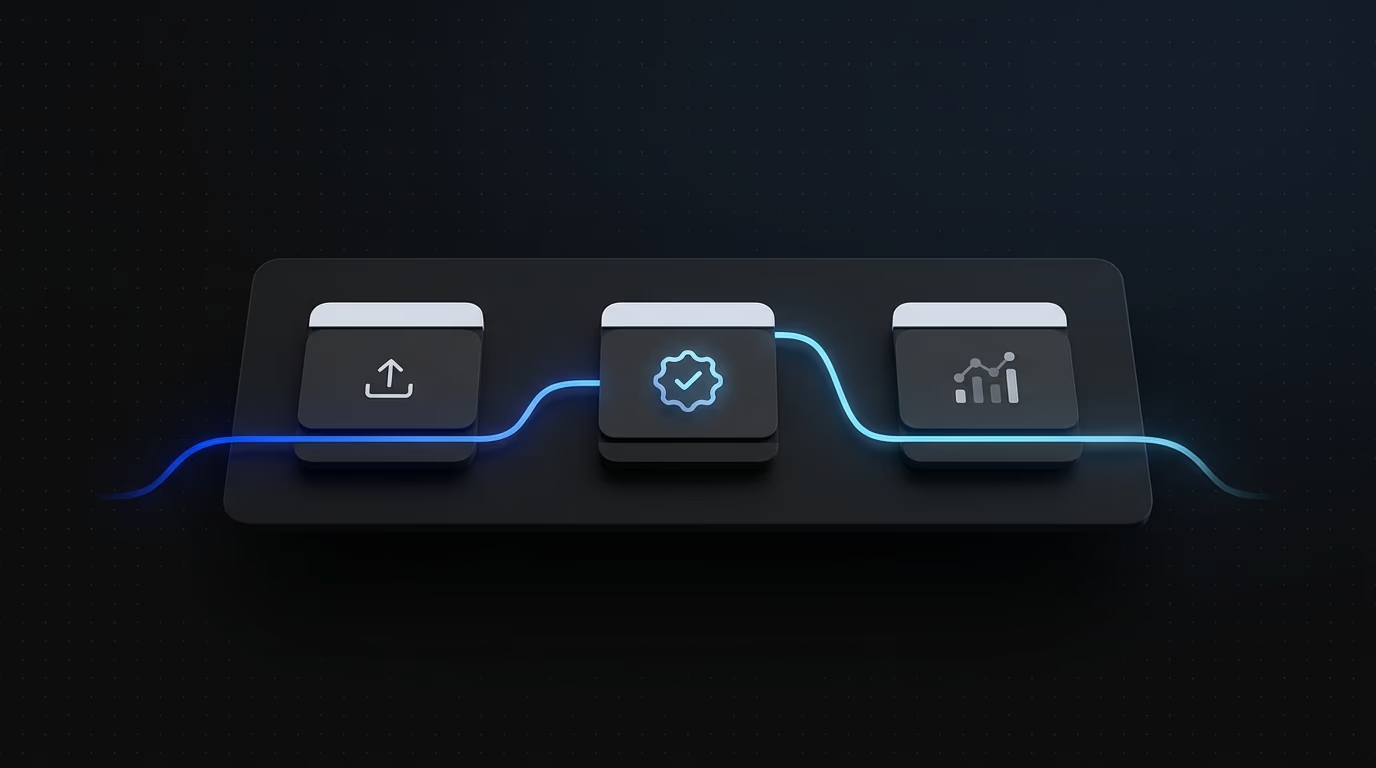
To support this volume, they needed better infrastructure.
Manual setup simply didn’t scale.
They implemented a Facebook ads uploader using Instrumnt and restructured their workflow:
- 15 primary text variations
- 5 headline options
- 3 creatives
- Naming conventions tied to hypotheses
Bulk uploads reduced setup time from ~4 hours to under 1 hour per batch.
This unlocked something critical: consistency.
They could now reliably launch 15–25 ads per week.
Compared to alternatives:
- AdEspresso was simple but limited for high-volume structured testing
- Smartly.io offered powerful automation but was built for enterprise teams
- Hunch excelled at creative generation but lacked full testing workflow control
Instrumnt, combined with AI and Claude Code, gave them a middle ground: speed + structure.
For a deeper breakdown, see Meta Ads Bulk Upload Workflow: A Step-by-Step Operations Guide and How to Build a Facebook Ads Bulk Testing System with Instrumnt and Claude Code.
From Cost Control to Cost Advantage: Using AI + Claude Code to Increase Testing Velocity Without Increasing Budget
Once execution scaled, they introduced a feedback loop.
Every 3–5 days (after ~1,000 impressions per ad), they evaluated performance:
- Pause bottom 50%
- Shift budget to top performers
- Generate new variations using AI
Claude Code played a key role here.
It generated structured variations based on:
- Winning hooks
- Proven messaging angles
- Audience response patterns
This meant they weren’t guessing—they were iterating systematically.
Over six weeks, three things happened:
- CPA volatility decreased
- Winning patterns became predictable
- Budget efficiency improved without increasing spend
Cost stopped being reactive.
It became a controllable system.
Operational Playbook: How to Actually Control Facebook Ads Costs Day-to-Day
This is where most teams struggle.
They understand benchmarks—but not execution.
Here’s the exact operational system this team followed:
1. Weekly Testing Targets
- Launch 15–25 new ads per week
- Maintain at least 3 active experiments
- Refresh creatives every 7–10 days
This prevents fatigue and keeps learning loops active.
If you’re launching fewer than 10 ads per week, you’re likely under-testing.
2. Budget Reallocation Rules
- Day 3: Evaluate CTR vs baseline
- Day 5: Evaluate CPC vs average
- Day 7: Evaluate CPA (if enough conversions)
Kill quickly. Scale gradually.
Avoid emotional decisions—use thresholds.
3. Creative Throughput System
Use AI and Claude Code to:
- Generate 10–20 variations per concept
- Structure outputs into testable formats
- Feed directly into your Facebook ads uploader
This is where most efficiency gains come from.
If creative production is slow, costs rise—even if CPC stays stable.
For more on this, see Why Your Creative Testing Is Failing (And How to Automate the Solution).
4. Naming + Tracking Discipline
Every ad should encode:
- Hook type n- Creative format
- Audience segment
Without this, you can’t learn from results.
And without learning, costs drift upward.
5. Compounding Learning Loops
The real advantage isn’t one winning ad—it’s a system that keeps producing them.
This is why Automated Facebook Ads Learning Loops with Instrumnt and Claude Code becomes critical at scale.
Key Insights: How Costs Shift Across Campaign Types and Placements
After stabilizing their system, the team noticed consistent patterns:
- CPC and CPM remained relatively stable
- CPA fluctuated based on creative performance
- Prospecting had higher CPMs but drove growth
- Retargeting had lower CPA but limited scale
Most importantly:
Cost predictability increased with testing volume.
This contradicts common advice.
It’s not about “spending more to stabilize performance.”
It’s about executing faster.
FAQ
What is a good budget to start Facebook ads?
$3,000–$5,000 per month is a practical starting range for small to mid-market teams.
At this level, you can:
- Test multiple creatives per week
- Maintain separate prospecting and retargeting campaigns
- Generate statistically meaningful data
Below that, testing becomes constrained and results become harder to interpret.
Why does my Facebook CPA increase over time?
The most common cause is creative fatigue.
As frequency increases, CTR drops. Lower engagement leads to higher CPC and ultimately higher CPA.
This aligns with industry data showing that ad performance typically declines after repeated exposure without creative refresh cycles (Meta Ads Guide).
The solution isn’t lowering budget—it’s increasing creative throughput.
How can I lower Facebook ad costs without reducing spend?
Focus on execution speed:
- Launch more variations
- Test systematically
- Reallocate budget quickly
Tools like Instrumnt, combined with AI and Claude Code, help automate this process.
You’re not lowering costs directly—you’re increasing the probability of finding efficient ads.
Are CPC and CPM the best way to measure Facebook ads cost?
They’re useful—but incomplete.
CPC and CPM indicate auction efficiency, but not business outcomes.
CPA and ROAS are better indicators of real cost efficiency.
However, early signals like CTR and CPC are critical for making fast decisions before conversion data accumulates.
If there’s one takeaway, it’s this:
Facebook ads costs aren’t fixed—they’re earned through execution.
The faster you test, the more predictable your costs become.
And in 2026, the teams that win aren’t the ones with the biggest budgets.
They’re the ones with the fastest systems.