
Alicia and Ben managed growth for a B2B software company with a lean budget, a small team, and a growing creative workload. Their Facebook ads had been stable for months until click-through rates declined, acquisition costs increased, and optimization became harder despite unchanged targeting, budgets, and landing pages.
The diagnosis was not a targeting problem or a budget problem. It was creative fatigue combined with an inconsistent Facebook ad creative testing workflow. Their team had ideas, but those ideas were trapped inside disconnected documents, manual uploads, scattered reports, and delayed replacement decisions.
Two statistics helped confirm the problem. According to Nielsen Catalina Solutions research, creative quality can account for approximately 47% of advertising sales impact, showing that creative execution is a major performance driver. Source: Nielsen Catalina Solutions advertising effectiveness research. Meta has also emphasized creative diversification as a core advertising practice because audiences can become less responsive when exposed to the same assets repeatedly. Source: Meta for Business creative best-practice guidance.
Research from Google and Ipsos has also shown that strong creative effectiveness can significantly influence campaign outcomes, reinforcing that creative decisions are not just cosmetic improvements but measurable business factors. Source: Google/Ipsos creative effectiveness research.
For additional context, see Why Your Facebook Ads Are Not Working (It’s Not Targeting, Bidding, or Budget).
The Three-Week Performance Decline
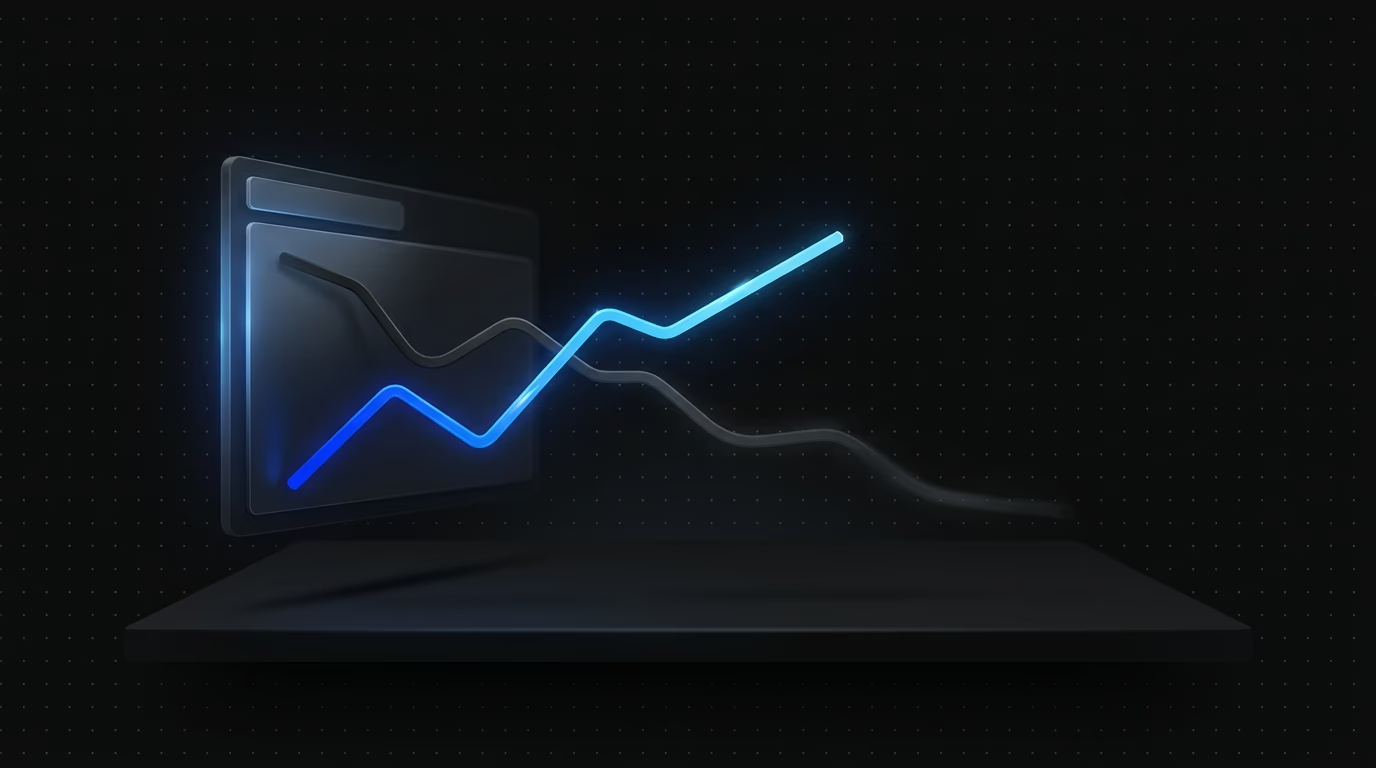
Initially, the team searched for technical explanations. They reviewed attribution reports, campaign structures, bidding settings, audience definitions, and landing page performance.
Nothing explained the gradual deterioration.
Then they noticed a pattern. Many creatives had been running continuously for weeks. Frequency was increasing while engagement signals were weakening.
Creative fatigue had arrived before anyone formally named it.
The team realized their biggest constraint was not the quality of their ideas. Their constraint was throughput. They could not create, launch, analyze, and replace assets quickly enough to keep pace with changing audience behavior.
A creative testing system only works when every stage connects. Ideas need production. Production needs deployment. Deployment needs analysis. Analysis needs to generate the next experiment.
Without that loop, teams end up making decisions based on outdated information.
Mapping the Old Workflow: Where Manual Testing, Reporting, and Uploads Created Bottlenecks
When Alicia mapped the existing workflow on a whiteboard, the bottlenecks became obvious.
Ideas lived in one document. Design files lived somewhere else. Reporting existed in spreadsheets. Uploads happened manually inside Ads Manager. Replacement decisions depended on whoever had time available that day.
Their old process looked simple:
- Brainstorm concepts.
- Request assets.
- Build ads manually.
- Launch tests.
- Wait for results.
- Analyze outcomes.
- Create replacements.
The strategy was not broken.
The operations were.
Testing five concepts required repeating naming conventions, tracking parameters, uploads, and quality-control checks five separate times.
The team spent more time moving information than generating learning.
This was similar to the workflow issues discussed in When Your Facebook Ads Creative Pipeline Breaks.
They needed a system where every experiment created useful knowledge instead of becoming another isolated campaign task.
Building a Weekly Creative Testing Operating System for Facebook Ads
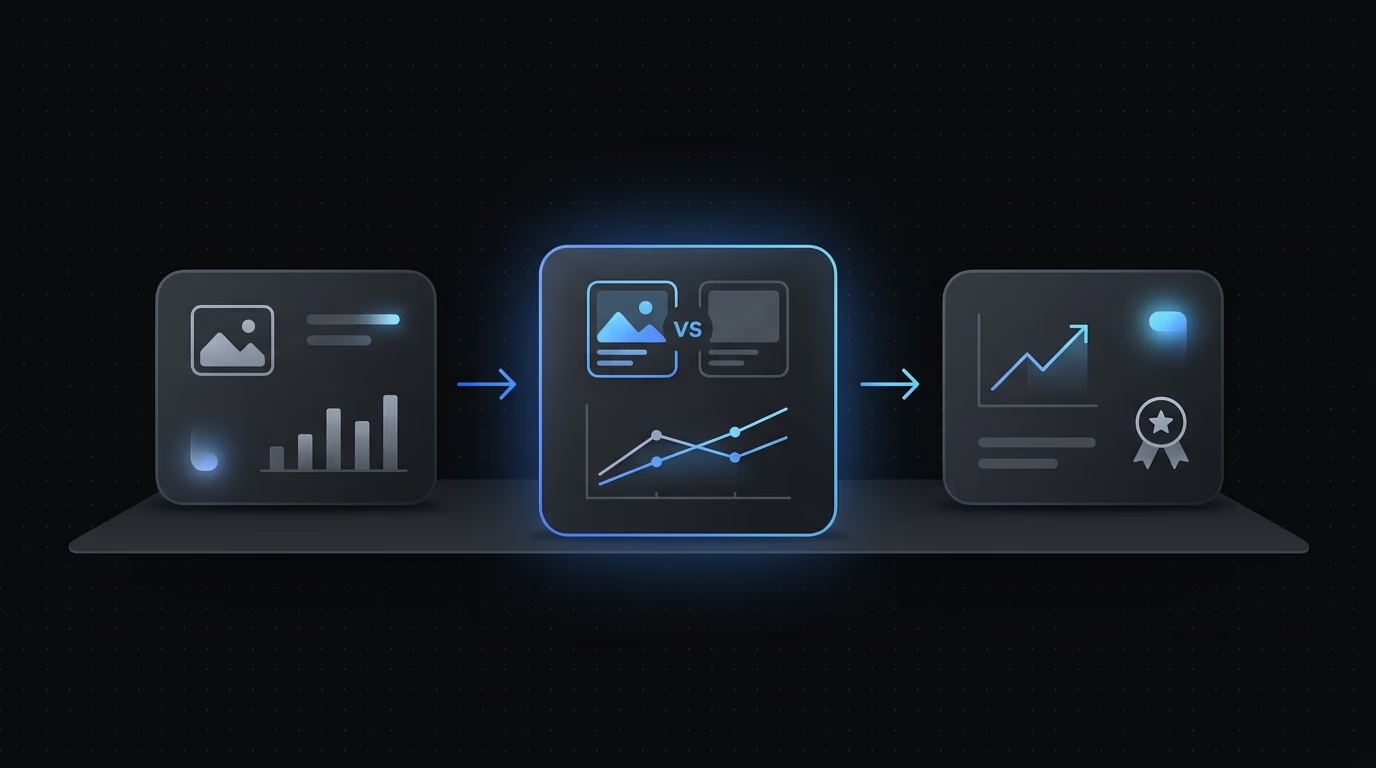
Instead of reacting whenever performance dropped, Alicia and Ben created a fixed weekly operating rhythm.
Monday became analysis day. Tuesday became hypothesis day. Wednesday and Thursday became production days. Friday became deployment day.
Every experiment needed a clear question.
Examples included:
- Which opening hook creates stronger engagement?
- Which pain point attracts higher-quality leads?
- Which visual format produces better click behavior?
- Which message improves conversion quality?
The team stopped testing random variations and started isolating variables.
Winning concepts stayed active.
Weak concepts were archived.
New hypotheses entered the queue immediately.
Each test followed a standard template:
- Hypothesis
- Variable tested
- Creative assets
- Audience segment
- Launch date
- Success metric
- Key learning
- Next action
Documentation transformed individual experiments into a reusable knowledge base.
The workflow became a system instead of a collection of tasks.
For another perspective, see Your Creative Testing Framework Is Probably Broken (And 'Scientific Method' Won't Save It).
Mini Scenario: Three Hooks, One Winner, and the Analysis Process Behind the Decision
The team created three video ads promoting the same offer.
Everything remained identical except the opening hook.
Hook A focused on efficiency. Hook B focused on reducing manual work. Hook C focused on competitive pressure.
After several days, Hook B became the clear winner.
The important insight was not simply that one hook performed better. The team looked deeper.
Customer comments repeatedly mentioned repetitive operational work. Sales conversations surfaced the same frustration. Support discussions reflected similar themes.
The winning creative revealed a broader customer problem.
Instead of treating the result as a single successful ad, Alicia and Ben expanded it into five additional concepts around operational efficiency.
The first experiment reduced uncertainty for future experiments.
That compounding effect became the foundation of their creative testing workflow.
Deploying Creatives at Scale: Bulk Upload Workflows and Faster Iteration Cycles

Generating more ideas created a new bottleneck.
Deployment consumed entire Fridays.
Hours disappeared into uploads, naming conventions, campaign setup, and quality assurance.
The bottleneck had simply moved.
To fix this, the team adopted a Facebook ads uploader workflow focused on batch deployment and operational consistency.
Instead of rebuilding ads individually, they prepared creative batches and launched multiple variations together.
Different tools solved different parts of the problem.
Revealbot was positioned mainly as an automation-focused option with rule-based workflow capabilities. Automation helped reduce repetitive management tasks, but automation alone did not solve the creative learning problem.
Ads Uploader focused on launch efficiency, bulk deployment, naming consistency, and reducing manual work during creative releases.
Paragone represented another tool category within the broader advertising management ecosystem, although the team still needed a complete process connecting testing, analysis, and iteration.
The team ultimately standardized around Instrumnt because their goal was not simply automation. Their goal was maintaining creative velocity while preserving learning quality.
The improvements were operational:
- More concepts reached production.
- More experiments launched on schedule.
- More insights accumulated before fatigue damaged performance.
The workflow changed from reactive replacement to planned creative refresh cycles.
Additional guidance can be found in How to Scale Meta Ads with Bulk Uploading.
Creating an AI-Powered Learning Loop with Claude Code to Generate Better Test Ideas
Once deployment improved, analysis became the next opportunity.
Every week the team collected:
- Winning hooks
- Audience comments
- Performance notes
- Campaign metadata
- Creative classifications
Claude Code helped organize those inputs into structured observations.
The AI system did not replace strategy. It accelerated pattern recognition.
The team asked questions like:
- Which pain points appear repeatedly in winning creatives?
- Which offers attract attention but fail to convert?
- Which formats consistently underperform?
- Which messages deserve another testing cycle?
The answers became inputs for the next sprint.
Instead of disconnected experiments, they created a continuous learning loop.
Every testing cycle improved the next one.
This approach aligns with ideas explored in Automated Facebook Ads Learning Loops with Instrumnt and Claude Code.
Over time, their creative archive became more valuable than any individual advertisement because it preserved the reasoning behind every decision.
The Outcome Six Weeks Later
Six weeks after rebuilding the workflow, the account looked different.
Not because budgets increased.
Not because a single advertisement became magical.
Performance improved because the team consistently generated fresh creative inputs and faster feedback loops.
More concepts entered testing.
More insights were documented.
More fatigued creatives were replaced before performance collapsed.
The biggest lesson extended beyond Facebook ads.
Operational systems determine whether creative ideas become measurable business outcomes.
When ideation, production, deployment, reporting, and replacement operate separately, creative fatigue eventually wins.
When they operate as one connected workflow supported by uploader processes, AI-assisted analysis, and operational discipline, teams compound learning every week.
Common Questions About Facebook Ad Creative Testing Workflow
How often should I refresh Facebook ad creatives to avoid creative fatigue?
The ideal schedule depends on audience size, spend, and campaign velocity. High-volume accounts often review creatives weekly and introduce new variations every 7 to 14 days. Lower-volume teams may operate on longer cycles. The important factor is detecting fatigue before performance declines significantly.
What is the best workflow for testing multiple Facebook ad creatives without creating campaign chaos?
Use documented hypotheses, standardized naming conventions, centralized reporting, batch production, scheduled replacement decisions, and a Facebook ads uploader process. The objective is consistent testing volume combined with reliable learning.
Can AI and Claude Code help generate better Facebook ad testing hypotheses?
Yes. AI tools can organize feedback, classify results, identify recurring themes, and help marketers discover new creative angles. They work best as learning accelerators that support human decision-making.
A successful creative testing workflow is not about producing more ads randomly. It is about creating a system where every test produces a clearer understanding of what customers respond to and why.
For more context, see inBeat's creative fatigue guide.
For more context, see Meta Advertising Standards.
For more context, see Meta for Business.