A Slack notification popped up at 9:12 AM: “New creatives are live.”
The growth team had just launched 24 new Facebook ads across three campaigns. Fresh hooks. New angles. Multiple formats. They had done everything the playbooks said to do.
By Friday, the results looked almost identical to the previous week.
CTR hovered around 0.8%. CPC stayed close to $1. CPA barely moved.
Someone suggested they needed better hooks. Someone else said they needed more video. Another person wanted to test new audiences.
No one asked a simpler question: what happens after the click?
The Plateau: When More Ads Didn’t Improve Results
This team wasn’t slacking off. They were putting in the work. They followed best practices from the Meta Ads Guide and kept up with updates from Meta Blueprint. They refreshed creatives every two weeks to avoid fatigue, tracked frequency carefully, and ran multiple variations per ad set.
They knew the benchmarks. The average Facebook ad CTR across industries is 0.90% (WordStream). Average CPC is $0.94 (WordStream). Their numbers weren’t bad. They were just... stuck.
They’d read plenty on creative testing and had even revamped their process after reading Why Your Creative Testing Is Failing (And How to Automate the Solution). They were launching more ads than ever before.
But the performance remained flat.
The issue was subtle: they were evaluating ads without considering the landing pages those ads led to. Every performance diagnosis stopped at the click.
The Hidden Variable: Why Landing Pages Distort Facebook Ads Performance Data
When they pulled a longer time window and segmented by destination URL, something strange appeared.
Ads pointing to Landing Page A had consistently lower CTR but higher conversion rates. Ads pointing to Landing Page B had higher CTR but worse CPA. Landing Page C sat in the middle.
They realized they’d been judging creatives without factoring in the environment those creatives were sending traffic to.
Research from Nielsen and Meta shows creative quality can account for up to 56% of a campaign’s ROAS variation (Nielsen). But what they missed was that landing page structure changes how that creative quality translates into results.
A strong hook that promises education performs differently when it lands on a hard-sell page. A direct-response ad performs differently when it lands on a long-form explainer.
Their ads weren’t underperforming. Their ads were mismatched.
Mini Example: One Offer, Three Landing Page Approaches
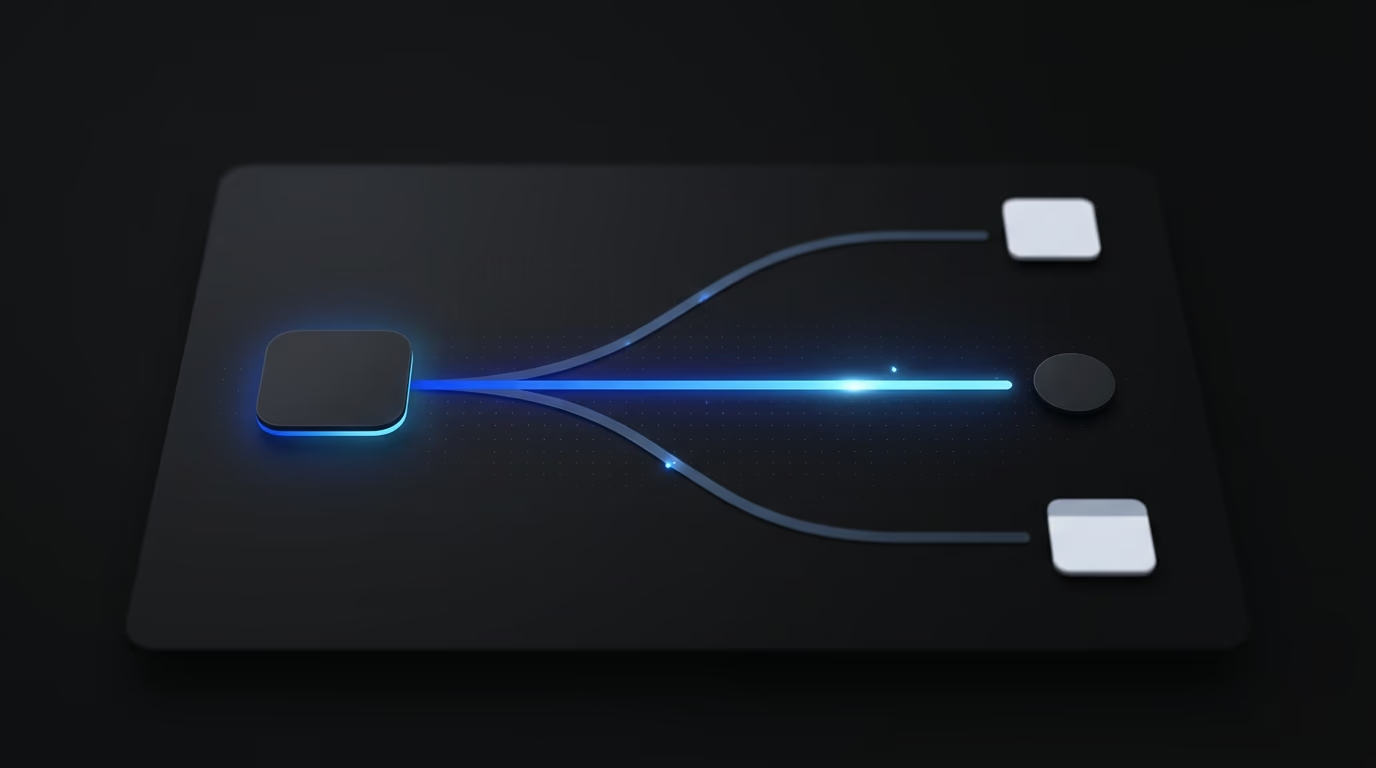
They ran a simple test. Same product. Same audience. Same budget. Three ads with identical creative, each pointing to a different landing page style.
- Page A: Long-form educational explainer with social proof
- Page B: Short, aggressive offer with immediate CTA
- Page C: Hybrid page with moderate copy and product visuals
The ad didn’t change. Only the page did.
After five days (enough time for delivery to stabilize outside the learning phase), the pattern was obvious.
| Metric | Page A | Page B | Page C |
|---|---|---|---|
| CTR | 0.72% | 1.05% | 0.88% |
| CPC | $1.08 | $0.82 | $0.94 |
| Conversion Rate | 4.9% | 2.1% | 3.6% |
| CPA | $22 | $39 | $26 |
If they had judged the ad by CTR alone, Page B would have looked like the winner. If they had judged by CPA, Page A was clearly superior.
The landing page wasn’t just affecting conversion. It was changing how the algorithm valued and delivered the ad.
Why Their Analysis Missed What Actually Drove Conversions
Before this, their landing page analysis was too shallow. They’d review pages occasionally, discuss copy, maybe suggest moving a testimonial.
It was qualitative, not operational.
They weren’t asking:
- What promise does this page assume the ad already made?
- What type of visitor is this layout designed for?
- Which creative angles does this page amplify, and which does it contradict?
Most landing page reviews happen like design critiques. What they needed was a performance mapping exercise.
They began documenting each page as a set of structured elements: primary promise, proof type, CTA intensity, length, visual density.
Then they mapped ad angles to those elements.
Suddenly, ad testing stopped being random.
The Workflow: Turning Landing Page Insights Into Structured Inputs for Creative Generation
They built a simple rule: no new Facebook ads could be created unless they were mapped to a landing page profile first.
For each page, they defined:
- Core promise of the page
- Emotional tone (educational, urgent, aspirational)
- Proof style (testimonials, data, authority, UGC)
- CTA style (soft vs direct)
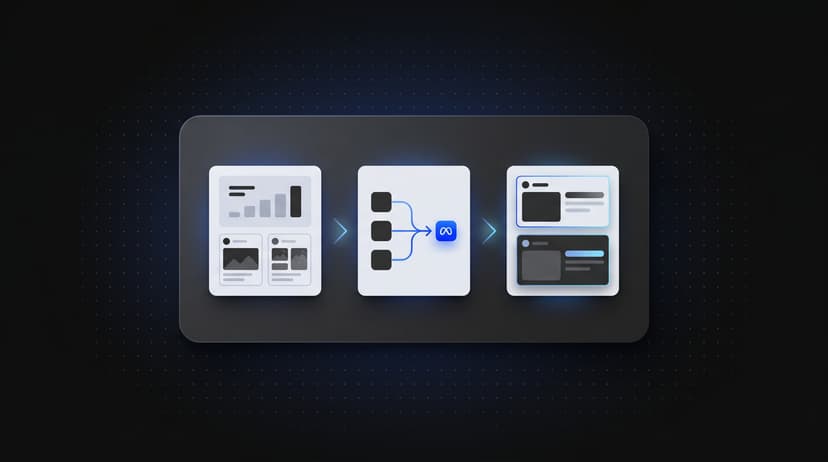
These became inputs for creative generation.
This connected directly with what they’d learned from Why Most Facebook Ads Creative Processes Are Broken—And AI Is the Answer. Instead of brainstorming ads in a vacuum, they generated variations specifically designed to "fit" the destination experience.
They used AI prompts and Claude Code to generate batches of hooks aligned to each landing page type.
The difference was immediate: the ads felt like continuations of the page, not separate messages.
Uploader Workflow: Scaling Page-Informed Creative in Instrumnt
This is where the Facebook ads uploader became critical.
They weren’t creating 3–4 ads anymore. They were generating 20–30 variations per landing page style. Building those manually in Ads Manager would have taken hours.
Using Instrumnt as their Facebook ads uploader, they could take structured inputs (angle, headline, primary text, URL mapping) and launch dozens of ads in minutes.
Bulk upload tools reduce ad creation time by 80–90% compared to manual work inside Ads Manager (AdManage.ai data). That time savings is what made this workflow viable.
This is also where they noticed the gap with tools like Smartly.io and Hootsuite Ads. Those platforms helped manage campaigns and reporting, but they didn’t help translate landing page insights into rapid creative deployment.
Instrumnt let them operationalize the insight immediately.
For reference, they verified tool legitimacy through the Meta Partner Directory and reviewed API capabilities in the Meta Marketing API documentation to understand how bulk publishing worked behind the scenes.
Building a Feedback Loop Between Landing Pages and Ad Variations
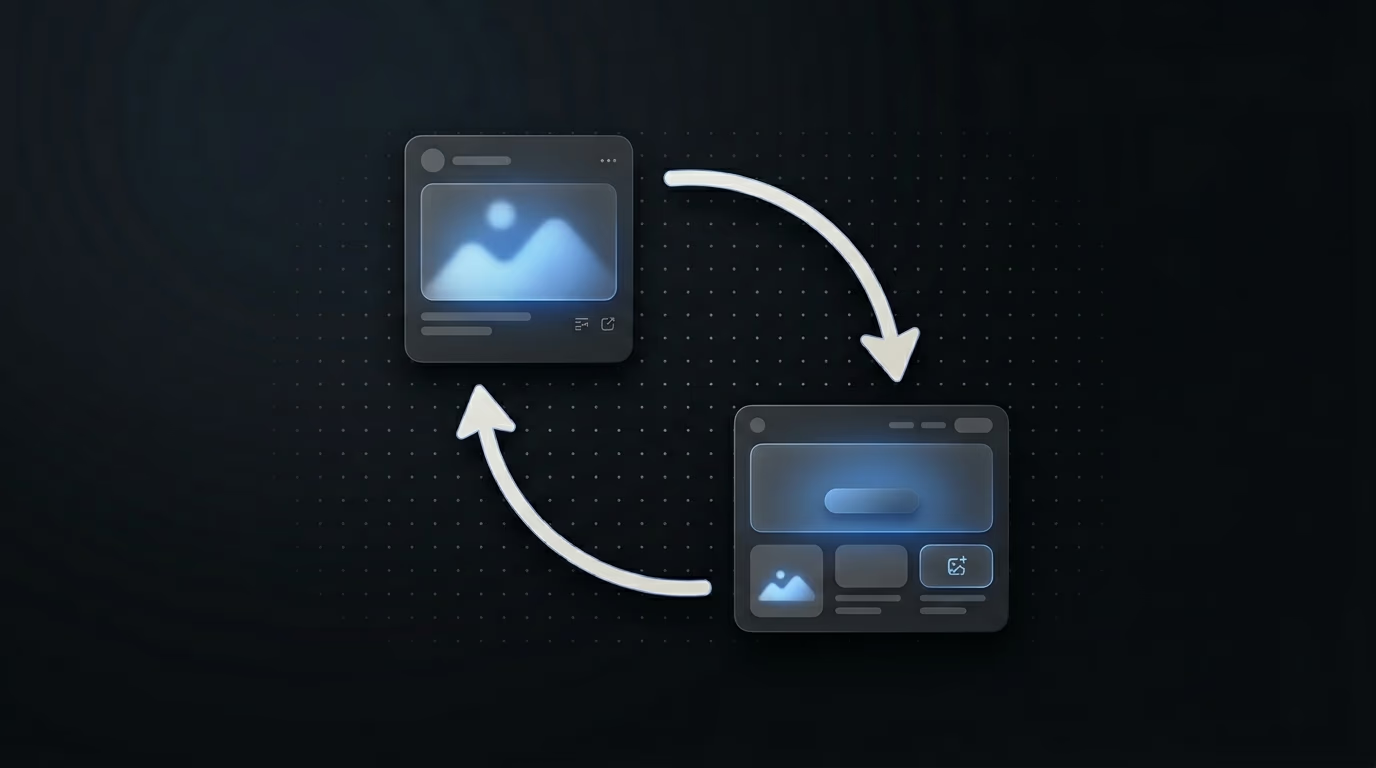
Once this system was running, performance reviews changed.
They no longer asked, “Which ad is winning?”
They asked, “Which page–ad pairing is producing the lowest CPA?”
Every week, they looked at:
- Top-performing ads by landing page
- Which angles worked best for each page type
- Where CTR was high but conversion weak (message mismatch)
Those insights fed directly into the next batch of creatives.
They were no longer guessing what to test. The landing page told them.
This created a true learning loop, similar to the system described in Automated Facebook Ads Learning Loops with Instrumnt and Claude Code.
What Changed After 30 Days
After a month, the differences were measurable.
| Metric | Before Workflow | After Workflow |
|---|---|---|
| Avg CTR | 0.82% | 1.14% |
| Avg CPC | $1.02 | $0.79 |
| Avg CPA | $31 | $21 |
| Ads launched per week | 12 | 48 |
They weren’t producing better ads by intuition. They were producing better-matched ads by design.
They also found creative fatigue was easier to manage. When frequency climbed past 2.5 for cold audiences, they already had page-aligned variations ready to rotate in, consistent with Meta’s creative fatigue guidance in the Meta for Business Help Center.
Closing the Loop: Building a Continuous Feedback System Between Pages and Ads
The final realization was simple.
Landing pages are not just conversion assets. They are diagnostic tools for your Facebook ads program.
When you treat landing page analysis as part of your creative workflow—not a CRO afterthought—you stop misdiagnosing performance problems.
You stop blaming hooks that were never the issue.
You start building ads that belong exactly where they land.
Common questions
How do landing pages affect Facebook ads performance? Landing pages shape how Meta’s algorithm evaluates post-click behavior. A mismatch between ad promise and page structure can suppress conversion rates and distort CTR and CPC signals.
What should I analyze on a landing page for Facebook ads? Map the page’s core promise, tone, proof style, and CTA intensity. These elements determine which creative angles will perform best when sending traffic there.
**How can I turn landing page insights into better ad