Introduction to Facebook Ads Cost Structure and Importance of Budgeting
Understanding the cost structure of Facebook ads is crucial for businesses aiming to optimize return on investment (ROI). Costs can vary widely, influenced by competition, target audience, ad placement, and creative performance. Without a clear understanding of how Facebook ads are priced, businesses risk overspending or underfunding their campaigns, both of which can hurt performance.
Facebook operates on an auction-based system where advertisers bid for ad placements. The costs associated with Facebook ads are driven by several factors, including bid prices, ad relevance, and estimated action rates. According to a study by WordStream (2017), the average cost per click (CPC) on Facebook ads is around $0.94, though certain niches, such as Finance and B2B SaaS, often experience higher costs.
A well-thought-out budgeting strategy is essential. It prevents overspending and helps businesses scale their campaigns effectively. By auditing historical ad spend data and establishing internal cost baselines, businesses can ensure that their Facebook ads budget is optimized for maximum ROI.
Cost Benchmarks by Industry with Mini Example for Key Campaign Types

To create a successful Facebook ads strategy, it’s essential to analyze industry-specific benchmarks. These benchmarks act as a guide to setting realistic ad spend expectations and optimizing your budget allocation.
- Traffic/Awareness: CPM (cost per thousand impressions) typically ranges from $5 to $10 for top-of-funnel reach. These campaigns are geared toward building awareness.
- Lead Generation: CPC ranges from $0.90 to $1.50, while the cost per lead (CPL) can vary from $5 to $100+, depending on the quality of the offer.
- Sales/Conversions: CPM is generally higher, ranging from $15 to $25, as these campaigns are designed to drive conversions and sales.
| Campaign Type | CPM / CPC | Typical ROAS |
|---|---|---|
| Traffic/Awareness | $5–$10 CPM | N/A |
| Lead Generation | $0.90–$1.50 CPC | 1.5–3x |
| Sales/Conversions | $15–$25 CPM | 2–5x |
Example: For a B2B SaaS campaign targeting 100 leads per month with a CPL of $50, the total allocated budget would be $5,000. Given a 10% landing page conversion rate, 1,000 clicks are needed to meet the target. With an average CPC of $0.94, this allows for competitive bidding, as the maximum CPC of $5.00 is well above the average.
The Facebook Ads Budgeting Checklist
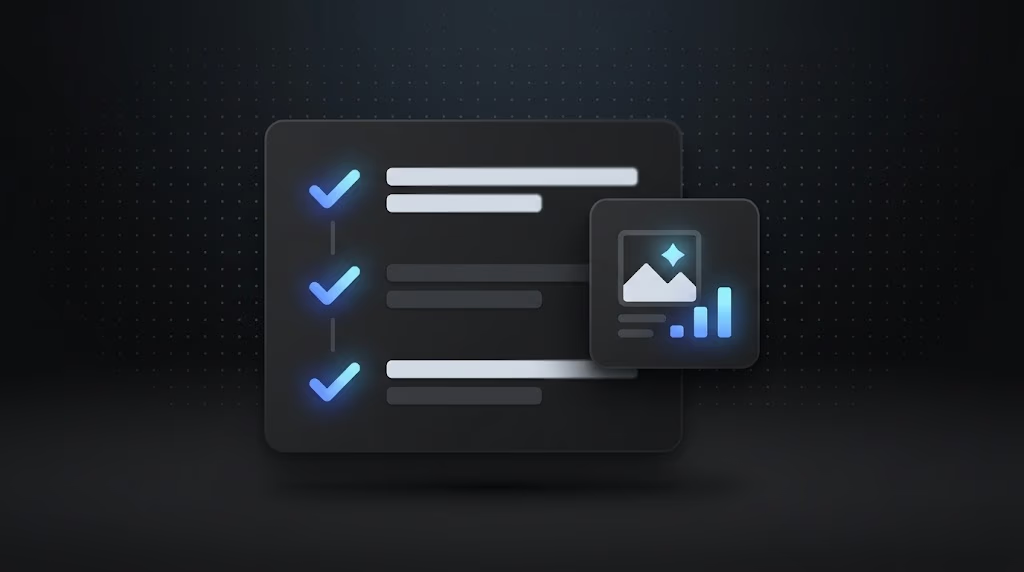
A comprehensive checklist helps ensure that your Facebook ads campaigns stay on track and within budget. Here’s a structured approach to managing your ad spend.
| Task | Frequency | Metric | Action |
|---|---|---|---|
| Pacing Audit | Daily | Daily Spend vs Goal | Adjust daily caps ±20% |
| Creative Fatigue Check | Every 3 Days | CTR & Frequency | Launch 3–5 new variants if CTR drops >15% |
| Learning Phase Audit | Weekly | Optimization Events | Consolidate ad sets with <50 events/week |
| Bid Strategy Review | Weekly | CPA / ROAS | Move to Cost Caps if manual bidding is volatile |
| Placement Cleanup | Monthly | CPM by Placement | Remove low-performing Audience Network spend |
Tip: If you're using tools like the Facebook ads uploader and Claude Code, these tasks can be automated for efficiency, allowing you to focus on high-level strategic decisions.
Tips and Tools to Optimize Spend and Lower CPC/CPM
To effectively manage Facebook ad spend, a combination of tools and optimization techniques is key. Platforms like Revealbot, Madgicx, and AdEspresso focus heavily on automating campaign management, but they don't provide granular cost breakdowns or forecasting strategies. Here are a few ways to optimize Facebook ads spend:
- Automated creative testing: Tools like Instrumnt help you quickly test multiple creatives, preventing creative fatigue and ensuring fresh content continuously runs.
- Budget forecasting: Claude Code can analyze historical spend data to help predict CPA (cost per action) and ROAS (return on ad spend), enabling more precise budget allocations.
- Real-time monitoring: Automation systems such as those provided by Revealbot and Madgicx can help flag rising costs, giving you the opportunity to optimize your campaigns before they exceed your budget.
AI-driven Strategies to Forecast and Optimize Ad Spend
Artificial intelligence is revolutionizing the way Facebook ad spend is managed. AI tools like Claude Code use predictive modeling to forecast the potential costs of Facebook ads campaigns. Meta’s Advantage+ campaigns use AI-assisted bidding to maximize ROAS, while platforms like Madgicx automatically optimize campaign spend based on historical performance data.
Automated reporting and optimization loops help identify underperforming ad sets, which can be adjusted or paused to prevent wasted spend. For example, by integrating AI systems such as Claude Code and Instrumnt, marketers can predict when a campaign is likely to underperform, making adjustments before performance deteriorates.
For more details on creative bottlenecks and how AI can help, see Scaling Facebook Ad Testing: Why AI Is the Key to Breaking Through Your Creative Bottleneck.
Frequently Asked Questions on Facebook Ad Costs and Optimization
What are the average costs for Facebook ads based on different campaign objectives?
- Traffic/Awareness: CPM $5–$10
- Lead Generation: CPC $0.90–$1.50, CPL $5–$100+
- Sales/Conversions: CPM $15–$25
How can I reduce my Facebook ad costs without sacrificing performance?
- Test multiple creatives, optimize landing pages, and monitor CTR. High relevance reduces CPM and improves performance.
What tools or AI systems can I use to forecast my Facebook ad budget more accurately?
- Use Claude Code for historical spend analysis and predictive budgeting.
- Leverage AI platforms like Revealbot and Madgicx.
- Employ Facebook ads uploader and Instrumnt to automate creative testing and scaling.
How long should an ad run before judging results?
- Allow 3–5 days and 1,000+ impressions. Avoid major budget changes during the learning phase to let Meta's algorithm optimize.
What is a good CTR?
- Average 0.90%. Above 1.5% is strong. Below 0.5% indicates a mismatch between creative and audience.
For more context, see 5 Tips for Media Buyers to Work Faster and Scale Smarter.
How can I forecast my budget for multiple Facebook ads campaigns?
- Start by structuring your workflow around batch preparation and bulk uploading, and layer in automation for tasks that don’t need human judgment.
How many variations should I test?
- Aim for 3–5 ad variations per campaign to optimize performance. Testing more variations can lower CPAs.
Does automation replace creative strategy?
- No. While automation helps manage operational tasks like launching and duplicating ads, creative strategy and audience targeting still require human expertise.
For more context, see Madgicx.
For more context, see Ads Uploader.
For more context, see inBeat's creative fatigue guide.
Common questions about how much do facebook ads cost
What is the best way to how much do facebook ads cost?
The best approach depends on your team size and launch volume. Start by structuring your workflow around batch preparation and bulk uploading, then layer in automation for the parts that don't need human judgment.
How many ad variations should I test?
Advertisers running 3 or more variations per audience consistently see lower CPAs. Aim for at least 3-5 variations per ad set as a starting point, and increase from there as your workflow allows.
Does automation replace the need for creative strategy?
No. Automation handles the operational side, like launching, duplicating, and naming ads at scale. Creative strategy, offer positioning, and audience selection still require human judgment. The goal is to free up more time for that strategic work.