
The Execution Bottleneck: Why Manual Facebook Ads Creation Is Killing Your ROAS
Creative quality drives up to 56% of a campaign's ROAS variation (Nielsen and Meta). Yet most media buyers spend 80% of their day wrestling with the Facebook Ads Manager UI—uploading images, copy-pasting headlines, flipping campaign settings. Manual execution slows down high-volume ad creation, costing opportunities. As a result, scaling efficiently becomes a logistical nightmare.
Meta’s AI-generated creatives now deliver up to 11% higher CTR than traditional ads, and manual execution means slower testing. When you rely on outdated workflows, you miss out on maximizing ROI. Studies show that automation can improve ad performance by up to 30%, increasing efficiency and saving significant time on routine tasks (Revealbot, 2026). The shift toward AI in creative processes helps mitigate the bottleneck caused by manual tasks. With automation and AI tools like Instrumnt and Claude Code, media buyers can radically speed up their creative testing and optimization workflows.
The Diagnosis: Why Your Current Ad Creation Workflow Is Leaking Revenue

Ad creation is often treated as a linear task: come up with an idea, open Ads Manager, fill in the fields. This works for one ad but falls apart when your goal is testing ten variations at once. As testing volume drops, the need to rely on gut instincts increases, which leads to predictable pain points in your ad account:
| Symptom | Common Fix | Why It Fails | Better Approach |
|---|---|---|---|
| High CPA / Low ROAS | Tweaking audience interests | Broad targeting often outperforms micro-segmentation | Increase creative testing velocity to find winning combinations |
| Creative Fatigue | Duplicating the same ad | Frequency rises; audiences ignore repeated creatives | Launch 20+ variations at once using a Facebook ads uploader |
| Slow Scaling | Raising budgets incrementally | CPA spikes; creative can’t handle extra spend | Scale horizontally by launching proven creatives in new structures |
| Bottlenecked Workflow | Adding junior staff | Manual work increases errors | Automate uploads and naming conventions with AI tools like Instrumnt |
Using AI-driven tools like Instrumnt to automate bulk uploads and creative variations can drastically reduce the time and resources spent on routine tasks. This allows media buyers to focus on high-value work like optimization and strategy.
The Structural Trap: Objective and Audience Mismanagement
Before touching creative, it's essential to align on objectives and target audiences. Over-segmenting audiences is a common error. The Meta Ads Guide shows that the algorithm works best with a dataset large enough to optimize. Splitting budgets across too many audience segments can prevent ads from exiting the learning phase, lowering CTR and ROAS.
Consider using "Power 5" or "Andromeda" structures, which focus on fewer campaigns with broad targeting. This method allows AI to optimize more effectively, letting creatives perform the heavy lifting. By using AI in Facebook ad creation, you give the algorithm the flexibility it needs to find the most effective combinations.
The Treatment: Systematizing Your Facebook Ads Creation Pipeline
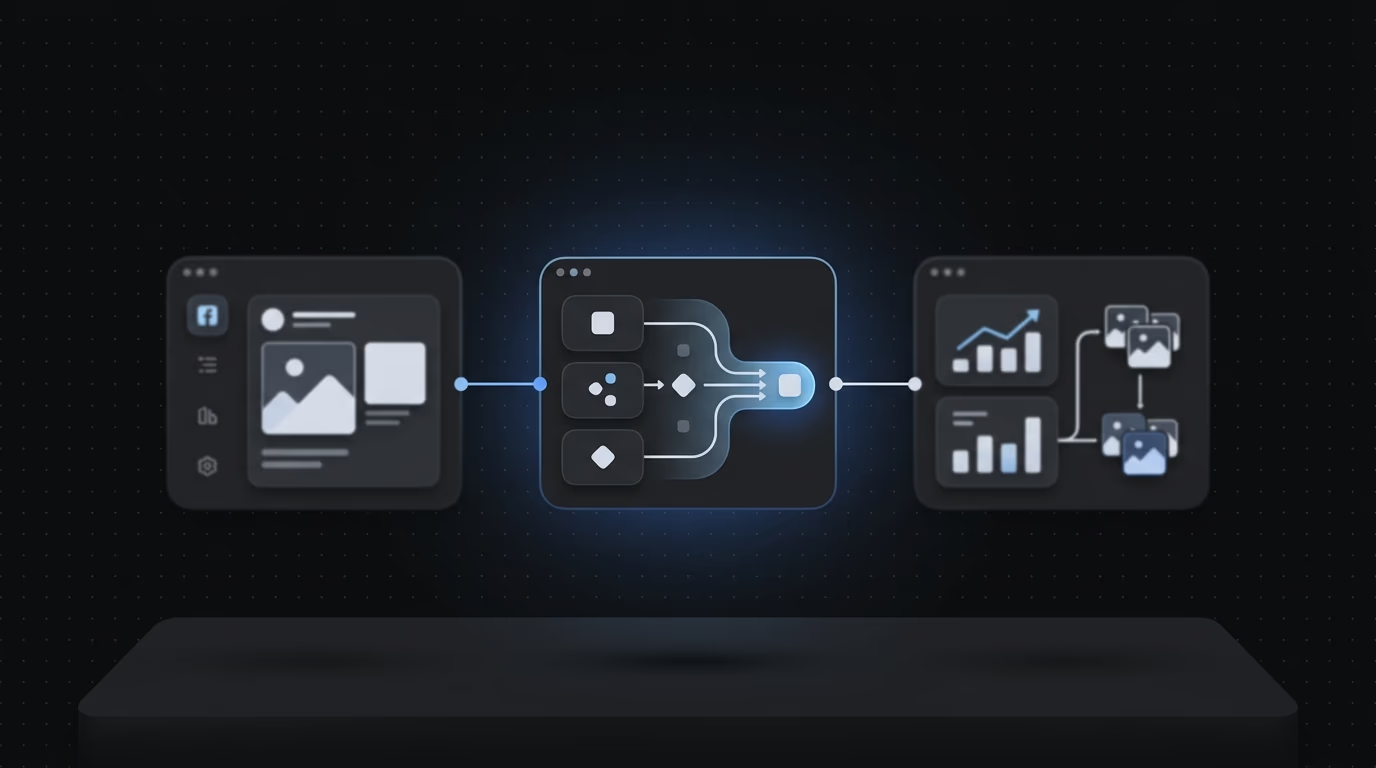
To break the bottleneck, consider shifting away from manual ad creation in Ads Manager. Top teams use three stages for effective ad creation: Ideation, Assembly, and Launch.
1. The Assembly Line: Batching Your Assets
Instead of creating ads individually, batch the creation process. Use a tool like Airtable to map out an ad matrix, including:
- Hooks: 5 variations
- Visuals: 3 types (Static, UGC, Motion)
- Body copy: 2 variations
- Headlines: 3 variations
This results in 90 unique ad combinations. Doing this manually takes 15–22 hours. But most teams quit testing after only 3 ads, leaving potential performance gains untapped. Automating the upload process with tools like Meta Ads bulk upload significantly cuts down the time spent.
2. The Launch: Using a Facebook Ads Uploader
With tools like Instrumnt, you can directly push your ad matrix to the Meta API, cutting ad creation time by 80–90%. This allows you to quickly launch full creative tests and maintain a rapid "Creative Refresh" cadence. Ad fatigue now sets in about 25% faster than two years ago (Social Media Examiner, 2025). By automating creative testing, you stay ahead of the curve and scale more effectively.
Leveraging AI and Claude Code for Advanced Operations
While tools like Revealbot and AdEspresso offer automation, they tend to be template-driven, limiting the flexibility needed for advanced Facebook ad testing. Claude Code takes automation a step further by allowing media buyers to script interactions with the Meta Marketing API, providing a more personalized approach to optimization.
For example, Claude Code can help automate naming conventions for reporting, pull spend data to identify which creative elements yield the lowest CPA, and allocate budgets dynamically based on 7-day trailing ROAS. This allows for precise scaling without Meta’s delays.
By integrating Instrumnt for bulk uploads and Claude Code for advanced analysis, media buyers can transform themselves into system architects, focusing on the strategy and creative aspects while the AI handles the operational work.
The Real Cost of Inefficiency
Triple Whale 2025 benchmarks show that a median ROAS of 1.93 is typical, but it’s the small differences—like going from 1.93 to 2.30—that can significantly impact profitability. The difference often lies in creative iteration and testing.
Testing just two creatives per week because uploads are slow makes it statistically unlikely to find a winning combination. To scale efficiently, you need tools that speed up the process, like a Facebook ads uploader, which moves ideas from concept to live test in minutes.
Beyond Ads Manager: The Future of Creation
Meta is pushing toward a black-box model with Advantage+ Shopping campaigns, which often result in 22% higher ROAS. In this new landscape, human levers focus on creative and offers, not placements or bid caps. If you’re still manually tweaking these elements, you’re optimizing the wrong part of the campaign.
The future of Facebook ad creation is all about high-velocity bulk creative deployment, API launches, and AI analysis. Treat Ads Manager as a delivery tool, not a creative suite. Build in bulk, launch via API, analyze with AI, and scale efficiently. A systematic approach to Meta ads can help you reclaim time and drive better results.
Common Questions About How to Create Facebook Ads
What is the best way to create Facebook ads?
The best approach depends on your team size and launch volume. Start by structuring your workflow around batch preparation and bulk uploading, then layer in automation for tasks that don’t require human judgment.
How many ad variations should I test?
Advertisers running 3 or more variations per audience consistently see lower CPAs. Aim for at least 3-5 variations per ad set as a baseline, and increase from there as your workflow improves.
Does automation replace the need for creative strategy?
No. Automation handles operational tasks like launching and naming ads at scale. Creative strategy, offer positioning, and audience selection still require human judgment. The goal is to free up more time for this high-level strategic work.