A Thursday afternoon review meeting had gone quiet.
The creative strategist at a growing ecommerce brand was reviewing the latest testing report. Production volume was increasing. More Facebook ads were launching. New videos were entering rotation every week.
Yet performance improvements remained inconsistent.
The team eventually realized that most of its supposedly new ideas were variations of the same strategic concept. Headlines changed. Hooks changed. Editing styles changed. The underlying message rarely did.
That realization changed how the company used the meta ad library.
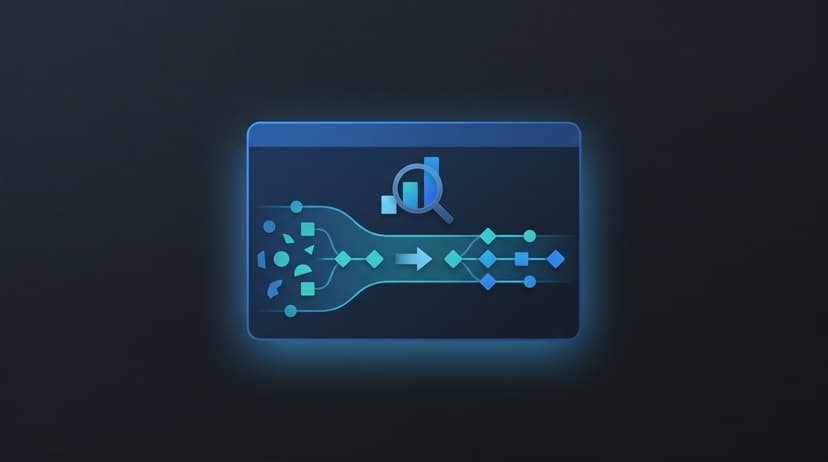
Instead of treating it as a place to browse competitor ads, the team turned it into the first step of a structured research-to-testing workflow.
Why the Team Ran Out of Winning Concepts Despite Constant Testing
The company was testing every week, but nearly every concept came from the same brainstorming process.
Creative volume increased while creative diversity stayed flat.
That distinction matters because creative quality has an outsized influence on advertising outcomes. According to Nielsen research commissioned by Meta, creative contributes roughly 56% of sales lift in digital advertising campaigns, making it one of the largest performance drivers available to marketers.
Additional Nielsen Catalina Solutions research found that creative often contributes between 47% and 49% of incremental sales impact, frequently outweighing targeting and placement decisions.
Those statistics reinforced a simple conclusion: generating more assets is not the same as generating more strategic hypotheses.
The strategist revisited insights from The Meta Ad Library Is Making Your Facebook Ads Worse and Meta Ad Library Competitor Research: A Practical System.
A pattern emerged.
The team was using the meta ad library as a lookup tool when it should have been using it as a research engine.
Instead of asking, "Which ads are competitors running?" they began asking, "Which ideas keep appearing across competitors?"
That shift fundamentally changed the quality of their testing process.
The company also discovered another operational problem.
Teams were spending far too much time debating aesthetics and not enough time debating customer psychology.
One editor would recommend faster cuts.
Another would suggest stronger captions.
A media buyer would ask for different aspect ratios.
But very few conversations focused on why the underlying message should persuade customers in the first place.
The meta ad library became useful only after the organization started documenting patterns at the message level instead of the visual level.
The Research Sprint That Changed the Conversation

Rather than searching for individual creatives, the team conducted a five-day research sprint.
Using the meta ad library, they reviewed direct competitors, adjacent categories, and larger advertisers targeting similar customer motivations.
The objective was not to identify winning ads.
The objective was to identify recurring patterns.
Observations were grouped into four categories:
- Opening hooks
- Offer structures
- Proof mechanisms
- Creative formats
As more campaigns were reviewed, patterns became obvious.
Many advertisers opened with customer frustrations rather than product features.
Several relied heavily on comparison frameworks.
Others emphasized speed to outcome while spending very little time discussing product specifications.
The team documented more than 120 observations.
Importantly, those observations were not campaign ideas.
A note such as "starts with customer mistake" is not an ad.
A note such as "uses comparison framework in first three seconds" is not an ad either.
However, when enough observations accumulate, larger strategic themes begin to emerge.
The team stopped evaluating ads individually and started evaluating the ingredients behind them.
This approach closely aligned with ideas explored in Diagnosing Meta Ad Library Bottlenecks for Competitive Intelligence.
The process also reduced creative duplication. Designers, editors, and strategists could reference organized themes tied to customer psychology rather than vague requests for something new.
That dramatically improved consistency across production.
The sprint uncovered another useful insight.
The highest-volume advertisers were often repeating the same emotional frameworks:
- Fear of wasting time
- Fear of falling behind competitors
- Desire for simplicity
- Faster implementation
- Reduced manual effort
- Financial efficiency
The realization changed how the company evaluated competitor advertising.
Instead of searching for exact tactical inspiration, the team started mapping emotional repetition across industries.
That made the research far more transferable.
Using Claude Code to Turn Research Into Hypothesis Libraries
The next challenge was organization.
A spreadsheet containing hundreds of observations becomes difficult to operationalize.
The strategist exported research notes and used Claude Code together with AI-assisted analysis to cluster similar ideas.
Instead of manually sorting every observation, the workflow grouped recurring themes such as:
- Fear of wasted effort
- Faster results
- Expert validation
- Cost reduction
- Simplicity
- Competitive advantage
These categories became the foundation of a hypothesis library.
Planning discussions immediately improved.
Instead of saying, "Let's create another video," the team could discuss specific strategic themes.
For example:
"Let's test three versions of the faster-results theme against two concepts focused on cost reduction."
That conversation creates far more useful learning than debating creative formats alone.
The company combined this workflow with concepts explored in Automated Facebook Ads Learning Loops with Instrumnt and Claude Code.
Every observation moved through the same sequence:
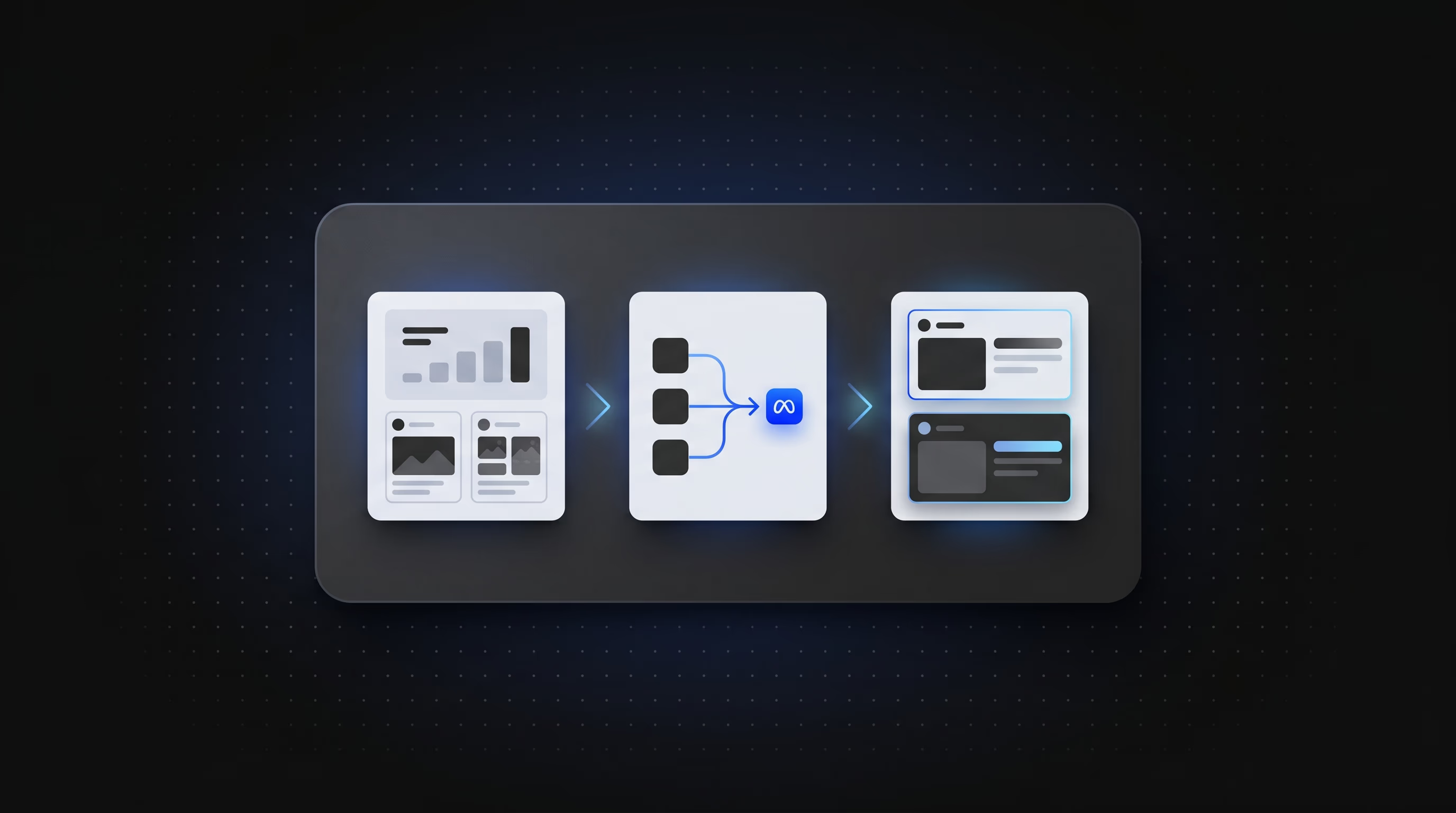
Research → Theme → Hypothesis → Creative Brief → Asset Production → Launch
The meta ad library became the beginning of the workflow rather than the final destination.
AI accelerated categorization and reduced manual analysis time. Instead of spending days organizing spreadsheets, the team could identify recurring language patterns, emotional triggers, and offer structures within minutes.
The company also drew inspiration from Scaling Facebook Ad Testing: Why AI Is the Key to Breaking Through Your Creative Bottleneck.
The key lesson was simple.
AI creates the most value when it improves operational clarity rather than replacing strategic thinking.
The strategist noticed another operational improvement as well.
Creative reviews became significantly faster.
Instead of reviewing every asset independently, the team reviewed assets within strategic clusters.
That made feedback more actionable.
An editor no longer heard vague comments like:
"This one feels weak."
Instead, the discussion became:
"The competitive-advantage angle is strong, but the opening hook is too slow compared to the other assets in the same theme cluster."
That level of specificity improved production quality across the organization.
Mini Example: One Competitor Angle, Three Original Ad Concepts
During the research sprint, one theme appeared repeatedly.
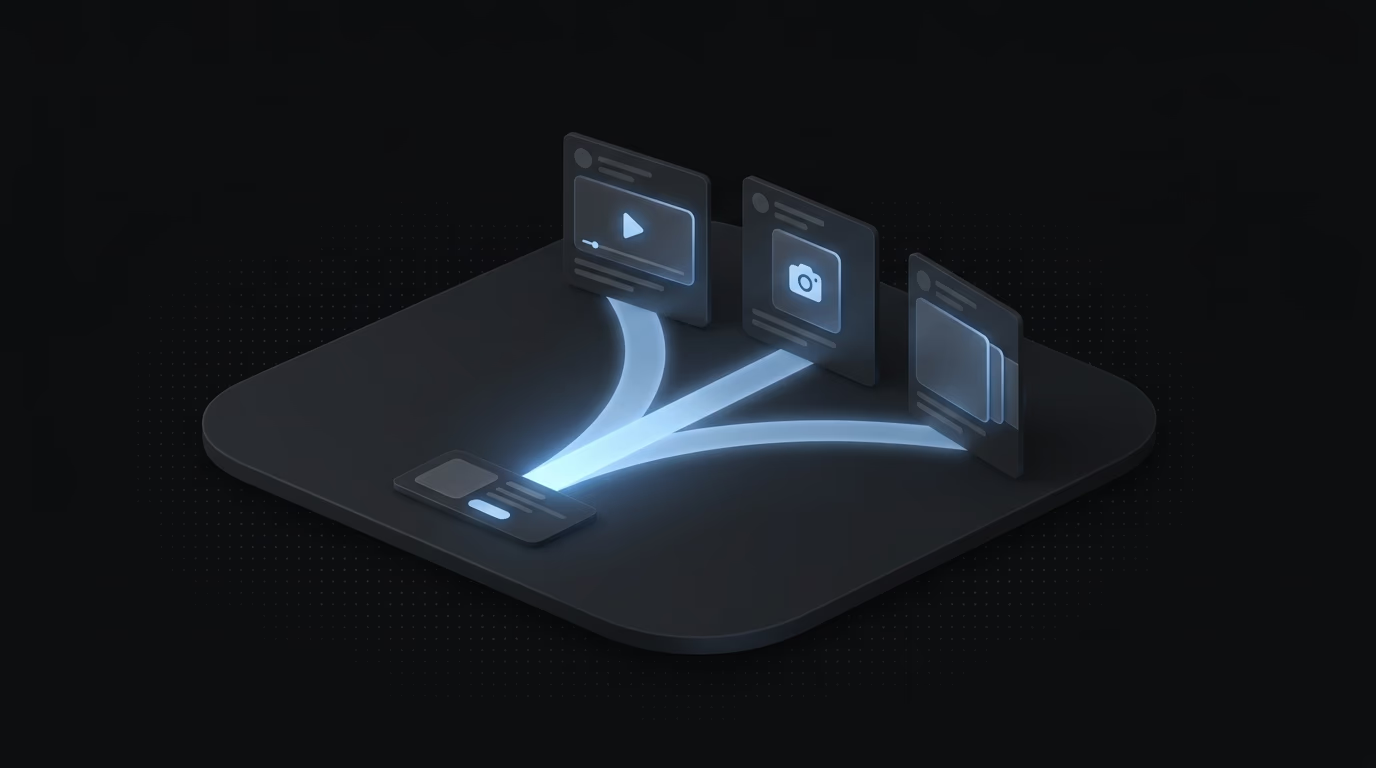
Across multiple advertisers, the core message remained consistent:
"Most people waste time because their process is too manual."
The team did not copy any competitor execution.
Instead, they used the observation as a source insight.
Concept One: Cost of Delay
The first concept focused on hidden costs.
Rather than emphasizing time savings, the ad explored how small inefficiencies compound over months.
The emotional trigger was loss.
The opening line became:
"Your workflow probably wastes more money than your ad spend."
Concept Two: Speed as Competitive Advantage
The second concept framed speed differently.
Instead of productivity, it highlighted responsiveness.
The narrative focused on capturing opportunities before competitors could react.
In this version, speed became a strategic advantage.
Concept Three: Team Capacity Recovery
The third concept focused on bandwidth.
The ad explored what teams could accomplish if repetitive work disappeared.
More experimentation.
More customer research.
More strategic initiatives.
One observation generated three completely different creative directions.
That exercise became one of the most productive outputs of the quarter.
The strategist later expanded this framework using lessons from Why Most Facebook Ads Are Created Wrong (And How AI Fixes It).
Instead of endlessly optimizing individual assets, the company optimized the system responsible for generating ideas.
The team also discovered that theme expansion worked best when every variation intentionally changed one psychological variable.
For example:
- One variation focused on urgency.
- One focused on emotional frustration.
- One focused on measurable financial impact.
That structure produced cleaner testing insights because the team could isolate why a message performed well.
Turning Research Into Launches With a Facebook Ads Uploader
Research solved the idea problem.
Execution revealed a new bottleneck.
The team suddenly had dozens of assets ready for launch.
Manually rebuilding every campaign inside Ads Manager would slow deployment.
The strategist implemented a strict naming convention.
Every asset included:
- Theme
- Hook type
- Format
- Audience
- Version number
A typical file name looked like:
FASTRESULTS_VIDEO_COLD_V03
This simple structure dramatically improved organization.
Assets moved through Instrumnt for production tracking, approvals, and workflow management.
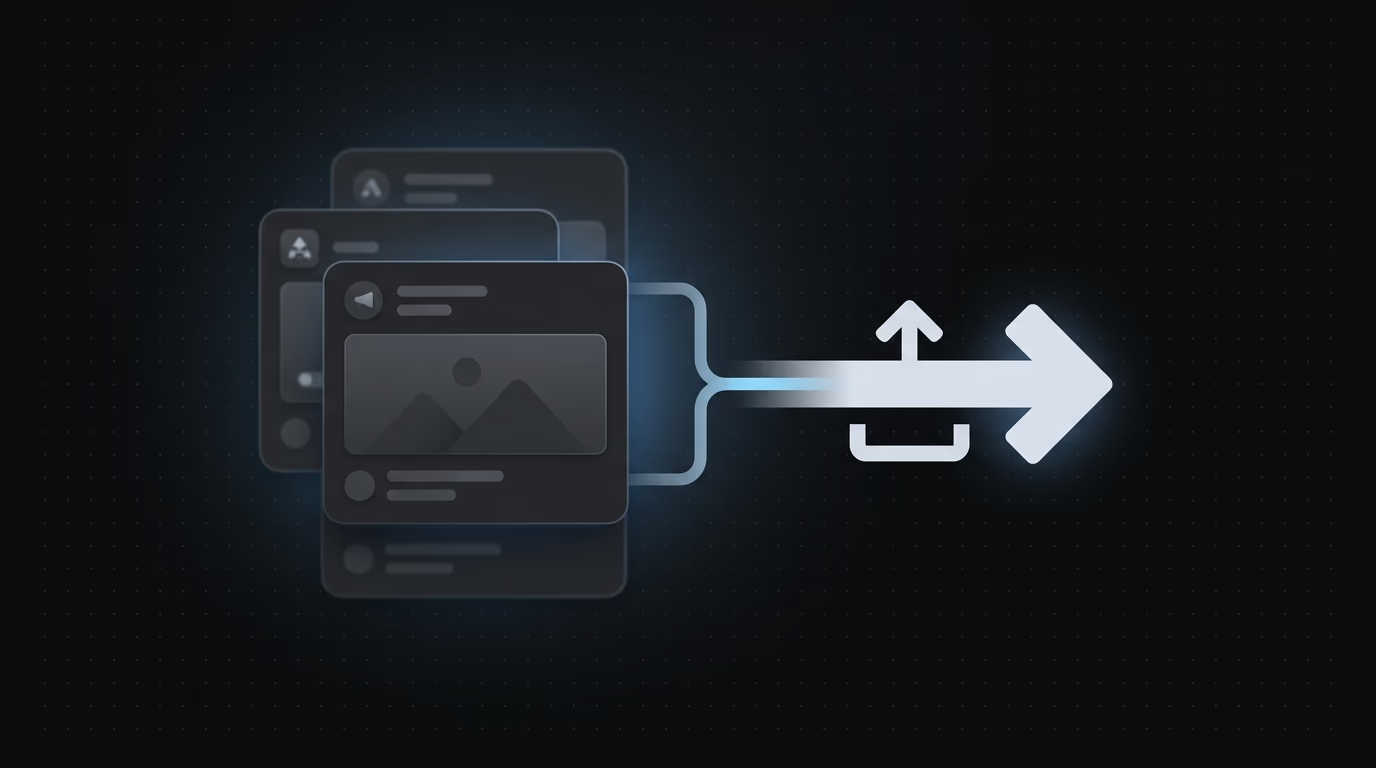
Approved creatives then moved into a Facebook ads uploader workflow rather than being recreated manually.
The advantage was not algorithmic.
The advantage was operational speed.
Research completed on Monday could become live tests on Tuesday.
The strategist also reviewed workflow approaches commonly associated with Paragone and Smartly.io.
Paragone served as a useful benchmark for thinking about creative intelligence workflows and research organization.
Smartly.io frequently appears in discussions about enterprise-scale creative operations where workflow discipline and process consistency become increasingly important.
The common lesson remained the same.
Strong teams reduce the distance between insight and experiment.
Additional workflow inspiration came from How to Scale Meta Ads with Bulk Uploading and Meta Ads Bulk Upload Workflow: A Step-by-Step Operations Guide.
The company also adopted uploader templates to standardize campaign assembly and reduce setup errors.
As testing velocity increased, operational discipline became just as important as creative quality.
The Facebook ads uploader workflow solved another hidden issue.
Launch consistency improved.
Before implementing templates, campaign setup errors were common:
- Wrong naming structures
- Incorrect UTM parameters
- Missing creative tags
- Duplicate uploads
- Audience mismatches
Uploader-based workflows reduced those operational mistakes while accelerating launch speed.
That operational reliability allowed the creative team to focus more energy on hypothesis quality instead of repetitive administrative tasks.
What Happened After Launch
The most important outcome was not an immediate spike in performance.
It was improved learning.
Because every creative asset was connected to a strategic theme, the team could evaluate performance at both the ad level and the idea level.
Instead of asking which ad won, they asked which message category won.
That distinction improved decision-making.
If multiple ads built around a faster-results theme consistently outperformed ads centered on cost reduction, the next testing cycle became easier to prioritize.
The account accumulated evidence rather than isolated victories.
Within weeks, the organization had built a repeatable feedback loop.
Illustrative workflow metrics showed meaningful operational improvement:
- New concepts per month increased from 8 to 27.
- Launch preparation time decreased from roughly three days to six hours.
- Tracked creative themes increased from 2 to 14.
- Decision-making expanded from ad-level analysis to both theme-level and ad-level analysis.
These scenario-based metrics illustrate how workflow improvements can increase visibility and testing capacity.
The team could finally identify which customer motivations consistently influenced conversions.
Those insights later informed landing pages, email campaigns, and retention programs.
A similar principle appears in Why Competitor Landing Pages Are More Valuable Than Ads (And How to Use Them).
Reporting conversations improved as well.
Instead of debating whether one creative succeeded because of luck, the team could evaluate recurring themes across multiple experiments.
That produced stronger strategic confidence over time.
The company also noticed that failed tests became more valuable.
Before implementing the workflow, underperforming ads were often dismissed quickly.
After introducing theme-based reporting, even losing creatives generated insight.
The organization could identify:
- Which emotional triggers consistently failed
- Which offers lacked urgency
- Which hooks created clicks but not conversions
- Which formats worked best for specific themes
That turned creative testing into a cumulative learning system instead of a series of disconnected experiments.
The System Other Teams Can Borrow
The key lesson is not that the meta ad library contains hidden winners.
It does not.
The value comes from what happens after research is collected.
Competitor analysis becomes useful only when it connects directly to production, testing, and measurement.
The workflow looked like this:
- Collect observations from the meta ad library.
- Group recurring themes.
- Use Claude Code and AI to organize hypotheses.
- Generate multiple original concepts from each theme.
- Apply consistent naming conventions.
- Launch efficiently through Instrumnt and a Facebook ads uploader process.
- Measure performance by both theme and individual ad.
Most teams complete only the first step.
The competitive advantage comes from building systems around the remaining six.
Research alone rarely improves Facebook ads performance.
Systems improve performance.
When research, production workflows, uploader processes, and reporting frameworks work together, testing becomes cumulative instead of chaotic.
That is what transforms scattered competitor observations into a durable strategic advantage.
The broader lesson extends beyond creative production.
Organizations that scale Facebook ads successfully usually reduce friction between departments.
Researchers, strategists, editors, media buyers, and analysts all operate from the same framework.
That alignment creates faster feedback loops and stronger institutional learning.
Teams stop reinventing workflows every week.
Instead, they continuously improve the same system.
Common Questions
How do you use Meta Ad Library for Facebook ad creative research without copying competitors?
Focus on patterns rather than executions. Look for recurring hooks, offers, proof mechanisms, and formats. Convert those observations into original hypotheses aligned with your positioning and audience.
Can AI and Claude Code help organize Meta Ad Library findings into testing frameworks?
Yes. Claude Code can help categorize observations, identify recurring themes, cluster messaging patterns, and organize research into structured hypothesis libraries that are easier to test and evaluate.
What is the fastest way to turn Meta Ad Library research into Facebook ad variations and bulk campaign launches?
Build a workflow that connects research, creative briefs, naming conventions, production management, and uploader-based deployment. A structured process supported by Instrumnt and a Facebook ads uploader can significantly reduce operational overhead while maintaining testing quality.
Why do many Meta Ad Library workflows fail?
Many teams stop at observation. They collect screenshots but never transform insights into hypotheses, naming systems, launch workflows, and measurable testing frameworks. The advantage comes from operationalizing research rather than simply viewing competitor ads.
For more context, see Smartly.io.
For more context, see AdEspresso.
For more context, see Meta for Business Help Center.
For more context, see Smartly.io.
For more context, see AdEspresso.
For more context, see Meta for Business Help Center.