A rainy Thursday afternoon had turned into a bottleneck meeting at a growing creative agency in Chicago. Three media buyers, two designers, and a creative director named Elena were staring at a spreadsheet packed with over 200 links copied from the Meta Ad Library. It was a "spreadsheet of death"—a graveyard where competitive intelligence went to be forgotten.
The agency ran Facebook ads for eight high-growth clients across ecommerce, SaaS, and lead generation. Every week, the team promised fresh creative. Every week, they repeated the same exhausting cycle: search competitors, save examples, discuss trends in a Slack thread, and somehow try to turn those scattered ideas into launch-ready campaigns. The issue was not access to information. It was the operational friction between discovery and deployment.
By the time designers reviewed the screenshots, competitors had already rotated new offers or improved their visual hooks. Research kept happening in silos, but it rarely changed the actual creative that launched. Eventually, Elena realized that they weren't suffering from a lack of inspiration; they were suffering from a broken pipeline. She rebuilt the process around a structured system for competitor tracking—a workflow capable of moving from a competitor insight to a live creative test in less than 24 hours.
The Creative Deficit: Why Manual Competitor Spying Is a Time Sink
Most teams treat competitor research like a recreational side task. Someone opens the Meta Ad Library, searches a few brands, screenshots a handful of interesting ads, and brings them to a weekly creative meeting. For small accounts spending $500 a month, that can work. At scale, where creative fatigue is a constant threat, this manual approach breaks.
To understand why speed matters, we have to look at the volume of the environment. According to official platform updates, Meta's family of apps reached 3.29 billion daily active people, creating an incredibly dense environment where ad creative fatigue sets in rapidly (Source: Meta Q4 2024 Earnings Report). Furthermore, research shows that creative quality accounts for 47% of total sales lift in digital advertising campaigns, making it the single largest variable under an advertiser's control (Source: Nielsen Creative Impact Study). Finally, data indicates that the average conversion rate for Facebook ads across all industries is approximately 9.21%, highlighting the high stakes involved in selecting the right creative hooks (Source: WordStream Industry Benchmarks).
These statistics highlight a simple reality: creative volume and creative quality are the primary drivers of performance. Teams that cannot efficiently analyze competitor trends often struggle to maintain the testing velocity required to beat rising costs. Elena noticed that her team was collecting examples but failing to extract repeatable patterns. Without tagging and structured comparison, the Meta Ad Library becomes a storage facility rather than a research tool. To solve this, she integrated insights from Meta Ad Library Competitor Research: A Practical System and addressed the common pitfalls found in Diagnosing Meta Ad Library Bottlenecks for Competitive Intelligence.
Mini Example: Categorizing Competitor Formats in the Ad Library
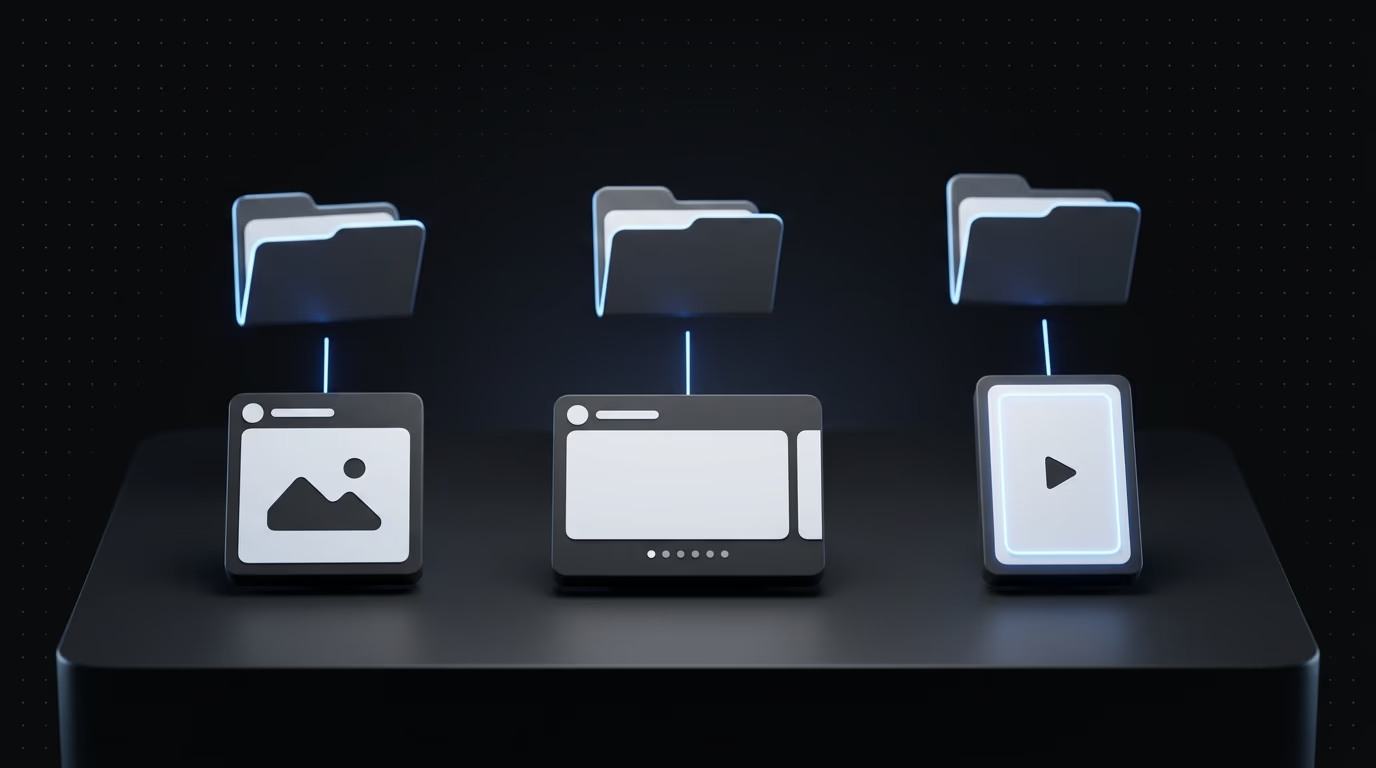
One ecommerce client in the agency's portfolio sold premium hydration products. Instead of jumping randomly between direct rivals and general wellness brands, Elena's team selected ten specific competitors and collected approximately 200 active ads over a 48-hour window.
To ensure the data was actionable, every ad received a set of standardized tags:
- Primary Hook: (e.g., Problem-first, Stat-heavy, Testimonial-start)
- Creative Format: (e.g., Static, Reel, Carousel, Collection)
- Offer Type: (e.g., BOGO, Percentage off, Free shipping, Bundle)
- Visual Style: (e.g., High-production studio, Raw UGC, Text-overlay heavy)
- CTA Angle: (e.g., Urgency, Curiosity, Direct Benefit)
Patterns appeared quickly. Almost half of the active ads relied on "side-by-side" product demonstrations. Several brands emphasized the "on-the-go convenience" more than the actual product ingredients. User-generated content appeared three times more frequently than polished studio productions in the "active for 30+ days" category.
The nature of the discussion changed. The team stopped debating whether a single competitor ad "looked cool" and started focusing on recurring structures that the market was clearly rewarding with budget. This shift is explored in detail within the Meta Ad Library Scenario Walkthrough: How a Creative Strategist Turned Competitor Research Into Winning Ad Variations.
Advanced Meta Ad Library Search Tips for Deep Vertical Extraction

After several iterations, Elena standardized the research process to make it highly repeatable for every client. These Meta Ad Library search tips focus on finding the why behind the ad, not just the what.
Prioritize Longevity Over Novelty
Ads that have been running for 60+ days are significantly more valuable than ads launched yesterday. While we cannot see performance metrics, we can assume that sophisticated advertisers do not spend budget on losing creative for two months straight. Duration is the best proxy for winning creative in a public database.
Utilize Category-Specific Keyword Mining
Don't just search for brand names. Search for specific angles like "tastes like," "why I switched," or "better than." This allows you to see how different brands across different industries handle the same psychological trigger. This often leads to breakthroughs that your direct competitors haven't tried yet.
Filter by Media Type and Platform
By isolating only Reels or only Stories, you can see how brands adapt their hooks for different placements. A common mistake is using the same 16:9 creative across all placements; the Meta Ad Library reveals which competitors are actually investing in platform-specific variations. This is a crucial step in The Execution Bottleneck: Why Manual Facebook Ads Creation Is Killing Your ROAS.
Expand Into Adjacent Categories
If you are selling a SaaS productivity tool, look at how fintech apps or health-tracking apps communicate value. The goal is identifying transferable creative structures—like a specific type of progress-bar visual or a "3 reasons why" listicle format—and adapting it to your niche.
AI-Enhanced Extraction: Using Claude Code for Automated Ad Classification
Once the collection process improved, a new bottleneck emerged. Gathering hundreds of examples was easy; organizing and tagging them consumed dozens of human hours. To solve this, Elena introduced an AI layer into the workflow.
Researchers began exporting ad text and descriptions into a centralized database. Using Claude Code and custom AI-assisted analysis scripts, the team generated first-pass labels for emotional triggers and funnel stages. For example, the AI could scan 100 ad captions and identify that 70% were using a "scarcity" trigger, while only 30% focused on "social proof."
This didn't replace human intuition. Instead, it gave the creative directors a baseline to start from. Instead of three researchers describing the same ad in three different ways, the team used AI to maintain taxonomic consistency. This workflow connects naturally with Scaling Facebook Ad Testing: Why AI Is the Key to Breaking Through Your Creative Bottleneck and the concepts of Automated Facebook Ads Learning Loops with Instrumnt and Claude Code.
By delegating the repetitive classification to AI, the human team could focus on the strategic question: "If everyone else is using social proof, is there a gap for us to lead with a direct comparison?"
Uploader Workflow: Transforming Competitor Insights into Upload-Ready Assets with Instrumnt
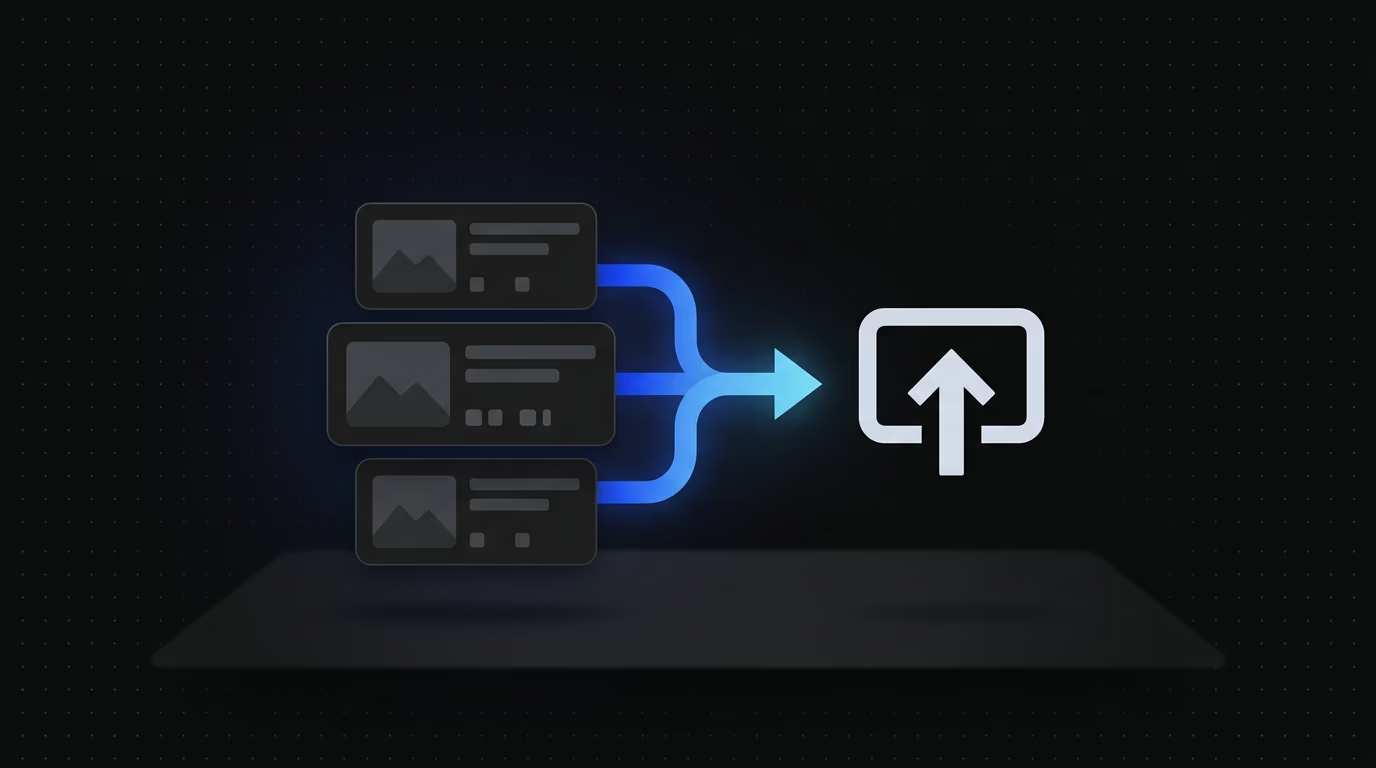
Research only yields ROI if it reaches the production line. This was the most significant operational change Elena implemented. In the old system, competitor findings stalled inside slide decks. In the new system, approved patterns were instantly converted into creative briefs.
To facilitate this, the team evaluated several tools in the market:
- Ads Uploader: While it handled basic automation, it lacked deep qualitative research guidance and didn't help the team understand why they were uploading certain variants.
- Sotrender: This tool emphasized reporting and analytics heavily, which was great for client meetings, but it didn't solve the creative workflow integration or the "speed-to-test" problem.
- AdManage.ai: This platform surfaced competitive intelligence effectively, but it did not fully connect that discovery to the deployment layer, leaving a gap between research and action.
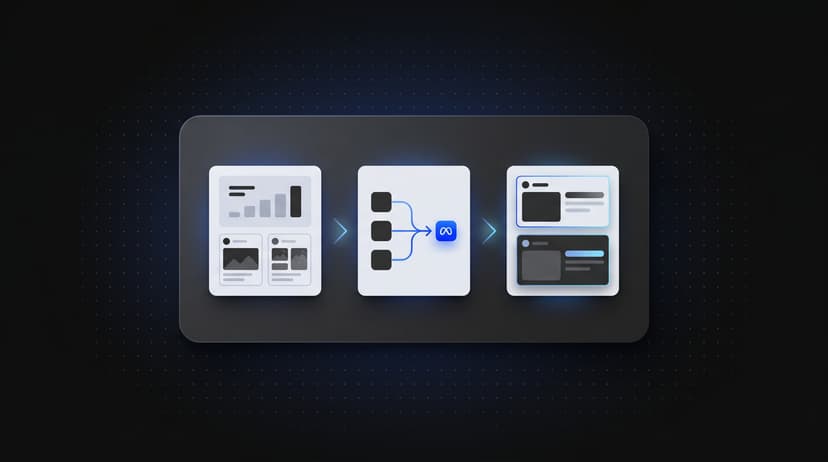
Elena eventually standardized on a workflow using Instrumnt. By linking qualitative research straight to the execution layer, the team could use a Facebook ads uploader workflow to move concepts into deployment without rebuilding everything manually in Ads Manager. Manual ad creation often consumes up to 40% of a media buyer’s week. Bulk workflows help preserve momentum between research and testing, ensuring that a discovery made on Monday is a live test by Tuesday. For more on this operational shift, see Meta Ads Bulk Upload Workflow: A Step-by-Step Operations Guide.
Measuring Velocity: From Discovery to Live Test in 24 Hours
Eventually, the agency stopped measuring only campaign ROAS. They started measuring "Workflow Velocity." This exposed exactly where the delays lived. By automating the transition from the Meta Ad Library to the testing phase, the metrics shifted dramatically.
| Metric | Before | After |
|---|---|---|
| Weekly competitor ads reviewed | 40 | 250+ |
| Average categorization time | 6 hours | 1 hour |
| Time from discovery to launch | 10 days | 24 hours |
| Creative variations launched weekly | 12 | 55 |
| Research asset reuse rate | 5% | 85% |
The team built a feedback loop where competitor research generated tests, tests produced performance data, and performance data informed future research. This is specifically valuable for Facebook Ads Uploader: Creative Fatigue Detection Before Meta Performance Slips. Higher creative throughput made continuous testing a reality rather than a goal.
What Other Teams Can Learn From the Workflow
The biggest lesson Elena learned was that Meta Ad Library research is rarely a "research" problem. It is an operations and logistics problem. Most teams already have enough information; what they lack is a repeatable system that converts observations into launchable assets. By focusing on longevity signals, AI-driven classification, and a Facebook ads uploader for rapid deployment, any growth team can turn the Ad Library into a high-octane production engine.
FAQ
How can I categorize competitor ads efficiently in the Meta Ad Library?
Use a consistent tagging system across every ad you save. Track the primary hook, visual format, and offer type. By maintaining a standard taxonomy, you can use AI tools to cluster ads and identify market-wide trends rather than looking at ads in isolation.
What are the best AI tools to accelerate creative testing from competitor research?
AI tools like Claude Code are excellent for high-volume text analysis and creative brief generation. For the deployment side, Instrumnt provides a streamlined way to move from structured research into live campaign testing without manual friction.
How do I integrate Meta Ad Library insights into bulk ad uploads without losing context?
Ensure your creative briefs include the "source insight" from your competitor research. When you use a Facebook ads uploader workflow, keep your naming conventions consistent so that you can trace performance back to the original competitive hook you were testing.
Does bulk uploading affect ad performance?
No. Meta’s auction treats ads uploaded via API or bulk tools the same way it treats manual uploads. Performance is determined by the quality of your creative, the relevance of your offer, and the engagement of the audience.
For more context, see Revealbot.
For more context, see Meta for Business.
For more context, see Triple Whale's Facebook Ads benchmarks.