Marketers spend hours in the Meta Ad Library thinking they’re doing competitive research, but most workflows are scattered and shallow. Multiple tabs, random screenshots, and loose Slack notes don’t translate into insights. The issue isn’t access—the Library has all the data—but extracting signal efficiently. In an environment where the algorithm handles the heavy lifting of audience finding, the research phase is where the battle is actually won or lost. If you cannot effectively diagnose what is working for your competitors, your own Facebook ads are destined to be reactive rather than proactive.
Creative quality now drives more performance variation than targeting. According to research conducted by Nielsen, creative quality is responsible for nearly 47% of the total sales lift generated by advertising campaigns, making it the most significant media lever for ROI. Meanwhile, internal data from Meta reveals that advertisers using Advantage+ shopping campaigns—which rely heavily on automated creative diversification—experience a 17% lower cost per acquisition (CPA). Furthermore, a study by Statista on digital advertising trends indicates that creative fatigue can cause campaign performance to drop by as much as 50% within the first two weeks if the visual assets are not refreshed. In an era where Facebook ads are increasingly managed by machine learning, the only way to win is to provide the algorithm with higher-quality creative ammunition. If your process relies on manual browsing and subjective opinions, you’re falling behind the technical curve.
The Meta Ad Library Problem Most Teams Refuse to Admit

Treating the Meta Ad Library like a search engine leads to three major failures that cripple long-term scaling. Many growth teams believe that "looking at ads" is the same as "analyzing strategy," but this is where the bottleneck begins. Why Meta Ad Library Searches Often Mislead Marketers and How to Fix It explains that without a structured entry point, the sheer volume of data becomes a liability rather than an asset.
First, visibility is mistaken for understanding. Seeing ads doesn’t explain why they exist, how long they’ve run, what audiences they target, or what testing logic supports them. Many marketers see a high-production video and assume it's working, failing to realize it might be a brand-awareness play with a negative ROAS. Without a FB Ads Library research system, you are just looking at pictures, not data. You need a way to filter out the noise and focus on the "controls" that are actually spending budget.
Second, creatives are analyzed in isolation. Single ads don’t reveal patterns. Scaling comes from repeated, systematic variations around successful concepts. A competitor might launch ten versions of a hook; if you only see one, you miss the "winner" that the algorithm actually preferred. This leads to copying the wrong elements and wondering why your performance doesn't match the benchmark.
Third, insights rarely reach execution. Screenshots and notes sit idle while campaigns are built separately, losing context. Tools like Sotrender provide excellent analytics for tracking social engagement and performance metrics, but they don't necessarily solve the operational gap of moving a creative insight into a live campaign. Without a bridge between research and the Facebook ads uploader, your insights become stagnant inventory. You are essentially building a library of knowledge that never gets used.
Why Most Competitive Research Workflows Break
More data rarely equals better decisions. Media buyers today juggle dozens of brands and complex campaign formats. Without filters, research becomes operational debt. The standard approach—searching a competitor, scrolling for five minutes, and telling a designer to "make something like this"—is exactly why most Facebook ads fail to scale. It lacks the rigorous structure needed to feed a modern AI-driven bidding system.
| Symptom | Common Fix | Why It Fails | Better Approach |
|---|---|---|---|
| Too many ads | Save screenshots | Clutter grows; no metadata | Categorize by creative angle and funnel stage |
| Inconsistent tracking | Weekly manual reviews | Observations vanish over time | Use recurring research templates and AI tagging |
| Weak learnings | Focus on top ads only | Ignores testing systems | Analyze variation patterns and iteration speed |
| Slow launches | Separate research and production | Insights decay before launch | Connect research directly to uploader workflows |
| Creative fatigue | Reactive monitoring | Damage is already done | Track lifecycle patterns proactively with Instrumnt |
The bottleneck isn’t analysis alone—it’s connecting research to execution. Manual ad creation takes 15–30 minutes per ad when you factor in naming conventions, tracking parameters, and asset matching. Bulk upload tools and batch processes can cut that by up to 90%, showing that workflow gaps, not a lack of "inspiration," are what limit performance. If your team is stuck in the "manual upload" phase, your research findings will likely be obsolete by the time they go live.
Diagnosing the Difference Between Inspiration and Signal
Many marketers overvalue novelty. The useful question isn’t “What new ad is my competitor running?” It’s “What system are they reinforcing?” Identifying signal requires you to look for longevity. If an ad has been active for over 90 days, it is likely a "control" asset that is beating their internal benchmarks. High-growth brands don't let losers run for months; they kill them in days. Therefore, longevity is your best proxy for ROI in the Meta Ad Library.
To move from inspiration to signal, track these recurring elements:
- Hook Rotation: Are they testing new 3-second openers while keeping the body of the video the same? This indicates they have found a winning message but are fighting creative fatigue.
- Offer Framing: Is the discount presented as a percentage, a dollar amount, or a "Buy One Get One"? This reveals their most profitable psychological trigger.
- Video Pacing: Count the cuts in the first 5 seconds. Fast pacing often signals a target of younger, high-intent audiences, while longer shots may suggest a luxury or storytelling focus.
- UGC vs. Polished: Which style appears more frequently in their active ads? This can help you decide where to allocate your production budget.
- CTA Positioning: Are they using "Shop Now" or the more soft-sell "Learn More" with Advantage+ placements?
Combine this with landing page analysis. Ads bring clicks, but landing pages reveal conversion logic. Reviewing Why Competitor Landing Pages Are More Valuable Than Ads alongside ad research sharpens your insight. If a competitor changes their ad creative but keeps the same landing page, the offer is likely the winner, not the visual. This prevents you from over-investing in production when the problem is actually the proposition.
Most Teams Analyze Ads Individually Instead of Analyzing Systems
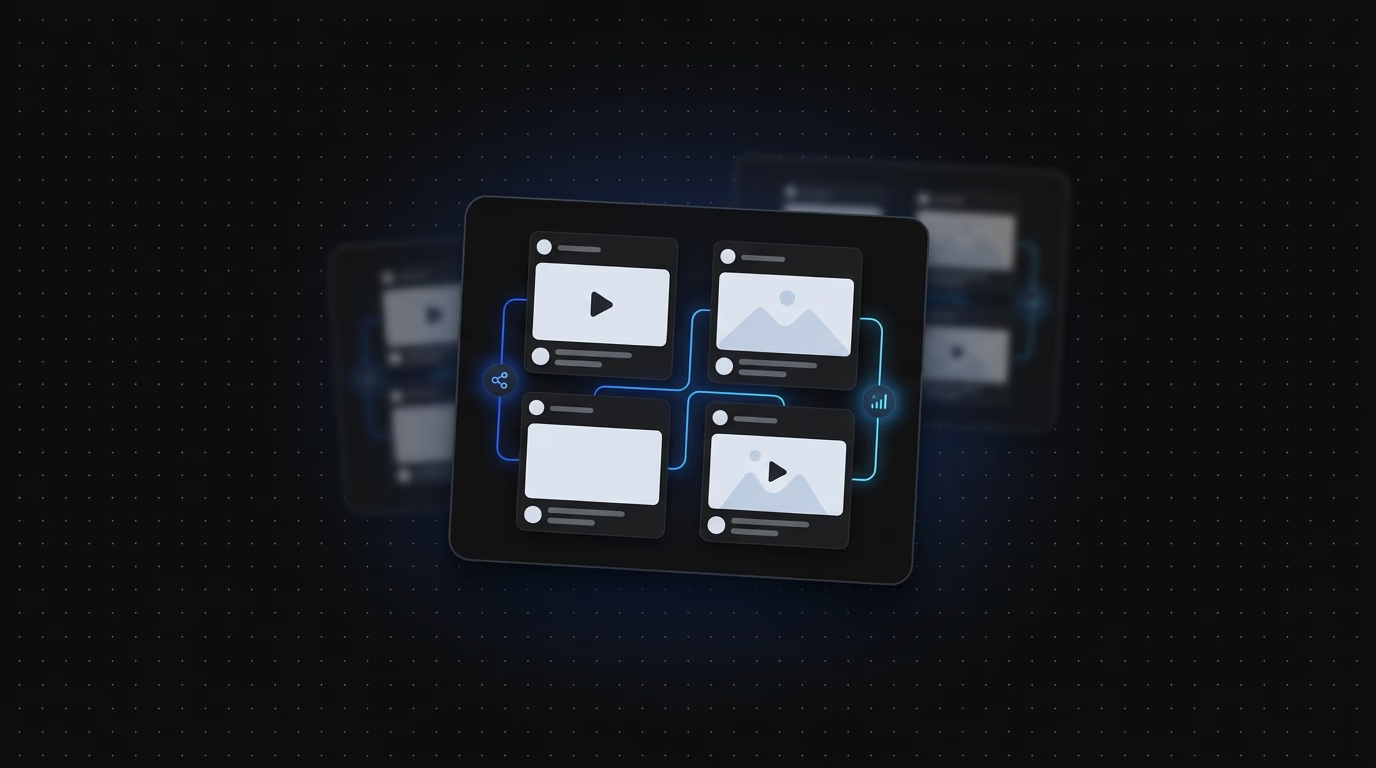
Scalable advantage comes from throughput, not individual winners. Only 5–10% of tested creatives become scalable hits. Therefore, reverse-engineering creative systems matters more than copying single ads. You need to understand the factory that produced the ad, not just the product. When you analyze a system, you see how a competitor scales through high-volume testing rather than "getting lucky" with one viral video.
Observe these system indicators:
- Format Adaptations: Do they turn every high-performing static into a Reel or a Carousel? This is a sign of a team that understands how to scale Facebook ad testing efficiently.
- Messaging Clusters: Are they attacking one specific pain point (e.g., price) across five different creative formats?
- Refresh Intensity: How many new ads do they launch per week relative to their total active count? High intensity usually indicates a brand that is scaling budget aggressively.
Static snapshots are obsolete in 2026. Continuous monitoring of patterns is essential. This is where AI and tools like Claude Code become transformative. By feeding creative transcripts or OCR data into Claude Code, strategists can cluster themes, summarize angles, and track CTA trends across hundreds of ads in seconds, significantly reducing cognitive load. Instead of manually watching 50 videos, you can use AI to tell you that 80% of them use a "problem/solution" framework with a 2-second hook focus on "saving time."
The Missing Layer: Connecting Research to Execution
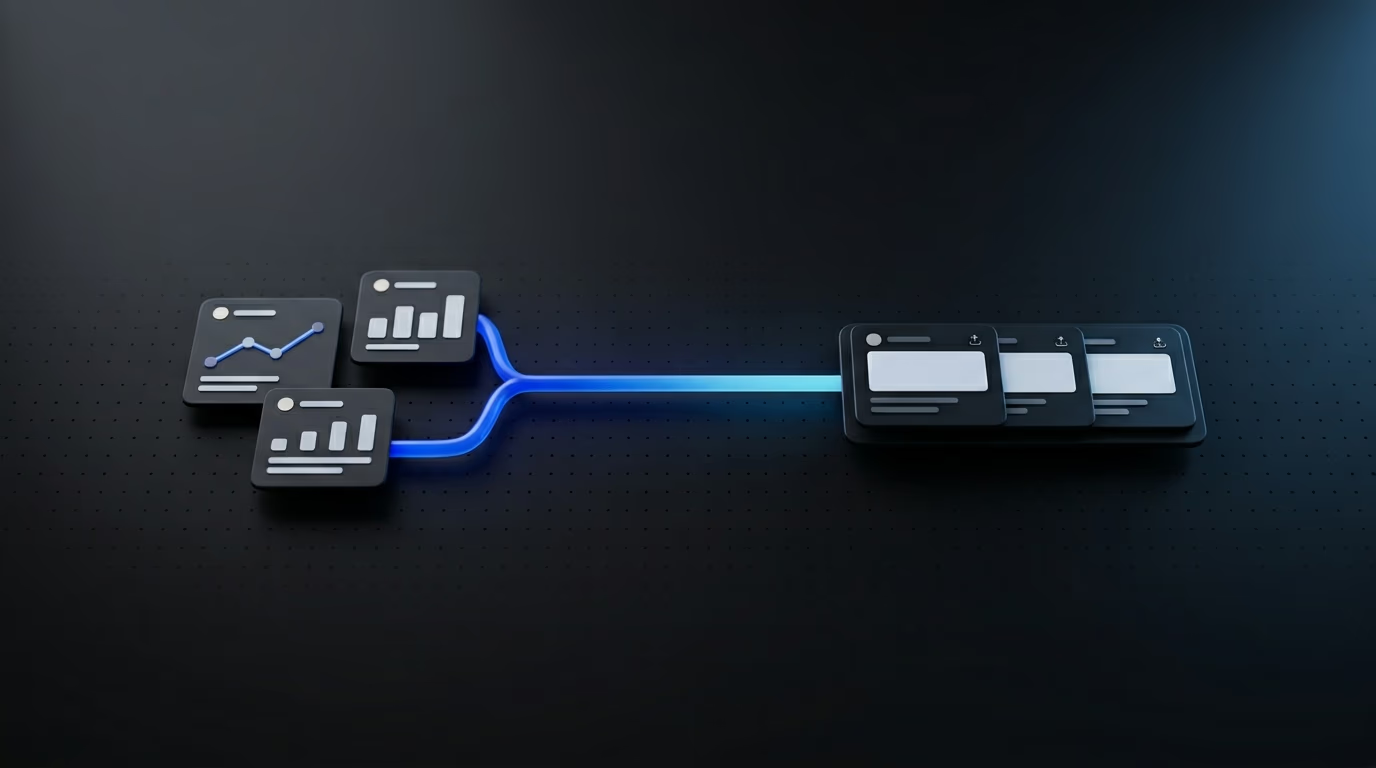
Research and production often exist in silos. Insights collected by strategists rarely transfer seamlessly to media buyers or designers. While Paragone offers comprehensive cross-platform reporting and performance tracking, the actual creation and uploading of Facebook ads remains a manual drag for most teams. This is where the workflow breaks: when the "what to do" is clear, but the "how to do it fast" is missing.
The Execution Bottleneck: Why Manual Facebook Ads Creation Is Killing Your ROAS highlights that the time spent in Ads Manager is time lost in strategy. A better workflow involves these five steps:
- Identify Repeatable Structures: Use the Meta Ad Library to find templates that work for your niche.
- Tag by Intent: Categorize insights by funnel stage (TOFU/MOFU/BOFU) and audience intent. Don't just save an ad; save the reason it exists.
- Systematic Variation: Don't just make one ad; make five variations of the hook for every one body clip. This gives the algorithm more opportunities to find a winner.
- Bulk Upload: Move assets directly into a Facebook ads uploader like Instrumnt. This bypasses the click-heavy Ads Manager interface and allows you to go from research to live testing in minutes.
- Feedback Loop: Feed performance data back into your research tags to see which "competitor-inspired" angles actually converted for your brand.
Teams using Instrumnt to bridge this gap see a massive reduction in operational friction, allowing them to test 3-5x more creative variations without increasing headcount. This increased throughput is the only reliable way to beat the rising costs of Facebook ads.
Why Surface-Level Research Produces Weak Facebook Ads
Focusing solely on aesthetics ignores the distribution logic that Meta’s AI uses to find buyers. Advantage+ campaigns reportedly deliver better results because they can test up to 150 creative combinations at once. If your research process only produces one or two "high-quality" ads, you aren't giving the algorithm enough options to find the winning combination. You are effectively starving the machine. Facebook ads uploader: Instrumnt vs Competitors provides a detailed comparison of how different tools handle this volume shift.
Real advantage comes from frameworks that survive scaling, not single visual tricks. You must monitor:
- Offer Persistence: Which offers have they run for 6+ months? This is your North Star for messaging.
- Hook Evolution: How do they evolve a winning hook without changing the core message? Look for variations in text overlays and first-frame imagery.
- Durable Themes: What emotional triggers (fear of missing out, social proof, ease of use) appear most consistently across their entire library?
This shifts research from a scavenger hunt to a diagnostic exercise, which is critical in the fast-moving Meta ecosystem where diagnosing Meta Ad Library bottlenecks is the first step to scaling. If you don't understand the underlying logic of a competitor's success, you are doomed to mimic their visuals while missing their results.
A 7-Step Checklist for Systematic Meta Ad Research
To ensure your research leads to actual revenue, follow this systematic checklist instead of browsing aimlessly. This process turns the Meta Ad Library from a gallery into a production line:
- Filter by Date: Look at ads that have been running for at least 30 days to filter out failed tests and focus on proven concepts.
- Isolate by Platform: Check if creative differs between Instagram Reels and Facebook Feed. This reveals if they are customizing assets for different user behaviors.
- Transcribe Hooks: Write down the first 3 seconds of the top 10 ads. Use Claude Code to find linguistic commonalities and emotional hooks that appear most frequently.
- Map the Funnel: Identify which ads are for prospecting (broad) vs. retargeting (specific product mentions). This prevents you from running a TOFU ad to a BOFU audience.
- Analyze the CTA: Is the competitor using "Shop Now" or "Get Offer"? The CTA often dictates the algorithm’s optimization goal and affects click-through rates.
- Check Landing Page Consistency: Ensure the ad's visual style matches the destination page. Use a landing page analysis system to ensure you aren't losing traffic due to a disconnected journey.
- Export to Uploader: Queue your findings directly for production. Do not let them sit in a spreadsheet. Use a Facebook ads uploader to turn these insights into live campaigns immediately.
The Operational Fix: Moving from Research to Facebook Ads Uploader Workflows
Teams need fewer disjointed workflows, not more research. Success comes from spotting patterns quickly, converting them into structured variations, and launching fast. The tool alone isn’t the advantage—the workflow is. If you find a winning angle in the Ad Library at 9:00 AM, but your team can't launch a variation of it until next Thursday, your research has zero value. The speed of iteration is the most under-discussed KPI in performance marketing.
Core changes to implement today:
- Treat the Meta Ad Library as structured intelligence, not a gallery.
- Categorize findings by messaging, audience, and funnel stage.
- Use a Facebook ads uploader to minimize time-to-market. Tools like Instrumnt allow you to bypass the manual labor of Ads Manager and upload high-volume creative tests in seconds.
- Measure iteration speed over research volume. Focus on how many new tests you launch based on insights, not how many ads you've saved to a folder.
In a platform reaching over 3 billion daily users, workflow efficiency compounds faster than any individual creative insight. Winning teams convert research into deployable systems before the competition even realizes they've been spotted. By integrating AI analysis with a streamlined Facebook ads uploader, you turn a passive research exercise into an active growth engine.
Common questions about meta ad library
How can I quickly identify high-performing ads using the Meta Ad Library?
The most reliable indicator of performance is longevity. Use the filters to view ads that have been active for at least 30 to 60 days. Advertisers rarely spend budget on underperforming ads for more than a few weeks, so long-running ads are almost certainly their "controls." Additionally, look for ads with multiple versions active, as this suggests a winning concept being scaled through variations.
What workflow practices reduce bottlenecks when researching competitors?
Stop taking manual screenshots and using static documents. Use a dedicated tool to save ads with metadata (launch date, platform, landing page) and use a systematic tagging system based on creative angles. Most importantly, integrate your research with a Facebook ads uploader like Instrumnt so that the transition from "insight" to "live ad" happens in minutes, not days. This eliminates the manual reentry of data into Ads Manager.
How can AI tools like Claude Code enhance Meta Ad Library analysis?
Claude Code and other AI tools can process the text and transcripts from hundreds of competitor ads to identify recurring themes, sentiment shifts, and specific hook structures. Instead of guessing why an ad works, you can use AI to find the mathematical patterns in the copy that are driving engagement across the entire market. It allows you to move from qualitative "vibes" to quantitative strategy.
For more context, see Smartly.io.
For more context, see Ads Uploader.
For more context, see Triple Whale's Facebook Ads benchmarks.