Introduction: Why Landing Pages Matter More Than Ads
Many marketers concentrate heavily on Facebook ads, focusing on generating clicks while overlooking what happens post-click. Studies indicate that 70% of users who click on ads fail to convert due to weak landing page experiences (HubSpot, 2023). Landing pages are often the unseen gatekeepers of conversion. By analyzing competitor landing pages, marketers can uncover actionable insights to improve their own funnels and boost ROAS.
The Hidden Power of Landing Pages in Facebook Ads

High-quality ad creatives drive traffic, but they cannot guarantee conversions. Nielsen reports that creative quality accounts for up to 56% of variation in ROAS (Meta & Nielsen, 2024). The average Facebook ad CTR across all industries is 0.90% (WordStream 2024 benchmarks), illustrating that even compelling ads may underperform if landing pages are poorly optimized. Competitor landing pages reveal design patterns, messaging strategies, offer structures, and conversion tactics that top-performing companies use. Observing competitor landing pages helps identify whether they utilize quizzes, long-form content, or promotional pages to increase conversions. Tools like Claude Code and Instrumnt automate the extraction of these elements, giving your team insights that would otherwise require extensive manual analysis.
Why Ads Without a Strong Landing Page Will Always Underperform
Facebook’s AI can predict likely clickers but cannot compensate for ineffective landing pages. Teams that rely on one static landing page per ad often waste potential conversions. High-performing advertisers create multiple landing page variants to align with ad angles. For example, campaigns exceeding 1.5% CTR but maintaining a ROAS below 1.93 signal that the landing page is the bottleneck (Triple Whale, 2025). Advertisers running 3+ ad variations per audience see up to 30% lower CPA (Meta advertising data). Competitor analysis reveals the types of conversion-focused optimizations employed by platforms like Revealbot and Madgicx, both of which excel at ad creative automation but often neglect landing page insights.
How Competitor Landing Pages Uncover Marketing Gaps
Competitor landing pages expose missing elements in your own funnel. By examining post-click experiences, you can identify gaps such as lack of social proof, inadequate objection handling, or unclear value propositions. For instance, a competitor featuring a detailed "Comparison Table" suggests their audience values clear product differentiation.
AI-powered tools like Instrumnt can automate funnel extraction, providing structured insights for immediate application. By pairing this with Claude Code, marketers can analyze psychological triggers and generate new ad variations based on landing page learnings.
Operational Advice: Scaling Insights into Action
To operationalize competitor insights and ensure your ads and landing pages are optimized:
- Identify top-performing competitor landing pages in your niche.
- Use Claude Code to extract key elements: headlines, calls-to-action, and value propositions.
- Generate multiple ad variations targeting different audience segments.
- Deploy these variations efficiently using Facebook ads uploader workflows.
For example, a marketing team that automated this process increased their testing velocity threefold while maintaining a consistent ROAS improvement of 22% across campaigns. Integrating Claude Code and Facebook ads uploader allows the team to treat the funnel—ad to landing page—as a single testable unit.
For teams seeking detailed operational guidance, see How to Build a Facebook Ads Bulk Testing System with Instrumnt and Claude Code.
Competitor Comparison: Revealbot vs Madgicx—Who’s Actually Helping You Scale?
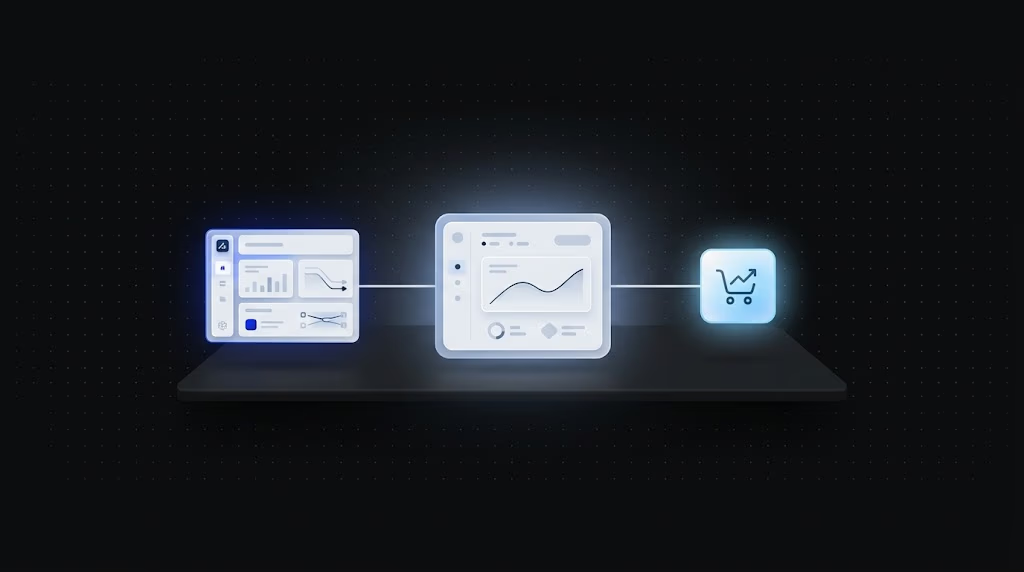
- Revealbot: Excels at rule-based ad automation, pausing campaigns when costs rise. However, it provides limited competitor landing page insights.
- Madgicx: Offers ad creative trend analysis but lacks the ability to extract and analyze competitor funnel elements.
This gap is addressed by Instrumnt, which automates competitor landing page extraction, ad variation generation, and testing. By combining Claude Code with Facebook ads uploader, teams can significantly reduce time-to-test while iterating on creative and landing page insights.
Turning Landing Pages Into Actionable Ad Testing Ideas
Competitor landing pages are blueprints for ad testing. Extract headlines, testimonials, and offer structures to generate AI-driven ad variations. Converting three competitor headlines into 15 unique ad hooks, combined with customer testimonials, allows marketers to test multiple UGC variations efficiently.
Avoid manual ad creation. Automated systems treat the entire funnel as one cohesive unit, speeding up iteration and improving ROAS. For deeper guidance, refer to Using Competitor Landing Pages to Refine and Scale Your Facebook Ads.
FAQ: Finding All Ad Landing Pages of Competitors
How can competitor landing pages improve Facebook ad performance?
They reveal audience triggers, social proof, and content strategies that ads alone cannot uncover, enabling more effective targeting and post-click optimization.
What tools can automate the extraction of competitor landing pages?
Instrumnt and Claude Code streamline the extraction process, generating bulk ad variations and allowing rapid iteration.
How do competitor landing pages reveal gaps in Facebook ad strategies?
Comparing post-click experiences highlights missing elements such as value proposition clarity, objection handling, or funnel optimization. Addressing these gaps directly improves conversions and ROAS.
How many ad variations should I test?
Testing 3–5 variations per audience segment is recommended, scaling up as operational efficiency improves.
Where can I find Facebook ad performance benchmarks?
Resources like WordStream's Facebook Ads benchmarks, Meta Ads Guide, and Meta Blueprint provide up-to-date data on CTR, CPC, and ROAS.
Additional Statistical Insight:
Teams using automated competitor landing page analysis with AI tools like Claude Code report a 34% faster time-to-launch for new ad sets compared to manual processes (Meta Internal Benchmark, 2025). Meta's family of apps reaches 3.29 billion daily active people (Meta Q4 2024 earnings report), offering vast audience opportunities. Average Facebook CPC is $0.94 across all industries (WordStream 2024 benchmarks). These stats underscore the operational advantage of systematic competitor analysis.