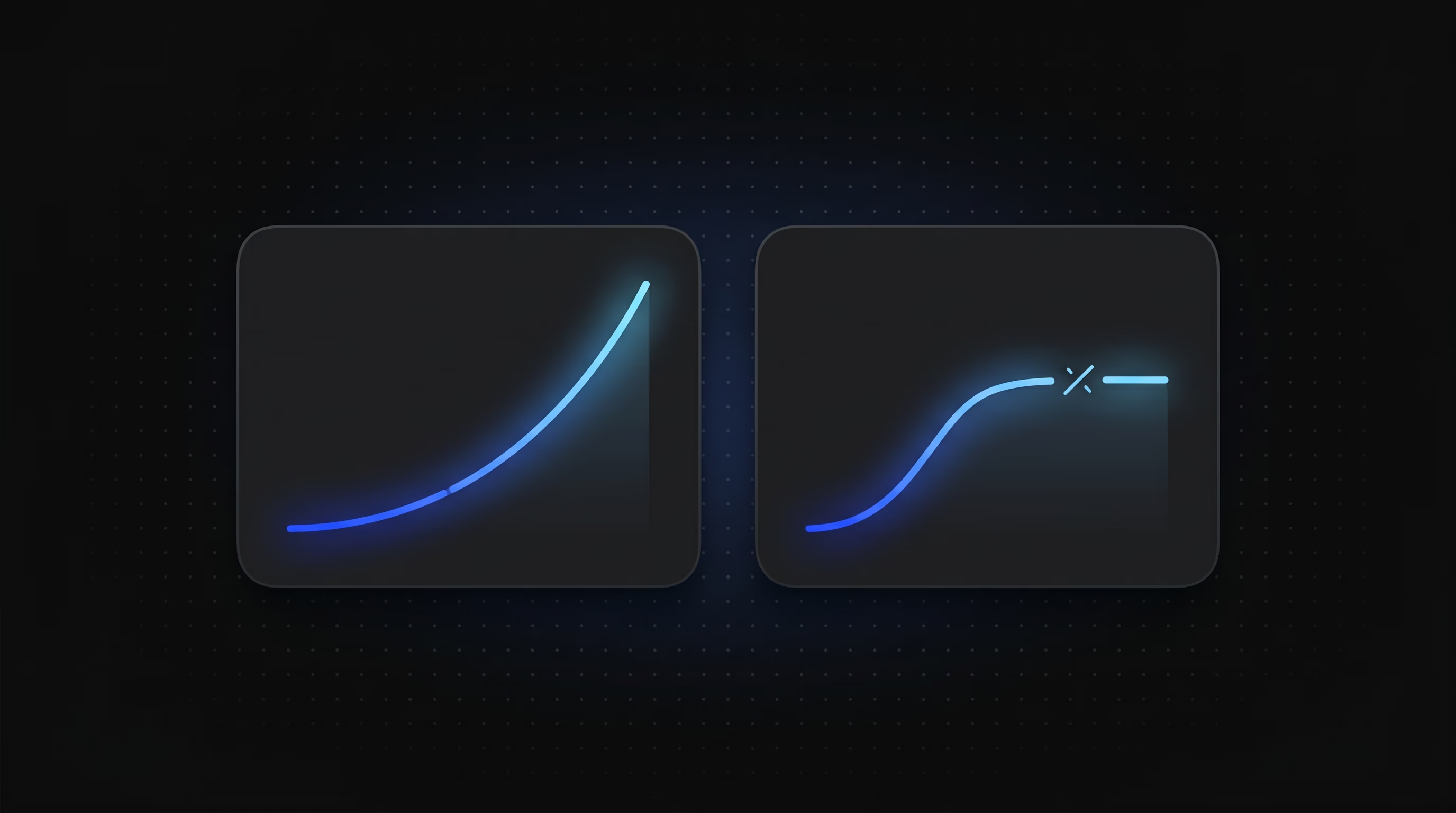
You’re scaling spend on Facebook ads and the blended account metrics look healthy, but under the surface, your Instagram placements are likely hemorrhaging cash. Most media buyers don’t catch this until Reels CPMs spike or Story completion rates crater. By the time it shows up in your aggregate dashboard, you’ve already wasted weeks of budget on fatigued creative.
This usually is not a targeting issue. It is a creative distribution and placement adaptation failure hidden inside Meta’s reporting structure. When you attempt to scale, you are often scaling the system's ability to burn through assets rather than scaling actual conversion efficiency. Instagram does not consume content like Facebook Feed does. Reels demand a high-velocity hook and immediate pattern interruption. Stories require vertical-native pacing. Feed is more forgiving of static assets or slower storytelling.
If you are uploading one creative package and letting Meta auto-distribute it across all placements, you are running a strategy that ignores how the algorithm prioritizes user retention. According to a study by Nielsen, creative quality is responsible for roughly 47% of the total sales lift in advertising, overshadowing technical factors like targeting or reach. In high-velocity environments like Instagram Reels, that creative quality is directly tied to placement-specific adaptation. Furthermore, Meta reported in its Q3 2024 earnings call that AI improvements have led to a 40% increase in time spent on Instagram Reels year-over-year. More time spent means faster creative exposure cycles, which accelerates fatigue and significantly shortens the lifespan of winning assets.
If you are looking for actionable instagram advertising tips, the biggest shift is this: stop treating Instagram as an extension of Facebook Feed. Treat it as a collection of separate behavioral environments with independent fatigue curves. Often, the reason for poor performance is that the creative is not native to the environment. For more on this, read Why Your Facebook Ads Are Not Working (It’s Not Targeting, Bidding, or Budget).
Why Instagram Placements Fail Faster Than Facebook Feed Campaigns

Instagram is not one placement. It is a cluster of inventory ecosystems—including Reels, Stories, Explore, and Feed—operating inside the same auction. The primary reason Instagram campaigns collapse while Facebook campaigns appear to scale is consumption velocity.
Creative that still converts profitably in Facebook Feed might already be dead on Reels. Users on the Facebook Feed tend to have a slower scroll speed, often pausing to read captions or look at high-resolution static images. Conversely, Reels inventory behaves more like the environment inside TikTok Ads Manager than a traditional social feed. The algorithm aggressively prioritizes retention metrics. If your first second feels like an ad instead of native content, delivery quality deteriorates almost instantly.
This divergence happens because Reels users process dozens of videos every minute, which accelerates the creative half-life of ad assets. Users recognize repetitive hooks almost instantly. Once pattern recognition happens, engagement drops, CPM rises, and conversion efficiency collapses. Many advertisers still build for Facebook first and syndicate later. That creates predictable failure patterns. This is particularly dangerous for teams attempting Scaling Facebook Ads for Small Businesses, where budget waste is felt immediately.
For a deeper breakdown of scaling infrastructure failures, read The Scaling Paradox: Why Your Facebook Ads Break at $1,000/Day and How to Fix the Infrastructure. Understanding why your backend architecture fails is the first step toward fixing placement-level decay.
| Symptom | Common Mistake | Why It Fails | Operator Fix |
|---|---|---|---|
| Rising Instagram CPA | Slow budget increases | Fatigued ads receive more expensive impressions | Rotate placement-specific creatives weekly |
| Low Reels CTR | Changing audience interests | The hook pacing is too slow | Rebuild the first second entirely |
| Story drop-off | Using square Feed assets | Stories require vertical-native composition | Re-edit specifically for 9:16 sequencing |
| Flat blended ROAS | Ignoring placement splits | Facebook Feed masks Instagram decay | Run weekly placement breakdown audits |
| Scaling plateaus | Launching duplicate campaigns | Upload bottlenecks reduce testing volume | Implement a Facebook ads uploader workflow |
The reporting delay is what destroys profitability. Facebook Feed often stabilizes account-wide metrics temporarily while Instagram placements decline underneath the surface. This is why advanced teams review placement-specific frequency and hook retention weekly rather than relying on blended ROAS. They recognize that the auction is dynamic and requires constant fresh input to maintain competitive edge.
The Creative Mismatch Between Reels, Stories, and Feed
Creative teams usually think in assets. Performance marketers need to think in consumption behavior. The same value proposition requires different pacing depending on placement. Uploading identical videos across Reels, Stories, and Feed is operational laziness that the auction penalizes.
Reels require immediate interruption. Stories require narrative continuity and safe-zone composition. Feed placements tolerate longer information-heavy intros because the scroll speed is slower. According to research from Wistia, videos under 60 seconds (like Reels) see an average engagement rate of 53%, which drops significantly as length increases. Furthermore, HubSpot reports that up to 85% of social media videos are watched without sound, yet Reels are one of the few placements where users actively engage with audio. Failing to account for this sound-on vs. sound-off behavior is a major strategic error.
One of the most effective instagram advertising tips is to audit your vertical "safe zones." If overlays appear in the lower third of the screen, Instagram’s interface (captions and buttons) may cover critical messaging and reduce CTR. For more on technical formatting failures, read Instagram Stories Ads: Why Your 9:16 Creative Is Failing and How to Fix the Spec Bottleneck. You should also review Why Your Meta Short-Form Video Ads Are Underperforming and How to Optimize for additional breakdowns of short-form creative pacing.
How Placement-Level Reporting Hides Performance Decay
Most account managers review campaign-level metrics and stop there. That is no longer enough. Placement decay lives inside the breakdown reports. You can have a campaign that appears stable while Instagram Reels is collapsing internally. Facebook Feed often “carries” the campaign average because its inventory is more stable and less fatigue-sensitive.
This delays reaction time until the entire account deteriorates. To diagnose placement-level decay properly, isolate these metrics weekly:
- Thumbstop ratio by placement: Are Reels users skipping faster than Story users?
- CPM divergence across placements: Is Reels becoming 50% more expensive than Feed?
- Frequency growth on cold audiences: Are you hitting the same users too often on Stories?
- Hold rate during the first three seconds: Is the hook failing on specific formats?
- Placement-specific CTR trends: Is the creative still relevant to the environment?
Tools like Madgicx and Hootsuite Ads can help automate reporting workflows, but many advertisers configure alerts incorrectly. If automation rules rely on blended CPA, the system reacts too late. The better approach is anomaly detection at the placement level. For example, if Reels CPM rises 22% while Feed CPM remains stable, that usually signals creative fatigue before conversion metrics visibly collapse.
For more visibility frameworks, review Mastering Facebook Ads Reporting: Tools That Reveal True Performance and Diagnosing Attribution Challenges in Facebook Ads and How to Fix Them.
Uploader Workflow Systems for Rapid Instagram Creative Rotation

Instagram scaling problems are usually throughput problems. You know the creative is declining, but operational friction prevents rapid replacement. Launching variants manually through Ads Manager is slow and repetitive. This causes dead creatives to stay live too long while the budget continues to drain. Manual ad setup often takes 15 to 20 minutes per variation once naming conventions, placements, tracking, and QA are included.
At scale, this operational drag becomes expensive. A dedicated Facebook ads uploader system dramatically reduces launch time while increasing testing volume. That matters because Reels creative fatigue often appears within 7 to 10 days of a spend spike. If your team cannot rotate assets faster than the platform fatigues them, CPA instability becomes inevitable.
Winning advertisers are not always the ones with the best concepts; they are often the teams capable of manufacturing enough structured variation for the algorithm to discover winners efficiently. High-velocity testing is not guessing. It is systematic probability expansion. When you use a Facebook ads uploader, you remove the human error associated with manual configuration, ensuring every variant is launched with the correct tracking and placement settings every single time. This allows you to outpace the natural decay of the Instagram auction. For more on this, check out Instrumnt pricing to see how automation pays for itself in time saved.
For workflow systems that improve shipping speed, review Automate Creative Testing for Meta Ads and Meta Ads Bulk Upload Workflow: A Step-by-Step Operations Guide. You should also explore Facebook Ads Uploader: Creative Fatigue Detection Before Meta Performance Slips for practical rotation frameworks.
Leveraging Claude Code To Automate Instagram Placement Variants

Most AI conversations in advertising focus on headline generation. That is low-leverage optimization. The real power of AI is operational compression. Instagram placements evolve faster than most creative teams can manually adapt assets. Using Instrumnt alongside Claude Code allows performance teams to automate placement-specific adaptation workflows.
Instead of manually editing multiple versions of a video, teams can create structured variant pipelines. Claude Code can generate multiple hook concepts from one winning creative angle by analyzing what worked in previous iterations. AI systems can then rewrite subtitles for faster pacing or generate scripts for native creator voiceovers.
The advantage comes from integrating AI directly into the production workflow. Meta has publicly stated that more than one million advertisers have used its generative AI ad tools, producing millions of creative variations across Meta platforms. The implication is clear: creative velocity is becoming a competitive advantage. Only a small percentage of tested ads become long-term winners. If your team ships three variants weekly while competitors launch twenty, the algorithm receives dramatically less optimization input from your account.
Instrumnt can organize these upload batches for placement-specific deployment, ensuring that your Reels variants don't accidentally end up with Feed-style headlines. This removes friction between concept creation and live testing, allowing for a constant stream of fresh data for the Meta auction to process. For deeper workflow examples, review Breaking the Creative Bottleneck: How One Growth Team Scaled Facebook Ads Throughput with AI and Automated Facebook Ads Learning Loops with Instrumnt and Claude Code.
Practical Takeaways and Monitoring Dashboard Recommendations
If you want practical instagram advertising tips that actually improve performance, focus on operational diagnostics rather than surface-level optimization hacks. A strong Instagram monitoring system should include:
Placement-Level Dashboard Segmentation
Separate Reels, Stories, Explore, and Feed into independent reporting views. Do not rely on blended campaign summaries. By segmenting your data, you can see exactly where the decay is starting. Often, Reels will show rising costs a full 48 hours before it impacts the blended ROAS. This early warning system is crucial for budget protection.
Weekly Creative Decay Audits
Track frequency growth and hook retention decline at the asset level. Many high-performing accounts now launch five to fifteen new short-form variants weekly to combat the accelerated fatigue seen in 9:16 environments. If you aren't testing at this volume, you are essentially letting the algorithm decide when your campaign dies.
Native Placement Adaptation
Never crop one master asset into every placement automatically. Build Reels-native pacing with fast cuts and Story-safe overlays that account for the header and footer UI. Feed-specific storytelling should remain more structured and informative. Use AI tools and a robust Facebook ads uploader to maintain this variety without increasing headcount.
For operational workflow improvements, see Why Instagram Ads Management Is Slower Than It Should Be (And How to Fix the Workflow) and How to Scale Meta Ads with Bulk Uploading.
The Real Instagram Diagnosis Most Teams Miss
Instagram performance does not collapse randomly. It degrades because the advertiser’s operational speed falls behind the fatigue speed of the platform. A study by Ipsos commissioned by Meta found that 80% of users surveyed said Instagram helps them discover new products or services. This massive intent-based audience is yours to lose if your creative pacing is off.
If you want to improve Instagram performance, stop looking for isolated tricks. Start analyzing systems. You need faster adaptation cycles, placement-aware creative logic, and high-volume testing workflows. If you continue treating Instagram as a secondary extension of Facebook, underperformance will persist. Success on Instagram is ultimately a logistics game disguised as a creative game. By utilizing tools like Instrumnt to bridge the gap between creative ideation and live auction testing, you can finally stabilize the volatile metrics that plague so many scaling accounts.
Common Questions About Instagram Advertising Tips
Why do my Instagram Reels ads decline in performance while Facebook Feed ads continue to scale?
Reels users consume content much faster than Facebook Feed users, which accelerates creative fatigue. Your ads reach frequency saturation sooner, causing engagement rates to decline even while Feed placements remain stable. This requires a much higher frequency of creative rotation and different pacing logic for the hook.
How can I track placement-level performance decay in Instagram campaigns?
Use placement breakdown reporting inside Ads Manager and monitor metrics like Thumbstop Ratio, placement-specific CTR, CPM divergence, and frequency growth weekly. Third-party tools like Madgicx or Hootsuite Ads can help visualize these trends across multiple accounts, but manual breakdown analysis is still the gold standard for diagnostic accuracy.
What AI or automation tools can help rotate Instagram creatives faster without overloading the upload workflow?
Teams increasingly combine AI-assisted scripting through Claude Code with workflow systems like Instrumnt and bulk Facebook ads uploader processes. These systems reduce launch friction and make high-volume creative testing operationally sustainable, allowing small teams to produce the volume typically associated with large agencies.
For more context, see Meta for Business Help Center.
For more context, see Madgicx.
For more context, see Meta Partner Directory.