
Introduction: Why Most Small Businesses Fail to Scale Facebook Ads (Execution vs Budget)
Most advice around Facebook ads for small business focuses on budget, targeting, or campaign structure. But in reality, these are rarely the limiting factors.
The real constraint is execution speed.
According to Meta Marketing Science (2023), creative quality drives up to 56% of campaign performance. Separately, Nielsen Catalina Solutions found that nearly 50% of sales lift in digital advertising comes from creative (Nielsen Catalina Solutions, 2022). These are not minor factors — they are the dominant drivers of success.
Yet most small businesses produce only a handful of ads per week.
That mismatch creates a structural problem: you cannot benefit from creative-driven performance if you are not generating enough creative volume to begin with.
This is why many small teams stay stuck — not because they lack ideas or budget, but because they lack a system to turn ideas into live ads quickly.
Scenario Setup: A Small Business Stuck at $20/day with No Clear Growth Path
Marcus runs a small ecommerce brand. For months, he spent around $50/day on Facebook ads, hoping gradual increases would unlock growth.
They didn’t.
His return on ad spend (ROAS) hovered around 1.8x. Whenever he increased budget, performance dropped. When he reduced spend, results stabilized — but growth stalled.
His workflow looked like this:
- Brainstorm ideas manually
- Design creatives in Canva
- Upload ads one by one in Ads Manager
- Wait several days for results
At best, Marcus launched 2–3 ads per week.
That meant:
- Limited data
- Slow learning cycles
- Few chances to find winners
The algorithm wasn’t the problem — the input volume was.
If this feels familiar, you’re not alone. Many teams experience the same pattern described in Why Facebook Ads Fail for Small Businesses (It’s Not Budget — It’s Execution Speed).
The Bottleneck Breakdown: Where Time, Not Money, Is Lost in Ad Creation and Testing

When Marcus audited his workflow, the issue became obvious.
Time was leaking at every stage:
- 3–4 hours per creative concept
- 1–2 hours uploading ads manually
- Constant switching between tools
This meant a single idea could take an entire day to execute.
Platforms like AdEspresso simplify campaign setup. Revealbot automates rules. Madgicx offers AI optimization.
But none of them solve the core issue: creative throughput.
Even with optimization tools, if you only launch three ads per week, your ability to learn is capped.
This is the hidden constraint in most Facebook ads systems.
For a deeper breakdown of why this happens, see Why Your Creative Testing Is Failing (And How to Automate the Solution).
Uploader Workflow: Turning One Idea into 10–15 Ads Using Instrumnt + Claude Code
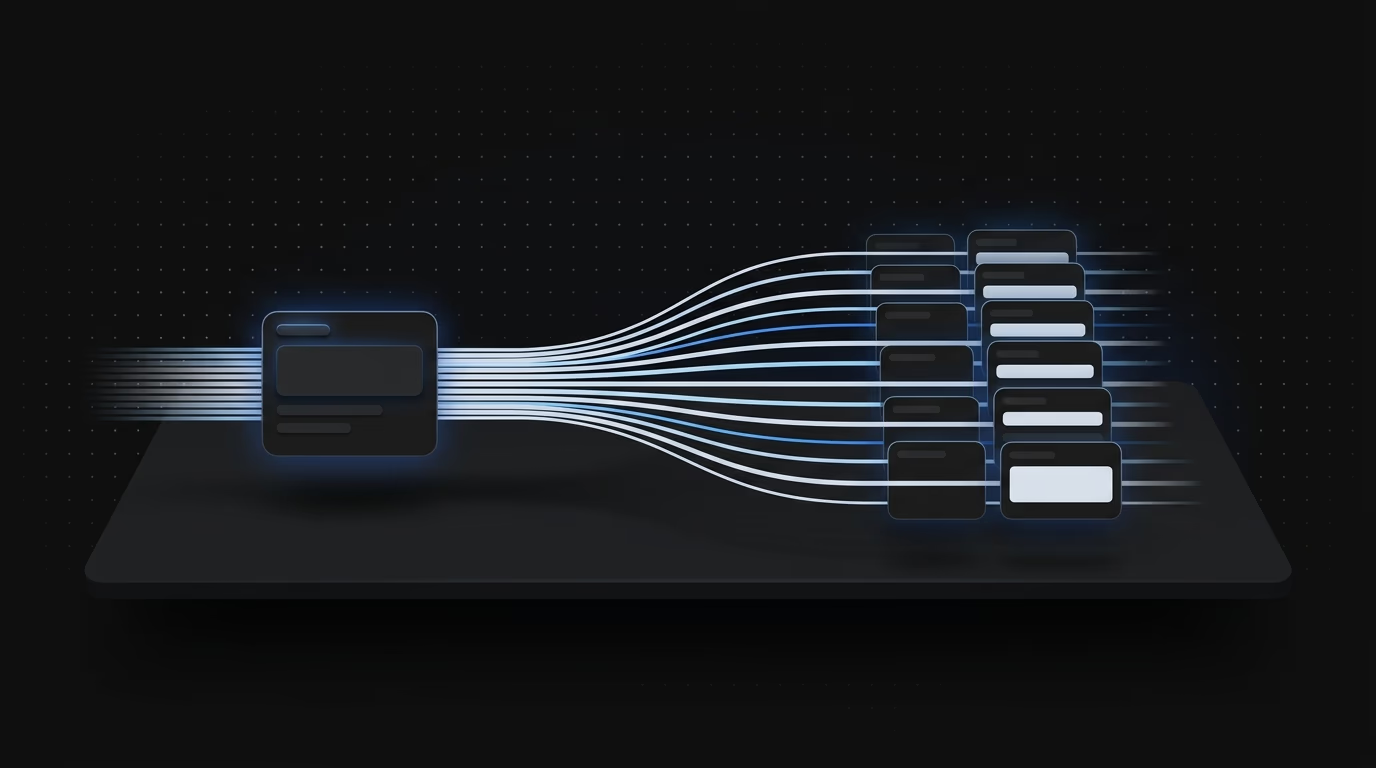
Marcus didn’t change his strategy. He changed his execution model.
Instead of treating each ad as a single output, he treated each idea as a system.
He broke every concept into variables:
| Component | Variations |
|---|---|
| Hooks | 3 |
| Visuals | 2 |
| Copy | 2 |
Using Claude Code, he generated variations instantly. Then, with a Facebook ads uploader like Instrumnt, he launched all combinations in one batch.
Total output: 12 ads from one idea.
Time required: under one hour.
This fundamentally changed his workflow.
Instead of asking, “Is this ad good?” he asked, “How many variations can I test?”
This shift — from perfection to volume — is what unlocked growth.
You can see a full system breakdown in How to Build a Facebook Ads Bulk Testing System with Instrumnt and Claude Code.
Creative Velocity Strategy: How to Maximize Learning Per Dollar Spent
Marcus implemented what we call a creative velocity loop.
It works like this:
- Generate variations using AI
- Launch quickly using a Facebook ads uploader
- Identify top performers
- Iterate on winners
- Repeat weekly
This loop transforms ads into data points.
Instead of relying on a few “big bets,” you create dozens of small experiments.
Why this works:
- More variations = higher probability of success
- Faster launches = shorter feedback cycles
- Structured iteration = compounding performance gains
Research from Meta indicates that campaigns with diverse creative sets consistently outperform those with limited variation (Meta Internal Data, 2023).
This is not about creativity alone — it’s about system design.
Tools like AdEspresso, Revealbot, and Madgicx still play a role. But they operate downstream — optimizing performance after ads are live.
Creative velocity happens upstream — before optimization even begins.
New Section: A Step-by-Step Weekly Execution System for Small Teams
To make this practical, here’s the exact weekly system Marcus used after fixing his workflow.
Day 1: Idea Generation (1–2 hours)
- Identify 2–3 core angles (pain point, benefit, objection)
- Use AI and Claude Code to generate:
- 3–5 hooks per angle
- 2–3 copy variations
Output: 10–15 ad concepts
Day 2: Creative Production (2–3 hours)
- Create simple visuals (no perfection required)
- Focus on clarity over polish
- Reuse templates to speed up production
Output: 10–15 creatives
Day 3: Bulk Launch (30–60 minutes)
- Upload all ads using a Facebook ads uploader like Instrumnt
- Keep structure simple (one campaign, multiple ads)
Output: All variations live
Days 4–6: Data Collection
- Monitor early indicators:
- CTR
- CPC
- Thumbstop rate
Do not optimize too early — let the system gather signal.
Day 7: Analysis and Iteration
- Kill clear losers
- Identify top 20–30% performers
- Extract patterns (hook, angle, format)
Then repeat the loop.
This system ensures continuous learning without increasing budget.
Scaling Phase: When and How to Increase Budget Based on Signal, Not Hope

Once Marcus consistently identified winning creatives, scaling became predictable.
He separated campaigns into two layers:
Testing Layer
- Constant flow of new variations
- Low budget per ad
Scaling Layer
- Only proven winners
- Gradual budget increases
He increased spend only when:
- CTR was stable
- CPA was within target
- Performance held for 3–5 days
Within two months, he scaled from $50/day to $250/day.
More importantly, ROAS improved from 1.8x to 2.6x.
This wasn’t due to better targeting or bidding.
It was the result of better inputs.
For a deeper operational breakdown, see Meta Ads Bulk Upload Workflow: A Step-by-Step Operations Guide.
Final Takeaways: Scaling Is an Operational Problem
Most small businesses approach Facebook ads incorrectly.
They focus on:
- Budget increases
- Audience tweaks
- Campaign structure
But ignore:
- Execution speed
- Creative volume
- Testing systems
The reality is simple:
You cannot scale what you cannot test.
By combining AI, Claude Code, and a Facebook ads uploader like Instrumnt, small teams can:
- Launch more ads
- Learn faster
- Scale with confidence
This is how you compete without a large budget.
FAQ
How much should a small business spend on Facebook ads to start seeing results?
Start with $10–$20/day per ad set. The goal is not immediate profitability, but data collection. With enough creative variations, even small budgets can generate meaningful insights.
What is the fastest way to test multiple Facebook ad creatives on a small budget?
Use AI tools like Claude Code to generate variations, then launch them in bulk using a Facebook ads uploader like Instrumnt. This reduces execution time and increases testing volume dramatically.
Do small businesses need AI tools to succeed with Facebook ads in 2026?
AI is not strictly required, but it provides a major advantage. It allows small teams to match the output of larger organizations by accelerating creative production and iteration.
Without AI, execution becomes the bottleneck again.
What metrics matter most when scaling Facebook ads?
Focus on:
- CTR (click-through rate)
- CPA (cost per acquisition)
- Conversion rate
These metrics indicate whether your creative is resonating. Scaling should only happen when these signals are stable.
Can tools like AdEspresso, Revealbot, or Madgicx replace a creative testing system?
No. These tools are valuable for optimization and automation, but they do not solve the upstream problem of generating and launching enough creative variations. Without volume, optimization has limited impact.
For more foundational strategy, explore Facebook Ads for Small Businesses: The Ultimate Playbook for Budget-Friendly Campaigns.
For more context, see Meta Marketing Science (2023), Nielsen Catalina Solutions (2022), and official Meta resources like https://www.facebook.com/business/ads.