
Most Facebook ads reporting tools are not helping advertisers make better decisions. They are helping teams avoid decisions while feeling productive.
That is the uncomfortable reality behind a large percentage of the reporting software market.
Open most Facebook ads dashboards and you see the same recycled interface:
- KPI tiles,
- attribution breakdowns,
- trend charts,
- export buttons,
- automated PDFs,
- and dashboards nobody actually acts on.
Teams spend hours reviewing reports that never materially change what happens inside the ad account.
Meanwhile, the fastest-growing Meta advertisers are doing something very different.
They are compressing feedback loops.
They are launching more creative.
They are reducing reporting lag.
They are prioritizing operational throughput over dashboard aesthetics.
And increasingly, they are using AI systems like Claude Code to summarize performance anomalies automatically instead of manually reviewing endless reporting tabs.
That shift matters because the economics of Facebook ads have changed.
According to Nielsen Catalina Solutions research commissioned by Meta, creative quality contributes roughly 56% of incremental sales lift in digital advertising performance.
According to WordStream Facebook Advertising Benchmarks, the average Facebook ads click-through rate across industries is approximately 0.90%.
Those numbers matter because they expose a deeper issue.
The problem is not missing metrics.
The problem is delayed action.
Most reporting systems were built for presentations.
Winning Facebook ads teams optimize for execution speed.
Why Most Facebook Ads Reporting Tools Become Expensive Screenshot Machines
The Facebook ads ecosystem became obsessed with visibility instead of operational leverage.
That sounds reasonable until you realize visibility has diminishing returns.
Nobody needs 40 widgets to tell them CPM increased.
Nobody needs another exported PDF explaining frequency drift.
Nobody scales because the dashboard looked prettier.
The real bottlenecks are usually operational:
- creative production moves too slowly,
- testing cycles remain too small,
- fatigue gets detected too late,
- reporting reviews happen weekly instead of daily,
- and nobody knows which metrics actually deserve action.
Many teams spend enormous amounts on reporting platforms while still manually launching creatives one by one inside Ads Manager.
That workflow is backwards.
Manual ad creation inside Meta Ads Manager can easily consume 15 to 30 minutes per variation once naming conventions, UTM parameters, creative formatting, and QA reviews are included.
Teams using a Facebook ads uploader and bulk launch workflow often reduce launch time dramatically because repetitive operational setup disappears.
That is why articles like How to Scale Meta Ads with Bulk Uploading and The Execution Bottleneck: Why Manual Facebook Ads Creation Is Killing Your ROAS resonate with performance teams.
The issue is not a lack of reporting depth.
The issue is execution friction.
Most Facebook ads reporting tools still optimize for observation.
The strongest teams optimize for response speed.
The Dashboard Addiction Problem Nobody Wants to Admit

The hidden cost of dashboard obsession is analysis paralysis.
A team reviews performance constantly but rarely changes execution speed.
That distinction matters because Meta advertising has become increasingly driven by creative velocity.
Meta has repeatedly emphasized the importance of creative diversity and testing volume in advertiser guidance.
Accounts running broader creative testing systems frequently outperform accounts relying on a small number of static ads.
A declining CTR only becomes useful when paired with workflow decisions:
- Which creatives are fatigued?
- Which audience segments collapsed?
- Which replacement ads should launch next?
- How quickly is fatigue accelerating?
- Does the account need a new offer, hook, or angle?
Most reporting dashboards stop at observation.
Performance teams need prioritization.
This is the difference between reporting infrastructure and growth infrastructure.
The smartest advertisers increasingly care less about infinite drill-down reports and more about reducing the time between signal and execution.
That operational compression matters more than another customizable graph.
It is also why workflow-connected systems are becoming strategically important.
Platforms tied directly to testing pipelines, launch workflows, creative systems, and uploader infrastructure shorten the distance between insight and action.
Tools like Instrumnt features are interesting because they focus heavily on execution speed instead of treating reporting as an isolated activity.
The strongest performance teams are no longer asking:
“What happened?”
They are asking:
“What should happen next, and how fast can we launch it?”
What Performance Teams Actually Need From Reporting Systems
Most Facebook ads reporting tools still assume the customer wants deeper visibility.
Modern media buyers usually want faster decisions.
That changes the requirements entirely.
The most useful operational reporting systems increasingly revolve around:
- fatigue detection,
- anomaly prioritization,
- launch automation,
- creative replacement alerts,
- testing workflows,
- AI-generated summaries,
- and Facebook ads uploader integrations.
This is where AI fundamentally changes the economics of reporting.
An AI workflow can already summarize performance anomalies faster than many reporting meetings.
Using Claude Code or other AI systems, teams can export Meta account data, process campaign patterns automatically, identify CPA instability, detect CPM spikes, flag creative fatigue, and generate optimization summaries without manually reviewing endless dashboard tabs.
That is operational leverage.
Not passive observation.
Meta itself is reinforcing this direction.
Across Advantage+ updates, automation tooling, and advertiser guidance, the company increasingly encourages advertisers to focus on:
- creative volume,
- iteration speed,
- strategic positioning,
- and testing throughput.
Not endless manual dashboard analysis.
This is why articles like Automated Facebook Ads Learning Loops with Instrumnt and Claude Code and Scaling Facebook Ad Testing: Why AI Is the Key to Breaking Through Your Creative Bottleneck point toward a broader operational shift happening across performance marketing.
The future of reporting is compressed interpretation tied directly to execution.
Sotrender vs Hootsuite Ads vs Revealbot: The Real Operational Difference
Most comparison articles evaluate reporting platforms using feature grids.
That framework misses the more important question.
Which platform actually reduces the time between signal and action?
Sotrender
Sotrender leans heavily into analytics visibility and reporting depth.
That makes sense for agencies managing client communication, executive summaries, or benchmarking workflows.
The challenge is that visibility alone rarely improves creative testing velocity.
If a team already struggles with delayed iteration, Sotrender often improves observation more than throughput.
That is the core limitation of analytics-heavy reporting systems.
They help explain problems without necessarily accelerating fixes.
Hootsuite Ads
Hootsuite Ads fits more naturally inside broader cross-channel social operations.
For organizations coordinating multiple teams across several platforms, centralized reporting can improve consistency.
But Facebook ads optimization has become increasingly creative-specific and workflow-driven.
Generalized social dashboards sometimes feel too broad for aggressive Meta execution.
That creates a tradeoff:
- broader coordination,
- versus faster Meta-specific iteration.
For enterprise reporting structures, that tradeoff may be acceptable.
For rapid-response performance teams, it often introduces additional reporting layers.
Revealbot
Revealbot is closer to where the market appears headed.
Not because the dashboards are prettier.
Because automation logic matters more than presentation depth.
Rules-based optimization, automated scaling conditions, budget triggers, and execution workflows are materially more useful than static reporting views.
The closer a platform gets to automated action, the more strategically valuable it becomes.
That is why automation-focused systems like Revealbot, Madgicx, and Smartly.io continue attracting serious performance advertisers.
They are attempting to collapse reporting into operational infrastructure instead of treating reporting as a standalone category.
Most reporting-only products still function like presentation software.
AI Will Replace Half Your Reporting Stack
The future Facebook ads workflow probably looks dangerous for traditional dashboard companies.
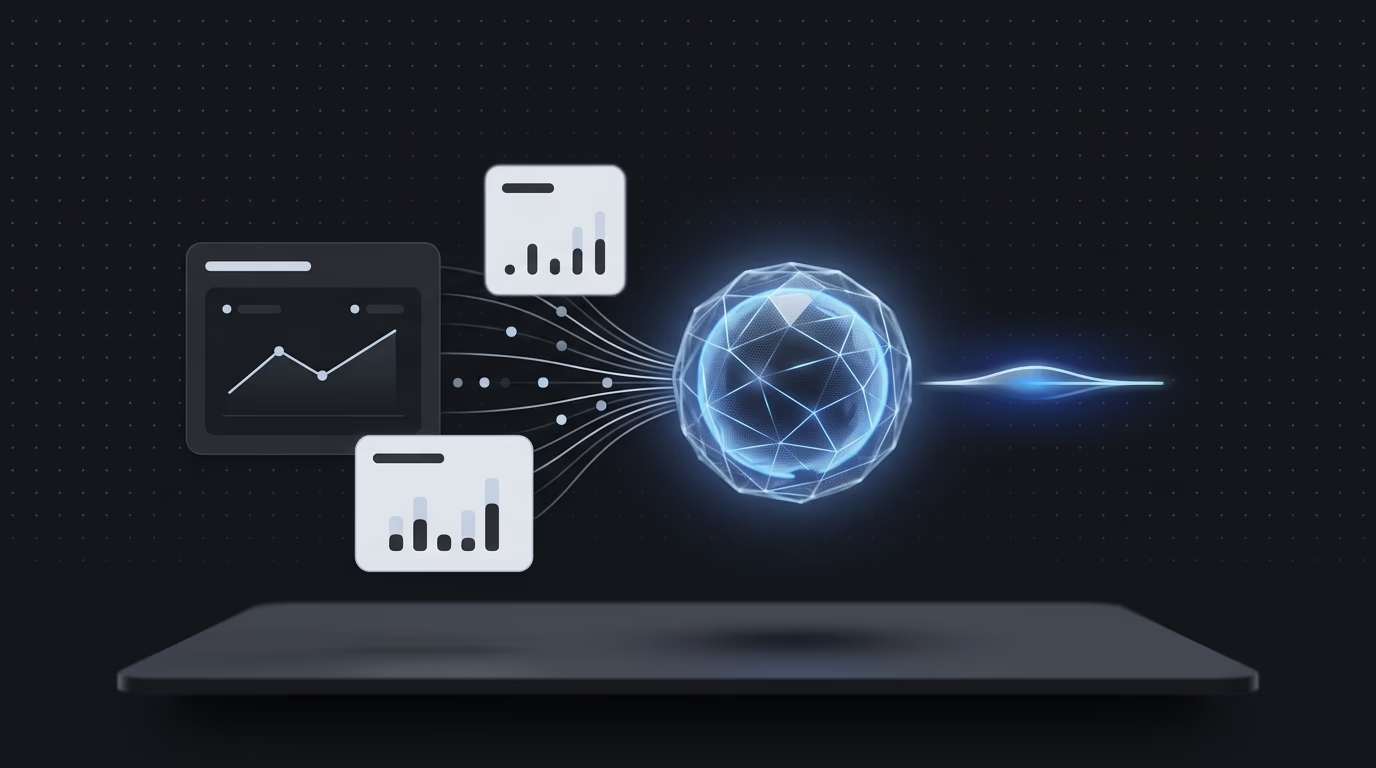
Because AI is already becoming a more efficient reporting layer.
Not necessarily better at strategy.
But dramatically better at compression.
An AI system can already:
- summarize creative fatigue patterns,
- identify abnormal CPM spikes,
- detect CPA instability,
- compare audience deterioration rates,
- flag attribution inconsistencies,
- prioritize scaling opportunities,
- and generate optimization summaries.
Faster than most weekly reporting reviews.
That changes the economics of reporting software.
Why pay for deeper visualization when AI can interpret exported Meta data directly?
The likely winners will not be the companies with the most attractive dashboards.
The winners will be the companies connecting reporting to operational throughput.
That means integrations with:
- upload systems,
- creative pipelines,
- testing infrastructure,
- workflow automation,
- launch systems,
- and AI interpretation layers.
This also explains why the Facebook ads uploader category is becoming strategically important.
A Facebook ads uploader directly affects iteration speed.
A prettier dashboard usually does not.
Meta's own automation roadmap reinforces the same direction.
Advantage+ campaign systems increasingly automate campaign structure decisions while shifting advertiser attention toward creative quality and testing volume.
According to WebFX Meta advertising benchmarks, the average Facebook ads cost per click across industries often ranges between $0.26 and $0.50 depending on vertical and optimization conditions.
If your reporting stack does not accelerate testing velocity, it eventually becomes operational overhead.
The Strongest Counterargument Still Has Limits
To be fair, dashboards still matter.
Large agencies need client-facing reports.
Executives need summarized visibility.
Enterprise organizations require centralized oversight.
None of that is wrong.
The mistake is confusing reporting infrastructure with growth infrastructure.
A reporting layer is necessary.
It is simply no longer the primary competitive advantage.
Facebook ads performance increasingly behaves like an execution-speed game.
Creative fatigue arrives faster because short-form video competition compresses attention cycles aggressively.
Meta has repeatedly encouraged advertisers to increase creative variation volume because campaigns running multiple active creatives frequently outperform accounts relying on narrow creative rotation.
That means the teams winning today are often the teams capable of:
- generating more creative,
- testing faster,
- replacing fatigued ads earlier,
- and launching at operational scale.
Dashboards alone do not solve that.
Systems do.
You can see the same pattern across Meta Blueprint guidance, the Meta Marketing API ecosystem, and Advantage+ tooling.
Operational leverage increasingly wins.
For teams still relying on slow reporting cycles, articles like Why Most Facebook Ads Automation Tools Are Doing It Wrong (And How Instrumnt Does It Right) and Breaking the Creative Bottleneck: How One Growth Team Scaled Facebook Ads Throughput with AI show how workflow design matters more than dashboard customization.
The Future Belongs to Action Systems, Not Reporting Systems
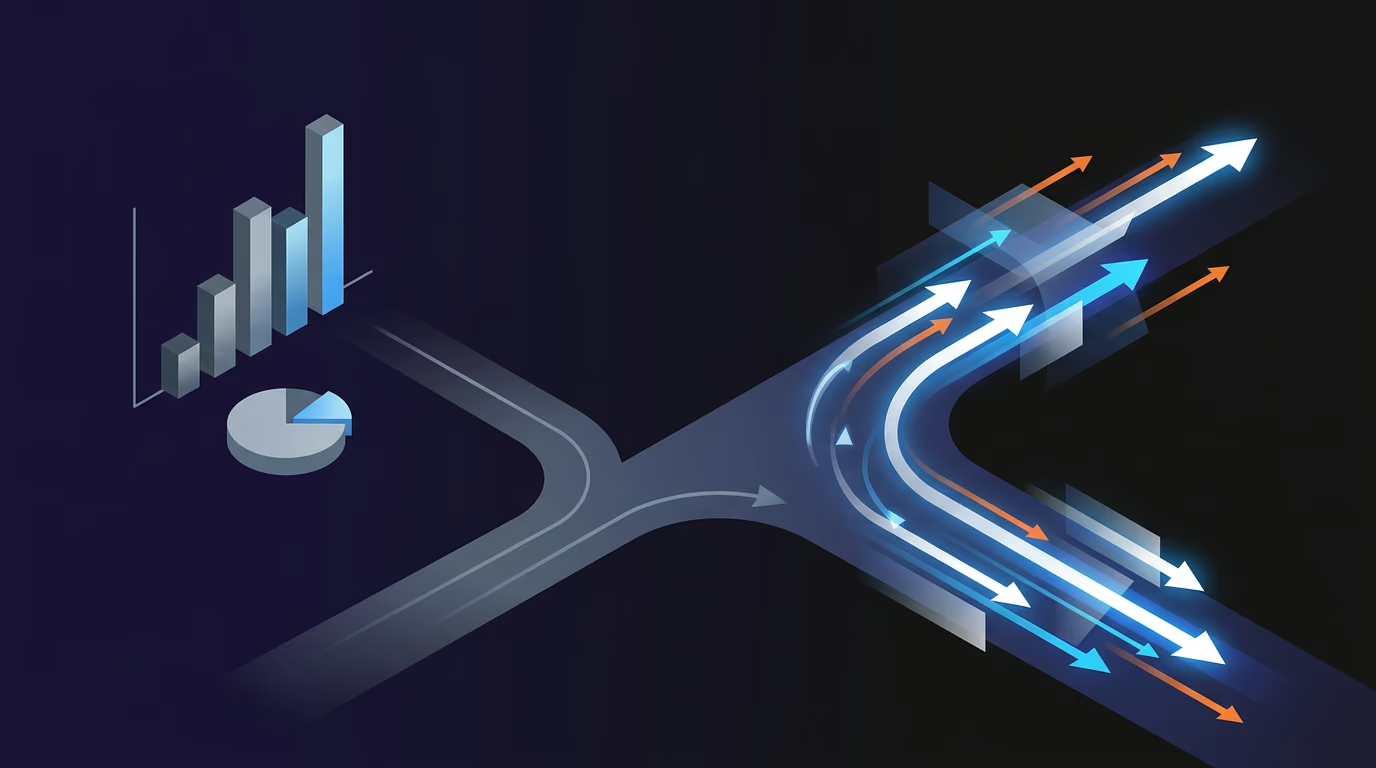
The next generation of Facebook ads reporting tools will probably not resemble traditional dashboards.
They will look more like operational command systems.
Systems that:
- detect performance shifts automatically,
- summarize risks instantly,
- prioritize actions,
- generate replacement creative directions,
- trigger launch workflows,
- and shorten iteration cycles.
That is where the market appears headed.
Not toward more KPI tiles.
Not toward prettier screenshots.
Not toward another analytics homepage filled with charts nobody acts on.
The smartest performance teams already understand this transition.
They care less about how reporting looks and more about how quickly the organization responds.
That is the metric many teams still ignore.
Decision velocity.
And right now, many Facebook ads reporting tools are slowing it down.
Common Questions About Facebook Ads Reporting Tools
What are the best Facebook Ads reporting tools for media buyers?
The answer depends heavily on operational goals.
Teams focused on visibility and executive reporting may prefer analytics-heavy platforms like Sotrender.
Cross-channel organizations may lean toward Hootsuite Ads.
Teams prioritizing automation and faster optimization workflows often evaluate Revealbot and systems connected directly to launch infrastructure.
The more important question is whether the platform reduces the time between insight and action.
Do Facebook Ads reporting dashboards actually improve campaign performance?
Dashboards improve visibility, but visibility alone rarely improves results.
Campaign performance usually improves when reporting systems shorten testing cycles, accelerate creative replacement, improve prioritization, and reduce operational lag.
A reporting tool becomes strategically valuable when it changes workflow behavior instead of simply displaying metrics.
How can AI automate Facebook Ads reporting and optimization workflows?
AI systems can summarize exported Meta data, identify anomalies, detect fatigue patterns, prioritize optimization opportunities, and generate action recommendations automatically.
Using workflows built around Claude Code, AI interpretation layers, and automated reporting pipelines, teams can dramatically reduce manual reporting review time while increasing optimization speed.
That is why AI-driven interpretation is becoming more strategically important than static dashboard customization.
For teams trying to rethink operational efficiency, 5 Tips for Media Buyers to Work Faster and Scale Smarter and Meta Ads Bulk Upload Workflow: A Step-by-Step Operations Guide provide practical examples of how faster execution compounds over time.
The future of Facebook ads reporting tools will not belong to the companies with the prettiest dashboards.
It will belong to the systems that reduce friction between insight and execution.
For more context, see WordStream's Facebook Ads benchmarks.
For more context, see WebFX Meta benchmarks.
For more context, see Ads Uploader.