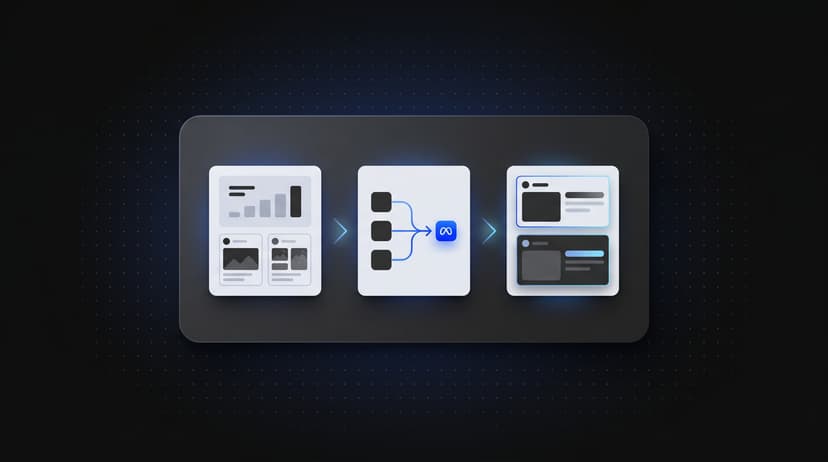
Introduction: Why Marketers Overestimate the Meta Ad Library
The meta ad library has become one of the most widely used resources for competitor research. It offers free access to active advertisements running across Meta properties and gives advertisers a quick way to monitor messaging, creative formats, and brand activity.
That accessibility creates an important misconception.
Many marketers assume visibility automatically leads to insight.
In reality, seeing advertisements is only a small part of understanding why campaigns succeed.
A marketer can spend hours browsing creatives, building swipe files, and collecting screenshots without learning much about what actually drives business outcomes. The meta ad library exposes creative outputs, but most performance variables remain hidden.
You cannot see profitability, conversion rates, testing frameworks, attribution quality, audience segmentation, retention performance, or account economics.
The meta ad library is useful. It is simply incomplete.
Advertisers who consistently outperform competitors rarely win because they discovered more ads. They win because they build better systems for identifying patterns, generating hypotheses, and testing ideas faster.
Beyond Ad Visibility: The Competitive Intelligence Illusion

The strongest argument in favor of the meta ad library is transparency.
Transparency matters, but transparency is not the same thing as competitive intelligence.
Imagine two marketers analyzing the same competitor.
The first downloads screenshots and copies headlines.
The second studies the offer structure, landing page experience, messaging consistency, creative refresh frequency, funnel design, and cross-channel positioning.
The second marketer is significantly closer to understanding performance.
This is one reason articles like The Facebook Ad Library Won’t Find Winners and FB Ads Library Won’t Show You Winners continue to resonate with experienced media buyers.
Creative assets represent only one visible layer of a much larger system.
A campaign may outperform competitors because of superior economics, stronger customer retention, more effective onboarding, better attribution infrastructure, or a more persuasive landing page.
The library shows the advertisement. It does not reveal the system supporting it.
As Facebook ads become increasingly automated, understanding hidden operational factors becomes more valuable than analyzing isolated creative assets.
The Invisible Variables Behind Every Search
Every search performed inside the meta ad library suffers from the same limitation.
You see inputs without outcomes.
In most cases, you cannot determine:
- Which ads receive the highest budgets
- Which creatives are active experiments
- Which audiences see specific messages
- Which landing pages generate the most conversions
- Which campaign structures drive profitability
- Which assets belong to automated optimization systems
- Which creatives survive because they work versus because they are new
These hidden variables often matter more than the visible advertisement itself.
According to Meta's Q1 2025 earnings report, Family Daily Active People reached approximately 3.43 billion users across Meta platforms. Source: Meta Q1 2025 Earnings Report. That scale highlights how much personalization, audience matching, and optimization occur behind the scenes beyond what advertisers can observe in a public archive.
According to DataReportal's 2025 Global Digital Overview, average daily social media usage remains above two hours per day globally. Source: DataReportal Global Digital Overview 2025. Consumers move across multiple platforms, devices, and touchpoints before making purchase decisions.
These statistics reveal an important reality.
Marketers observing a public ad archive are seeing only a small fraction of a much larger performance environment.
Because of that complexity, a visible ad should never automatically be interpreted as a winning ad.
In many cases, the landing page provides more valuable intelligence than the ad itself. That is why Why Competitor Landing Pages Are More Valuable Than Ads (And How to Use Them) often delivers a better research framework than simply browsing creative archives for another hour.
Where Alternative Platforms Fit Into the Research Stack
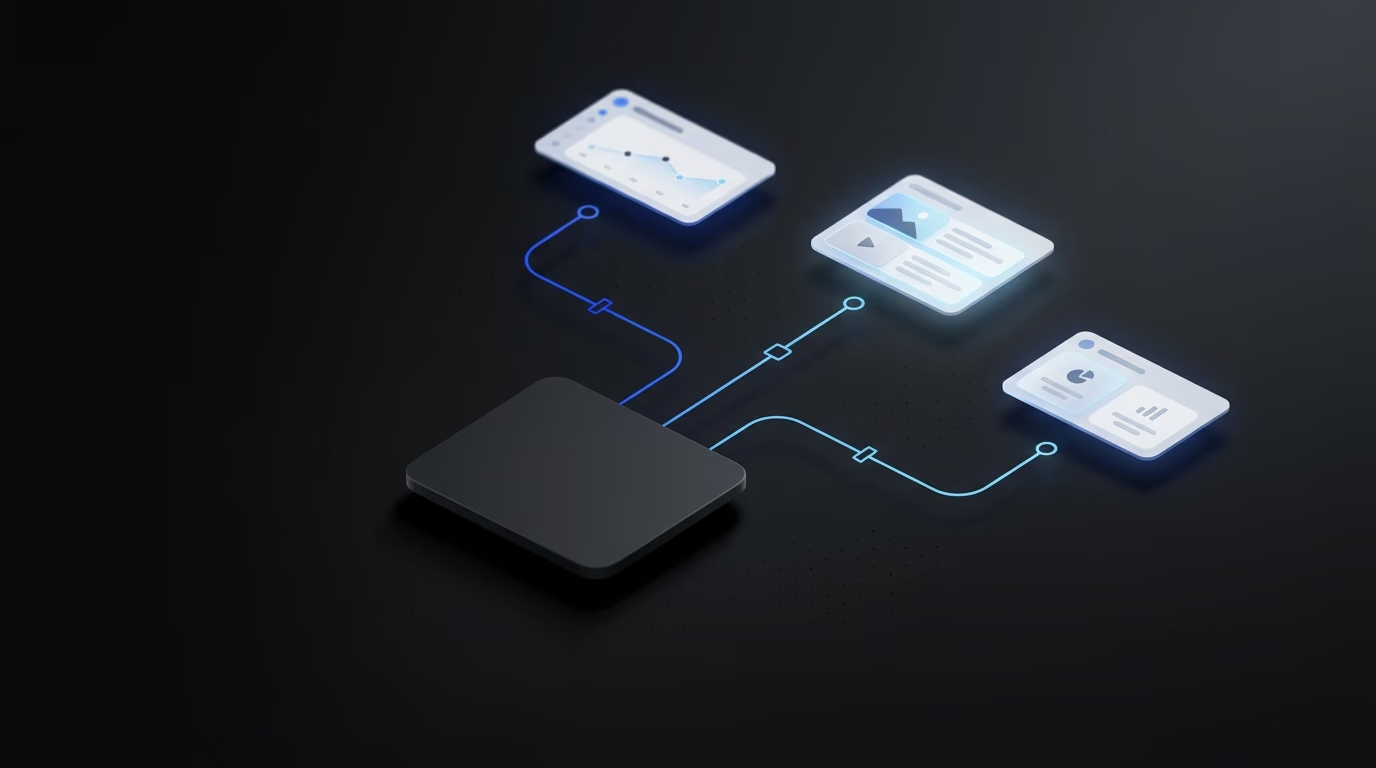
Looking at competing platforms helps clarify where the meta ad library fits within a broader research workflow.
Hootsuite Ads
Hootsuite Ads focuses heavily on campaign management workflows and operational coordination.
Its primary value comes from helping teams manage advertising activity across multiple channels.
Many organizations do not struggle because they lack access to competitor creatives. They struggle because campaign execution becomes fragmented as advertising volume increases.
Smartly.io
Smartly.io reflects the industry's shift toward automation, creative iteration, and AI-assisted optimization.
The platform emphasizes testing velocity, creative production, operational efficiency, and cross-platform execution.
Rather than focusing exclusively on what competitors are running, teams often concentrate on how quickly they can discover opportunities and launch experiments.
That changes the question from "What ad are they using?" to "What process allows them to learn faster?"
TikTok Ads Manager
TikTok Ads Manager offers a different perspective.
Its greatest value frequently comes from identifying emerging consumer behaviors and short-form video trends.
Many creative patterns appear on TikTok before spreading into Meta ecosystems.
Consumers do not experience marketing through a single platform.
Competitive research should not be restricted to one platform either.
Turning Ad Archives Into Pattern Intelligence With AI

This is where AI fundamentally changes competitor research.
Most marketers use the meta ad library as a database.
AI transforms it into a pattern-recognition system.
Instead of asking simple observational questions, marketers can investigate deeper signals:
- Which offers appear repeatedly across a category?
- Which emotional triggers survive multiple creative refreshes?
- Which visual frameworks show up across competing brands?
- Which messaging themes remain consistent over time?
- Which value propositions dominate a specific market segment?
Humans excel at recognizing individual examples.
AI excels at identifying repetition across large collections of data.
Repetition often contains the strongest competitive signals.
Using Claude Code, teams can organize creative captures, landing pages, offer structures, positioning frameworks, and research notes into searchable knowledge systems.
The result is not simply a larger swipe file.
The result is a structured learning system.
This approach aligns closely with Automated Facebook Ads Learning Loops with Instrumnt and Claude Code.
The competitive advantage increasingly belongs to organizations that convert observations into repeatable learning processes.
Building a Claude Code Research Workflow
A practical workflow starts by treating the meta ad library as one source of information rather than the final answer.
Step one is collecting relevant creative examples.
Step two is documenting the associated landing pages.
Step three is recording recurring pricing models, guarantees, offers, and positioning themes.
Step four is feeding those observations into Claude Code for categorization and pattern extraction.
Step five is transforming those findings into testable hypotheses.
For example, if multiple competitors repeatedly emphasize convenience, speed, and reduced friction, that pattern may justify testing.
If only one competitor consistently promotes a unique positioning angle, that may deserve investigation as well.
The objective is not copying competitors.
The objective is understanding market behavior.
Tools such as Instrumnt and a Facebook ads uploader can help operationalize those insights after opportunities have been identified.
Teams that combine structured research, AI analysis, and disciplined experimentation typically learn faster than teams relying entirely on manual browsing.
Organizations facing creative throughput challenges may also benefit from Scaling Facebook Ad Testing: Why AI Is the Key to Breaking Through Your Creative Bottleneck and Automate Creative Testing for Meta Ads.
What High-Performance Advertisers Analyze Instead
If a marketer has only one hour available for competitor research, most of that time should not be spent scrolling through ad archives.
Several areas deserve greater attention.
First, analyze offer architecture. Strong offers frequently outperform average creative.
Second, study landing page systems. The post-click experience often explains performance better than the advertisement itself.
Third, measure testing velocity. Brands that continuously launch new concepts usually outperform brands searching for a single perfect creative.
Fourth, evaluate cross-platform consistency. When the same message appears across Meta, TikTok, email, and landing pages, it deserves attention.
Fifth, examine durability. An angle that survives for months often provides stronger insight than a creative launched yesterday.
These signals reveal behavior.
Behavior is generally more useful than visibility.
Advertisers should also evaluate attribution systems, customer journeys, retention indicators, and creative production processes. These elements influence outcomes yet remain invisible inside the library.
For deeper thinking on workflow efficiency, see 5 Tips for Media Buyers to Work Faster and Scale Smarter.
Conclusion: Treat the Library as an Input, Not the Strategy
The meta ad library remains one of the most valuable transparency resources available to advertisers.
It helps marketers monitor creative activity, identify messaging trends, and maintain awareness of competitor behavior.
However, many marketers treat it as a shortcut to competitive advantage.
Competitive advantage does not come from collecting more screenshots.
It comes from interpreting information more effectively.
The strongest Facebook ads teams combine creative analysis, landing-page research, audience understanding, AI-powered pattern recognition, structured experimentation, Claude Code workflows, and operational systems supported by Instrumnt.
The meta ad library contributes to that process.
It simply should not sit at the center of it.
Organizations that build learning systems around AI, disciplined testing, and structured research will generally gain more value than teams focused primarily on expanding their swipe files.
The future belongs to marketers who learn faster, not marketers who scroll longer.
Frequently Asked Questions
Is the Meta Ad Library useful for competitor research?
Yes. The meta ad library is useful for discovering active creatives, monitoring messaging trends, and developing market awareness. Its primary limitation is that it provides little visibility into outcomes, audience performance, attribution quality, or profitability.
What are the limitations of relying solely on the Meta Ad Library?
The platform does not reveal budgets, conversion rates, attribution quality, audience targeting details, landing-page effectiveness, testing velocity, or campaign economics. Those hidden variables often determine actual performance.
How can AI tools like Claude Code enhance ad analysis beyond the library?
Claude Code can organize large collections of advertisements, landing pages, offers, and research notes into structured datasets. AI helps identify recurring themes, messaging patterns, competitive signals, and market opportunities that are difficult to detect through manual review alone.
What role does a Facebook ads uploader play in competitive research?
A Facebook ads uploader does not generate insights on its own. Its value comes after research is completed, helping teams operationalize testing, launch new creative variations faster, and scale experimentation without excessive manual work.
Why do platforms like Hootsuite Ads, Smartly.io, and TikTok Ads Manager matter?
Each platform provides a different perspective. Hootsuite Ads emphasizes workflow management, Smartly.io focuses on automation and creative optimization, and TikTok Ads Manager helps identify emerging short-form video trends. Together, they reinforce the idea that competitive intelligence extends beyond a single ad archive.
For more context, see Meta for Business Help Center.
For more context, see AdEspresso.
For more context, see WebFX Meta benchmarks.
Common questions about meta ad library
What is the best way to meta ad library?
The best approach depends on your team size and launch volume. Start by structuring your workflow around batch preparation and bulk uploading, then layer in automation for the parts that don't need human judgment.
How many ad variations should I test?
Advertisers running 3 or more variations per audience consistently see lower CPAs. Aim for at least 3-5 variations per ad set as a starting point, and increase from there as your workflow allows.
Does automation replace the need for creative strategy?
No. Automation handles the operational side, like launching, duplicating, and naming ads at scale. Creative strategy, offer positioning, and audience selection still require human judgment. The goal is to free up more time for that strategic work.