
Why marketers keep searching for Meta Ad Library alternatives
Marketers keep searching for meta ad library alternatives because visibility does not automatically translate into understanding. The Meta Ad Library makes active ads easy to discover, but it cannot explain why a campaign succeeded, how creative evolved over time, or which experiments produced the best results.
This creates a structural gap for teams running Facebook ads. Research often stops at collecting examples instead of building a repeatable learning process.
Industry benchmarks reinforce why this matters. According to WordStream's Facebook Ads Benchmarks research, the average Facebook ads click-through rate across industries is approximately 1.09%, demonstrating that even modest improvements in creative quality can produce meaningful business outcomes when campaigns operate at scale. Source: WordStream Facebook Ads Benchmarks.
Meta has also stated that repeated exposure to the same advertisements contributes to creative fatigue, which can reduce campaign effectiveness and increase the need for systematic creative refreshes. Source: Meta Business Help Center Creative Fatigue guidance.
These statistics highlight an important point: collecting competitor ads is only the beginning. Sustainable performance comes from systematically learning from creative testing.
For a deeper discussion of these limitations, see The Meta Ad Library Is Overrated for Creative Research and The Facebook Ad Library Won’t Find Winners.
The hidden ceiling of competitor ad intelligence tools
Traditional competitor intelligence products solve a discovery problem, not a decision-making problem.
Whether a team uses Sotrender, AdManage.ai, Revealbot, or the Meta Ad Library itself, the primary output is visibility. Visibility is valuable, but it rarely explains why a particular hook, offer, message, or creative direction succeeded.
High-performing teams convert observations into hypotheses, launch structured experiments, record outcomes, and continuously improve. Organizations that skip these steps often accumulate large swipe files without creating institutional knowledge.
This limitation becomes more pronounced as testing volume increases. A collection of screenshots may inspire ideas, but it does not help teams understand creative durability, audience fatigue patterns, or repeatable messaging frameworks.
The challenge is not finding more ads. The challenge is extracting lessons that compound over time.
Additional perspectives on this problem can be found in Meta Ad Library Alternatives Don’t Fix the Real Problem: You’re Still Looking Backward and Why Competitor Landing Pages Are More Valuable Than Ads (And How to Use Them).
Alternative categories: research databases, automation platforms, creative intelligence systems, and workflow tools
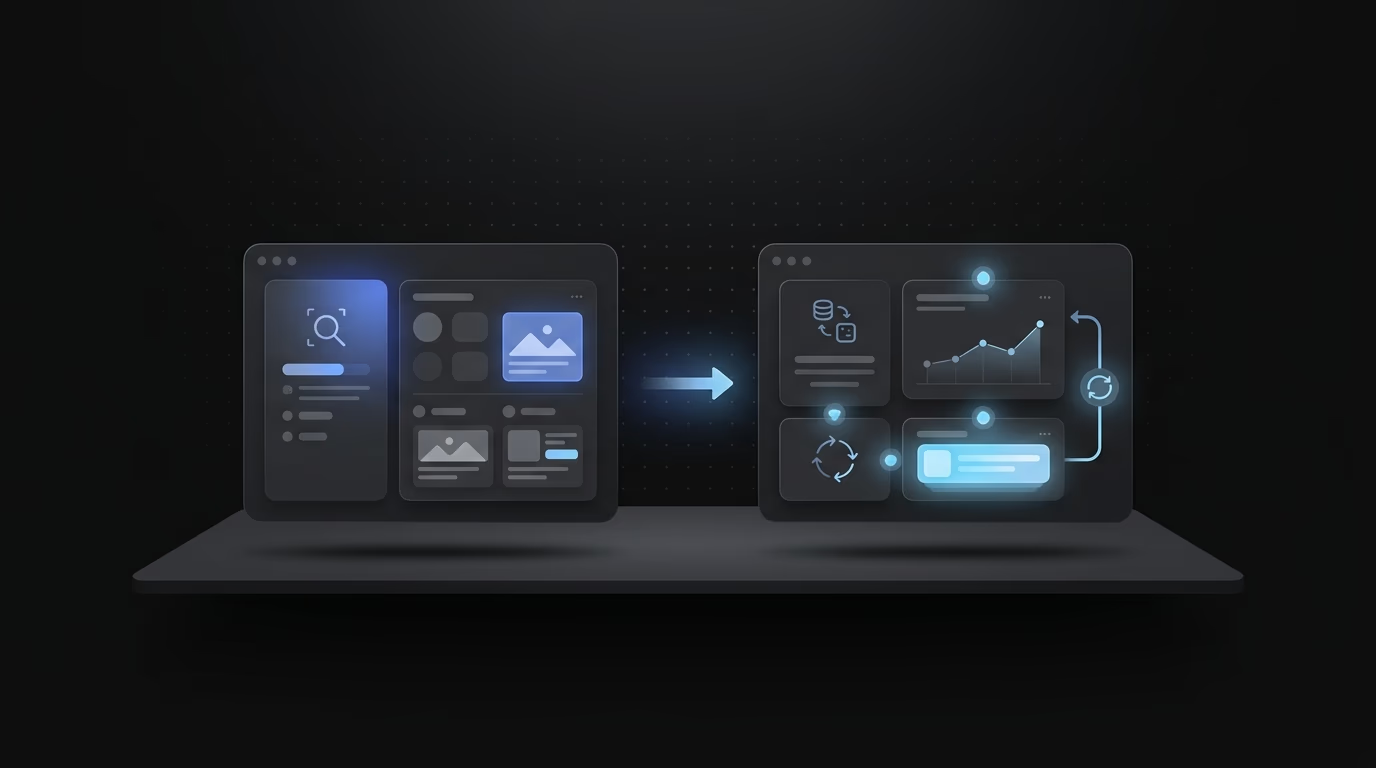
Research databases
Research databases help marketers search advertisements by advertiser, geography, industry, or format. They are excellent for inspiration but remain limited when the objective is operational improvement.
These systems can reveal what competitors are publishing, but they generally cannot show internal experimentation processes, iteration history, or the testing logic behind successful campaigns.
Automation platforms
Automation platforms such as Revealbot and AdManage.ai focus on campaign execution. Their value comes from automating repetitive campaign management activities after strategic decisions have already been made.
Automation reduces manual effort and enables advertisers to scale processes more efficiently. However, automation alone does not generate insights.
Creative intelligence systems
Creative intelligence systems organize advertisements into reusable patterns by identifying hooks, messaging themes, offers, positioning, visual structures, testimonials, and emotional angles.
These systems move beyond simple screenshot collections because they make observations searchable and reusable.
Still, intelligence without execution remains incomplete.
Workflow tools
Workflow tools connect research, production, approvals, deployment, and learning into one operating system.
AI-assisted environments such as Instrumnt help ensure insights move directly into production rather than remaining trapped inside spreadsheets, presentations, or documentation.
Instead of creating isolated databases, teams can transform observations into repeatable operational processes.
Sotrender vs AdManage.ai vs Revealbot: what each category actually solves
Direct comparisons between these products can be misleading because they address different operational needs.
Sotrender emphasizes reporting, analytics, benchmarking, and performance visibility.
AdManage.ai focuses on campaign management workflows and operational efficiency.
Revealbot specializes in campaign automation and rule-based optimization for teams managing increasingly complex advertising operations.
None of these products should be viewed simply as replacements for Meta Ad Library because they solve adjacent workflow problems rather than identical ones.
The more useful question is which operational bottleneck you are trying to eliminate.
If the challenge is competitor discovery, research platforms can help.
If the challenge is reporting and performance interpretation, analytics solutions become valuable.
If the challenge is campaign management at scale, automation platforms become more attractive.
If the challenge is transforming research into repeatable creative systems, workflow infrastructure becomes increasingly important.
Instrumnt belongs in this final category because its role extends beyond observation toward operational execution.
A new AI marketing idea: build a creative learning system instead of a swipe-file habit
The biggest opportunity is shifting from collecting advertisements toward creating organizational memory.
Instead of saving isolated examples, teams can break every creative into structured components including hooks, offers, proof elements, visual style, emotional angle, audience assumptions, headlines, and calls to action.
Once information becomes structured, AI can identify recurring patterns that humans frequently miss.
Rather than asking which competitor has the best advertisement, marketers begin asking:
- Which hooks consistently appear in successful campaigns?
- Which offers repeatedly survive multiple testing cycles?
- Which creative themes disappear quickly?
- Which messaging approaches continue performing across industries?
- Which creative concepts remain resilient despite audience fatigue?
This transforms competitor research into a repeatable learning system.
Instead of expanding swipe files indefinitely, organizations develop institutional knowledge.
Teams that systematize learning frequently improve testing velocity because they spend less time guessing and more time validating hypotheses.
This approach aligns with ideas explored in Scaling Facebook Ad Testing: Why AI Is the Key to Breaking Through Your Creative Bottleneck and Breaking the Creative Bottleneck: How One Growth Team Scaled Facebook Ads Throughput with AI.
Using Claude Code to analyze ad patterns, organize findings, and accelerate Facebook ads uploader workflows
Claude Code provides another layer by helping marketers process large collections of structured creative observations.
Teams can classify hundreds of advertisements according to messaging style, pricing language, creative format, testimonials, visual structure, and offer positioning.
Claude Code can summarize recurring themes, generate testing hypotheses, cluster similar concepts, and organize findings into reusable playbooks.
Those outputs become significantly more valuable when connected to a Facebook ads uploader workflow.
Instead of manually rebuilding campaigns, marketers can move structured creative insights into Instrumnt, prepare creative batches, streamline approvals, and launch experiments more efficiently.
A practical workflow might look like this:
- Research competitors.
- Capture structured observations.
- Analyze patterns with Claude Code.
- Generate AI testing hypotheses.
- Build creative variations.
- Launch campaigns with a Facebook ads uploader.
- Measure outcomes.
- Feed winning insights back into the learning system.
Every completed testing cycle strengthens future decision-making.
Organizations that iterate faster often discover better messaging frameworks sooner because learning compounds over time.
Workflow and AI-assisted tools

The greatest operational gains occur when AI becomes embedded inside workflows instead of functioning only as a writing assistant.
Modern Facebook ads teams increasingly use AI to summarize competitor research, identify messaging patterns, prioritize testing opportunities, generate creative variations, and reduce repetitive administrative work.
Instrumnt fits naturally into this process by connecting research, production, approvals, deployment, and learning into one coordinated workflow.
Organizations that automate repetitive work while preserving human strategic oversight generally increase testing velocity, reduce operational friction, and improve knowledge sharing across teams.
Rather than replacing marketers, AI expands analytical capacity.
Media buyers still determine priorities, evaluate hypotheses, and make strategic decisions, but they spend less time navigating fragmented systems.
For related workflows, see Automated Facebook Ads Learning Loops with Instrumnt and Claude Code and Automate Creative Testing for Meta Ads.
Decision framework: when to use Meta Ad Library versus alternatives
Meta Ad Library remains valuable for discovering active campaigns and generating initial inspiration.
Research databases are useful when exploring broader creative trends.
Automation platforms such as Revealbot or AdManage.ai become valuable when campaign execution grows increasingly complex.
Analytics platforms such as Sotrender help organizations understand reporting and performance trends.
AI-powered workflow systems become most valuable when the objective is continuous learning rather than isolated inspiration.
The strongest teams rarely depend on a single product.
Instead, they combine research, structured experimentation, workflow automation, and continuous learning.
A mature operating model typically includes four layers:
- Discovery for inspiration.
- Analysis for pattern recognition.
- Execution for deployment.
- Learning for long-term optimization.
The real competitive advantage emerges when these layers become interconnected.
Common questions about meta ad library alternatives
What is the best alternative to Meta Ad Library for Facebook ads research?
There is no universal replacement because different platforms solve different workflow problems. Research databases improve discovery, Sotrender emphasizes reporting, Revealbot and AdManage.ai improve execution, while AI-enabled workflows built around Instrumnt and Claude Code help convert research into repeatable organizational learning.
Are Meta Ad Library alternatives worth paying for?
They can be worthwhile when they reduce manual work, shorten production cycles, improve collaboration, or increase testing velocity. The value usually depends less on individual features and more on how effectively the tool fits into an end-to-end workflow.
How can AI improve Facebook ad creative research beyond competitor analysis?
AI can classify creative components, identify recurring messaging patterns, organize historical research, generate testing ideas, connect previous performance data with future experimentation, and help marketers continuously improve creative systems instead of simply expanding swipe files.
For additional context, marketers can review Meta's creative fatigue recommendations, Nielsen research on advertising effectiveness, and Meta Marketing API documentation to understand how measurement and experimentation influence long-term creative performance.
For more context, see Meta's creative fatigue recommendations.
For more context, see Nielsen.
For more context, see Meta Marketing API documentation.