Meta ad library alternatives have multiplied rapidly, but most of them still solve only a surface-level problem. They make it easier to browse competitor ads, yet they do very little to explain why those ads exist, how they evolve, or what strategic decisions produced them.
This gap matters more than ever. Meta’s advertising ecosystem continues to scale at enormous speed. Meta reports that over 3.4 billion people use at least one of its family of apps daily (Source: Meta Investor Relations, 2025). At the same time, Nielsen’s marketing effectiveness research consistently shows that creative quality is one of the strongest drivers of campaign performance, often explaining a significant portion of sales lift across campaigns (Source: Nielsen Marketing Effectiveness Research, 2024). In parallel, eMarketer estimates that digital advertising now accounts for over 70% of total ad spend in many developed markets (Source: eMarketer Digital Ad Spending Report, 2025). Together, these signals explain why surface-level competitor browsing is no longer enough. The real advantage comes from interpretation speed, not collection volume.
For Facebook ads teams, the bottleneck is no longer finding examples. The bottleneck is turning thousands of visible ads into structured, actionable insight before competitors iterate again.
Why Meta Ad Library feels useful but fails as strategy
Meta Ad Library remains one of the most valuable transparency tools in the ecosystem. It allows marketers to inspect active and historical creatives, review messaging trends, and observe how competitors evolve their Facebook ads over time.
But what it shows is only a thin layer of reality.
It does not reveal budget allocation, targeting logic, funnel design, landing page conversion performance, or testing methodology. It also cannot explain why one variation continues to run while another disappears within days.
This creates a false sense of understanding. Visibility is not the same as intelligence.
Most Meta ad library alternatives improve filtering, tagging, or historical browsing, but they still depend on the same public dataset. Even when using advanced tools like Paragone, Sotrender, and AdManage.ai, the core limitation remains unchanged: you are still observing ads, not interpreting systems.
That is why modern media buyers increasingly combine research tools with AI interpretation layers instead of relying on dashboards alone.
For a deeper breakdown of these limitations, see The Facebook Ad Library Won’t Find Winners.
From swipe files to intelligence systems: introducing AI creative analysis

Traditional swipe files are static collections of inspiration. They are useful for reference, but they do not scale as complexity increases.
AI systems change the structure of analysis entirely.
Instead of manually sorting ads into folders, AI can group Facebook ads by intent, messaging structure, emotional hook, creative format, and funnel stage. This is where tools like Claude Code become especially powerful, because they can automate classification, tagging, clustering, and summarization of large creative datasets.
This shifts the workflow from browsing to reasoning.
With AI, media buyers stop asking “what ads are running?” and start asking:
- Which messaging angles consistently survive testing?
- Which hooks appear across multiple competitors?
- Which offers are becoming saturated in the market?
- Which creative patterns disappear quickly after launch?
These insights are not just descriptive. They generate hypotheses that directly feed into new Facebook ads tests.
Platforms like Instrumnt extend this further by connecting structured insights directly into production workflows, reducing friction between analysis and execution.
Why most alternatives are still wrong
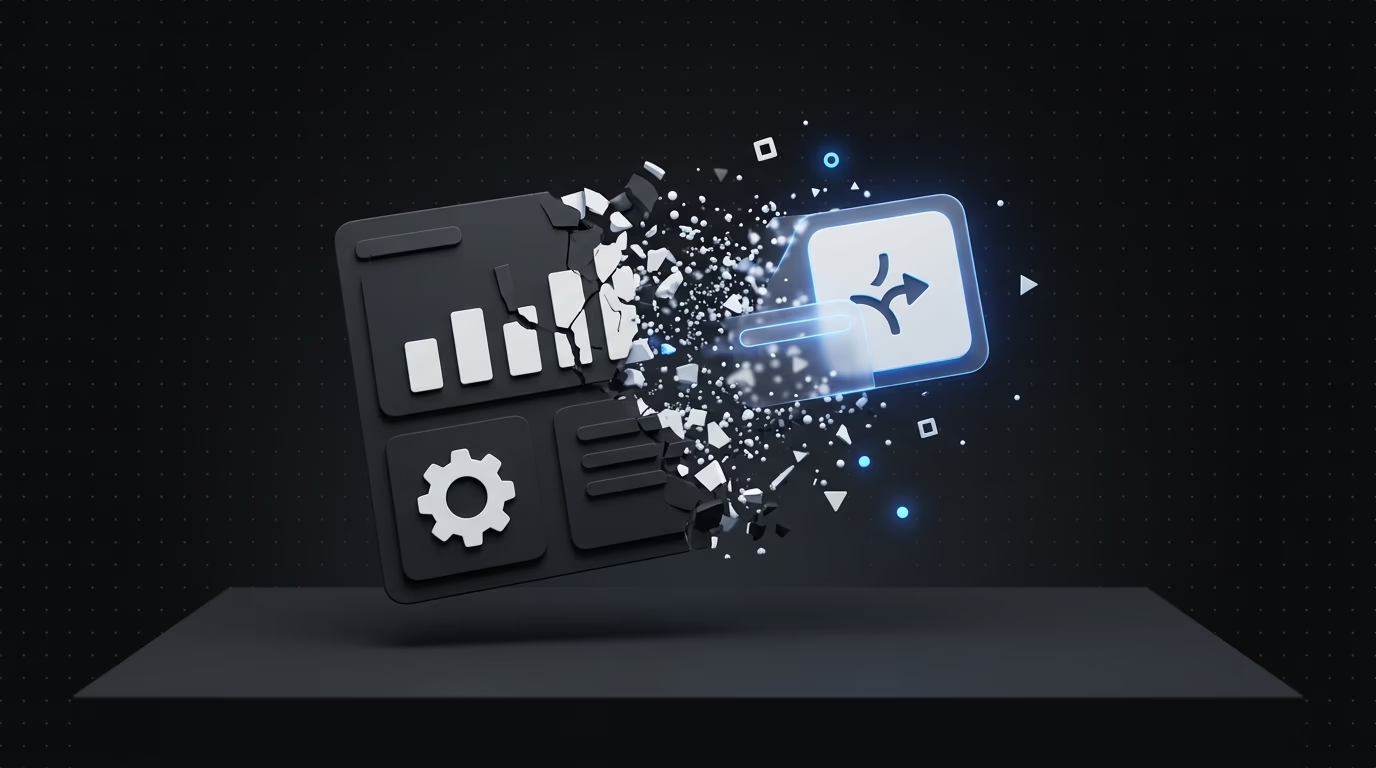
The competitive landscape for Meta ad library alternatives includes platforms such as Paragone, Sotrender, and AdManage.ai.
Paragone focuses on benchmarking and creative visibility.
Sotrender emphasizes analytics and reporting.
AdManage.ai improves campaign operations and management efficiency.
Each tool solves a real operational problem, but none of them fundamentally solve interpretation.
The missing layer is reasoning.
Even with the best dashboards, teams still struggle to extract repeatable creative patterns from large volumes of Facebook ads data. This is where AI-driven analysis becomes essential. Instead of replacing existing tools, AI complements them by transforming raw observations into structured decision-making frameworks.
In practice, teams increasingly combine Paragone-style visibility, Sotrender-style reporting, AdManage.ai operational workflows, and AI systems powered by Claude Code to build full-cycle intelligence pipelines.
The shift: from observation to prediction systems

The next generation of Meta ad library alternatives is not about finding more ads. It is about predicting which creative directions are worth testing.
A modern workflow looks like this:
- Collect competitor Facebook ads from Meta Ad Library.
- Normalize creatives into structured datasets.
- Use Claude Code to classify messaging, hooks, formats, and patterns.
- Cluster similar creative concepts using AI.
- Convert clusters into testing hypotheses.
- Launch experiments through a Facebook ads uploader workflow.
- Feed performance data back into the system for continuous learning.
This turns competitor research into a feedback loop rather than a static activity.
Instead of producing swipe files, teams produce iterative learning systems that improve every campaign cycle.
The hidden limitation: visibility versus understanding
Every advertiser can access the same public ads, but very few can interpret the system behind them.
Meta Ad Library does not explain:
- Why certain ads scale while others fail
- How spend distribution affects perceived success
- Whether landing page optimization is driving conversion differences
- Whether the algorithm is favoring specific creative formats
- Whether campaigns are primarily testing audiences, offers, or messaging
This is where competitive advantage emerges: not from data access, but from interpretation speed.
For additional context on how landing pages influence ad performance, see Why Competitor Landing Pages Are More Valuable Than Ads (And How to Use Them).
Building a modern competitor research workflow
A modern Facebook ads intelligence system is not a single tool. It is a stack.
Meta Ad Library becomes the discovery layer.
AI becomes the interpretation layer.
Claude Code handles automation of structure extraction and pattern recognition.
Instrumnt connects insights to execution workflows.
A Facebook ads uploader enables fast deployment of new tests without manual friction.
Together, these systems reduce the time between observation, insight, execution, and learning. Over time, this compounding speed becomes a competitive moat.
Comparing Meta Ad Library alternatives
When evaluating Meta ad library alternatives, feature lists are misleading.
Paragone excels at creative benchmarking but remains primarily descriptive.
Sotrender provides strong reporting capabilities but is oriented toward retrospective analysis.
AdManage.ai improves execution efficiency but does not deeply analyze creative strategy.
All three tools are valuable, but none replace the need for AI-driven interpretation of Facebook ads.
The strongest teams do not choose between tools. They combine them into systems that integrate visibility, analytics, execution, and AI-based reasoning.
From swipe files to systems thinking
Swipe files used to be the foundation of creative strategy.
Teams would collect Facebook ads examples and hope inspiration would translate into performance.
That model no longer scales.
Modern teams build structured learning systems instead.
They identify repeatable creative frameworks, test them at scale, and continuously refine future Facebook ads based on performance feedback.
AI accelerates this by reducing manual categorization and surfacing emerging patterns earlier than human analysis can.
The result is not automation of strategy, but acceleration of iteration.
Frequently asked questions
Is Meta Ad Library enough for competitor research in 2026?
No. It provides visibility into public Facebook ads, but it does not explain targeting decisions, creative testing logic, or conversion performance differences. Most advanced teams combine it with AI systems and structured analysis workflows.
What are the best tools to replace or complement Meta Ad Library?
There is no single replacement. Paragone, Sotrender, and AdManage.ai each solve different operational needs. The real advantage comes from combining these tools with AI interpretation layers that analyze patterns and generate testing hypotheses.
How can AI improve Facebook ad creative research and testing workflows?
AI can classify creatives, detect recurring messaging structures, cluster competitor behavior, and generate testable hypotheses. When paired with systems like Claude Code and platforms such as Instrumnt, it directly connects research to execution and learning loops.
Final thoughts
Meta Ad Library is not broken, and it is not obsolete. It remains one of the best public datasets for Facebook ads research.
The limitation is structural: visibility does not equal understanding.
Modern performance marketing depends on systems that convert observation into structured intelligence, and intelligence into faster experimentation cycles.
As competition increases, the advantage shifts away from collecting more swipe files and toward building systems that learn faster than competitors.
For more context, see Scaling Facebook Ad Testing: Why AI Is the Key to Breaking Through Your Creative Bottleneck.
For additional frameworks, see Automate Creative Testing for Meta Ads.
For more context, see Triple Whale's Facebook Ads benchmarks.
For more context, see AdEspresso.
For more context, see Meta Partner Directory.
Common questions about meta ad library alternatives
What is the best way to meta ad library alternatives?
The best approach depends on your team size and launch volume. Start by structuring your workflow around batch preparation and bulk uploading, then layer in automation for the parts that don't need human judgment.
How many ad variations should I test?
Advertisers running 3 or more variations per audience consistently see lower CPAs. Aim for at least 3-5 variations per ad set as a starting point, and increase from there as your workflow allows.
Does automation replace the need for creative strategy?
No. Automation handles the operational side, like launching, duplicating, and naming ads at scale. Creative strategy, offer positioning, and audience selection still require human judgment. The goal is to free up more time for that strategic work.