

Introduction: Why Small Business Facebook Ads Fail (Execution Speed vs Budget)
Most small businesses assume their Facebook ads fail because of budget constraints. If you're spending $1,000 per month while competitors spend $50,000, it feels like you're outmatched.
But the data suggests something else is happening.
According to Nielsen research commissioned by Meta, creative quality drives 56% of a campaign’s sales lift, making it more impactful than targeting or reach. Meanwhile, WordStream reports the average Facebook ads CTR is 0.90% and CPC is $0.94 across industries (WordStream Facebook Ads Benchmarks). In addition, HubSpot reports that Facebook remains one of the top ROI-driving paid channels for marketers, especially for small and mid-sized businesses (HubSpot State of Marketing Report).
These numbers show that even small budgets can generate meaningful data and traffic.
The real constraint isn’t budget—it’s how quickly you can test and iterate.
This article breaks down how one small ecommerce brand turned $1,000 into a scalable Facebook ads system by fixing execution speed and building a repeatable workflow.
The Scenario: A Small Business With $1,000 and No Reliable Ad System
At 9:12 a.m. on Monday, the founder of a home storage brand stared at Ads Manager. Campaigns were live, but results were inconsistent.
Their situation was typical:
- Monthly ad budget: $1,000
- Product price range: $28–$54
- No dedicated media buyer
- Limited creative production
The account looked functional—but fragile:
- Two campaigns edited repeatedly
- Four creatives running past fatigue
- One broad audience, one interest stack, one retargeting set
- No naming conventions
- A backlog of unused creative ideas
They had completed Meta Blueprint lessons and read help documentation. But they lacked something more important: a system.
Running Facebook ads occasionally is not the same as running a testing engine. With only 2–3 ads launched per week, learning cycles were too slow.
For a deeper breakdown of this pattern, see Why Facebook Ads Fail for Small Businesses (It’s Not Budget — It’s Execution Speed).
The Hidden Constraint: Why Time and Creative Output Limit Performance
Nothing in the account was fundamentally broken. The issue was operational.
- Ads stayed live too long
- Changes happened reactively
- New ideas were delayed
Launching a single ad required:
- Writing copy
- Duplicating structures
- Uploading assets
- Rebuilding UTMs
- Renaming everything
- QA checks
Even a few variations could take hours.
This is where most Facebook ads for small business strategies fail—not in targeting or budget allocation, but in creative throughput.
Meta’s own guidance emphasizes multiple creative variations per ad set. Yet most teams can't produce enough ads to meet that requirement.
So the constraint becomes clear:
You don’t need more budget. You need more variations per unit of time.
Mini Example: Turning One Product Idea Into 12 Ads on a Small Budget
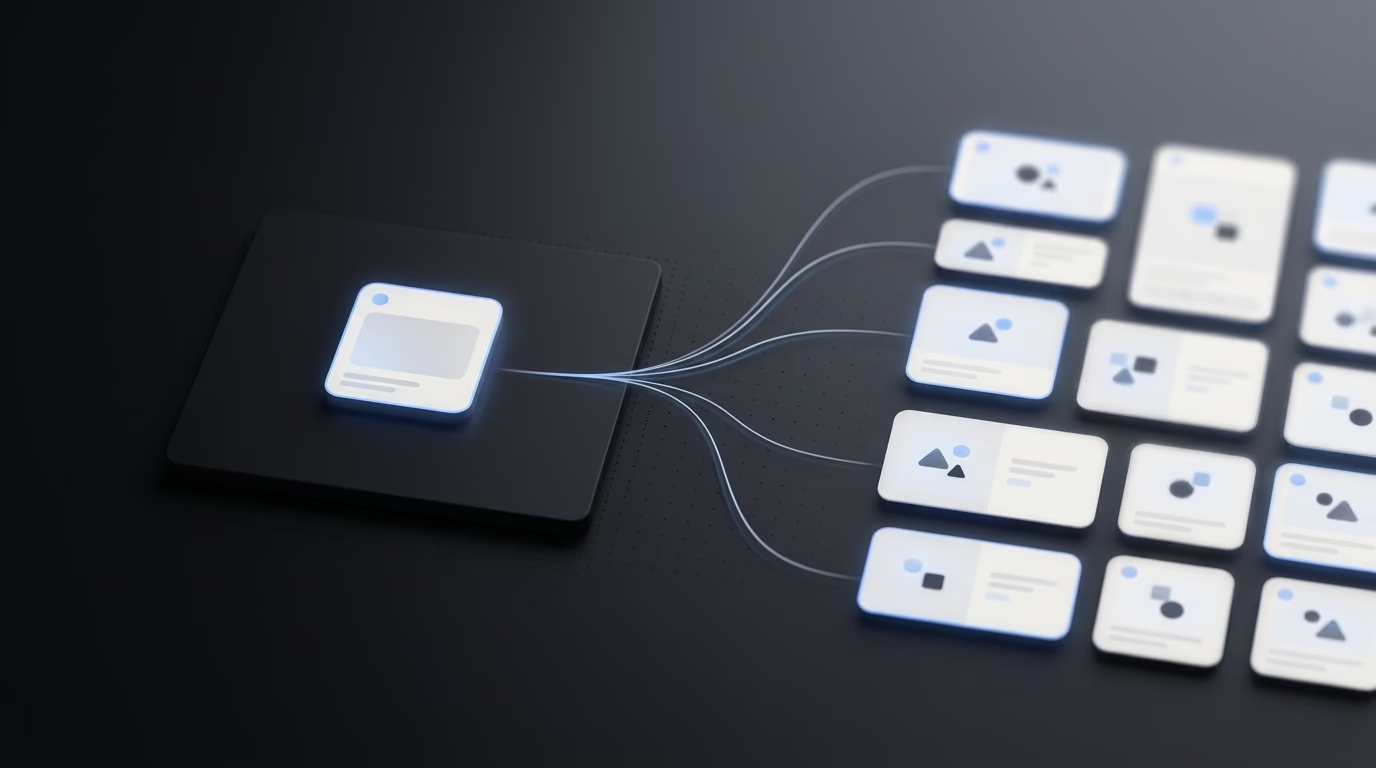
The team reframed their approach:
"How many ads can we generate from one idea before lunch?"
They picked one product: a modular kitchen drawer organizer.
Core Angle
- Problem: drawers get messy quickly
The 12 Variations
Hooks:
- The drawer you avoid opening
- The 10-minute reset
- Why organization never lasts
Visuals:
- Before/after static
- Handheld demo video
- Carousel breakdown
Copy angles:
- Time-saving
- Satisfaction / cleanliness
This produced:
- 3 hooks × 3 visuals × 2 copy frames = 18 combinations
- 12 were launched immediately
Instead of over-optimizing one ad, they increased testing surface area.
For a more structured version of this, see How to Build a Facebook Ads Bulk Testing System with Instrumnt and Claude Code.
Uploader Workflow: Using Instrumnt + Claude Code to Generate and Launch Variations
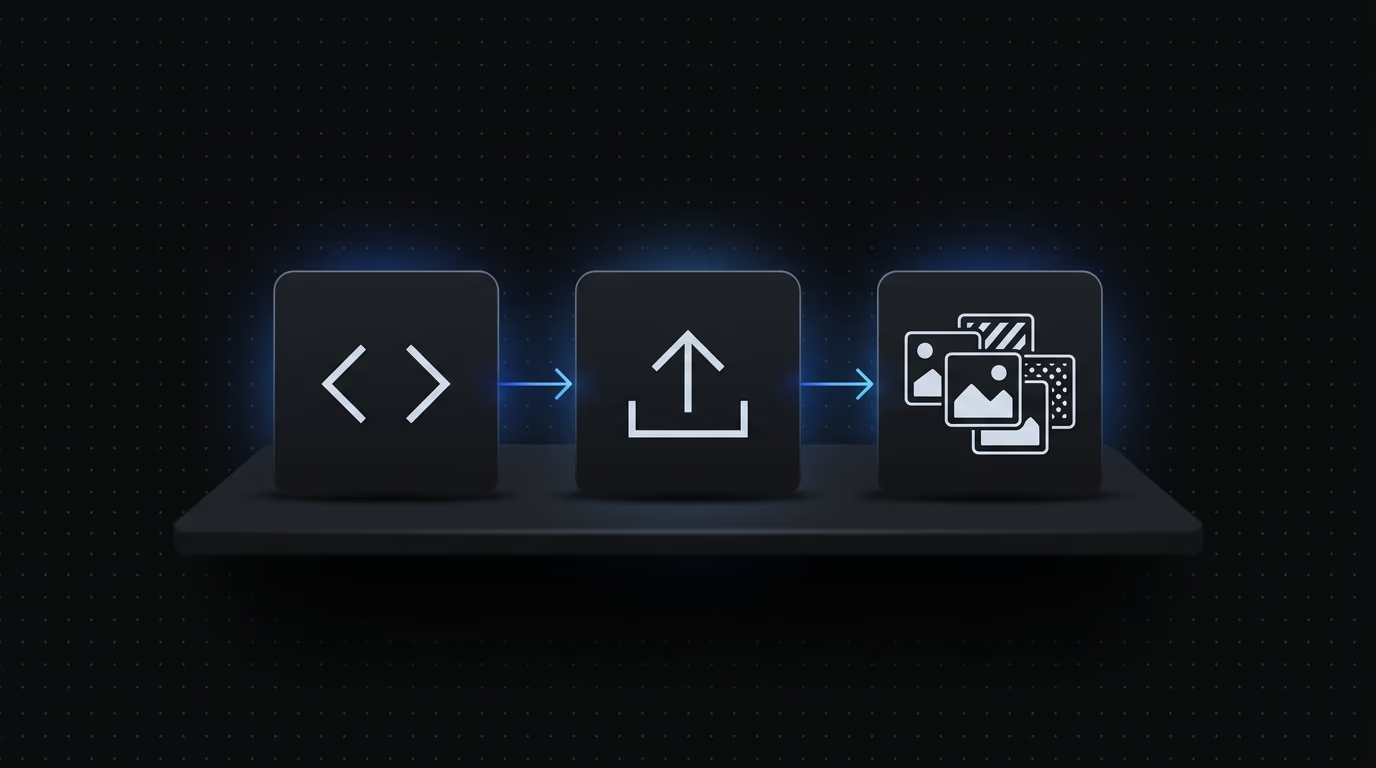
The real breakthrough came from changing where work happened.
Instead of building everything inside Ads Manager, they split the workflow.
1. Generate Variations with AI
Using Claude Code, they generated:
- Hooks
- Headlines
- Primary text variations
AI didn’t replace strategy—it increased speed.
If anything, it allowed the team to focus more on angles and less on manual writing.
2. Structure Inputs for Launch
Each variation included:
- Campaign mapping
- Ad set naming
- Copy
- Creative
- UTM structure
- CTA
This step turned ideas into structured inputs.
3. Batch Upload Using a Facebook Ads Uploader
Using Instrumnt, they launched 10–12 ads in under 45 minutes.
This replaced a 3–4 hour manual process.
Compared to alternatives:
- Hootsuite Ads focuses on scheduling and cross-platform management, but typically emphasizes control rather than creative testing speed.
- Smartly.io is built for enterprise-scale automation, often beyond the needs of small businesses running lean teams.
Neither is optimized for fast creative iteration at a small-team level.
A Facebook ads uploader designed for speed changes the equation completely.
For more context, see Why Most Facebook Ads Automation Tools Are Doing It Wrong (And How Instrumnt Does It Right).
The Result: How Faster Testing Creates a Scalable Facebook Ads System

Two weeks after implementing the workflow:
- New ads launched weekly
- Midweek edits dropped
- Losing ads were paused faster
- Winning ads scaled earlier
Performance patterns emerged quickly:
- Problem-first hooks outperformed features
- Video beat static images
- Time-saving messaging drove more clicks
| Metric | Before | After |
|---|---|---|
| Ads launched per week | 2–3 | 10–12 |
| Launch time | 3–4 hours | 35–45 minutes |
| Concepts tested/month | 3 | 8–10 |
| Decision confidence | Low | Higher |
At a $0.94 CPC benchmark (WordStream), a $1,000 budget can generate ~1,000 clicks—enough for meaningful testing if distributed across multiple variations.
Speed turned a small budget into leverage.
Operational Playbook: How to Run Facebook Ads for Small Business With Limited Budget
This is where most articles stop—but this is where execution actually matters.
If you're running Facebook ads for small business, here's a simplified system you can implement immediately.
Step 1: Set a Weekly Creative Output Target
Instead of focusing on campaigns, focus on output.
- Minimum: 8–12 new ads per week
- Ideal: 15+ variations
This ensures consistent learning.
Step 2: Work in Angles, Not Ads
One idea → multiple executions.
Example:
- Angle: "save time"
- Variations: 10–15 ads
This prevents random testing and improves signal clarity.
Step 3: Use AI for First Drafts
Tools like Claude Code can generate:
- Hooks
- Variations
- Copy directions
This removes the biggest bottleneck: starting from scratch.
For more on this shift, see Why AI Is the Only Way Forward for Facebook Ads in 2026.
Step 4: Batch Your Work
Do not:
- Create one ad at a time
Instead:
- Generate → organize → upload in batches
Batching reduces context switching and dramatically increases speed.
Step 5: Build a Feedback Loop
Speed only matters if it feeds learning.
Each week:
- Identify winning hooks
- Identify winning formats
- Kill losing variations quickly
Then feed those insights back into your next batch.
This creates a compounding system—not random testing.
For a deeper look at this loop, see Automated Facebook Ads Learning Loops with Instrumnt and Claude Code.
Budget Reality: Can $1,000 Actually Work?
Yes—but only if structured correctly.
A small budget fails when:
- Too few ads are tested
- Decisions are delayed
- Creative fatigue is ignored
A small budget works when:
- Variations are high
- Testing cycles are fast
- Learnings are reused
The difference is not spend—it’s system design.
Common Questions About Facebook Ads for Small Business
How much should a small business spend on Facebook ads to start?
Many small businesses start between $500 and $2,000 per month. The key is not the exact number, but whether you can generate enough variations to learn from that spend.
Can you run effective Facebook ads with only a $1,000 budget?
Yes. As shown in this example, $1,000 is enough to generate statistically meaningful data if distributed across multiple ad variations and tested efficiently.
How many ad variations should small businesses test at once?
Start with at least 3–5 variations per ad set. As your workflow improves, aim for 10+ variations per concept to accelerate learning.
Does automation replace creative strategy?
No. Tools like Instrumnt, AI systems, and a Facebook ads uploader handle execution. Strategy—angles, offers, positioning—still requires human judgment.
Final Takeaway: Speed Is the Real Lever
Most advice about Facebook ads focuses on targeting, budgets, or bidding strategies.
But for small businesses, the biggest constraint is simpler:
You are not producing and testing enough ads, fast enough.
Once that constraint is removed, everything changes:
- Data improves
- Decisions get faster
- Performance stabilizes
The small business in this story didn’t increase spend.
They increased speed.
And that’s what turned $1,000 into a scalable system.
For more context, see Meta Ads Guide.
For more context, see Meta Blueprint.
For more context, see Meta for Business Help Center.