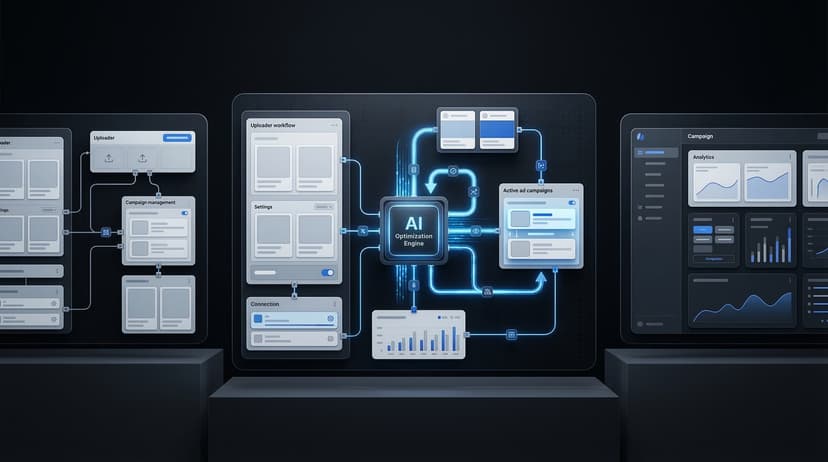

Facebook advertising has changed more in the last three years than in the previous eight. The way accounts get optimized today looks almost nothing like the manual, rule-based work that defined early Meta advertising.
That shift is not just a product update. It reflects a fundamental change in where performance actually comes from.
Meta's family of apps now reaches 3.29 billion daily active people. The scale of the platform means that the delivery system — Meta's auction, bidding, and placement algorithms — is already handling an enormous amount of the optimization work that media buyers used to do by hand. Bid strategies, budget allocation, audience expansion: these are areas where the machine consistently outperforms manual management at volume.
What that leaves for human strategy and tooling is a narrower but more consequential set of decisions. Chief among them: creative.
What Manual Facebook Ads Optimization Actually Looks Like — and Where It Falls Short
Manual optimization means a media buyer monitors performance data, identifies patterns, forms a hypothesis, makes a change, and waits for results. The cycle then repeats.
In practice, this looks like:
- reviewing campaign dashboards for CTR, CPC, and ROAS trends
- pausing underperforming ad sets based on spend thresholds
- duplicating ad sets with modified targeting
- swapping out creatives after frequency rises or CTR drops
- adjusting bids and budgets based on observed delivery patterns
This approach can work — and did work well — when campaigns were smaller and the signal-to-noise ratio in account data was manageable. But it has three structural problems at scale.
Speed: Manual optimization is bounded by human review cycles. A media buyer might review a campaign once or twice a day. Performance signals, particularly creative fatigue signals, can deteriorate meaningfully within hours.
Scope: A single media buyer can actively monitor a limited number of ad sets with genuine attention. Beyond a certain threshold, monitoring becomes superficial — and the accounts that get less attention tend to drift.
Bias: Manual reviewers develop pattern recognition, but they also develop blind spots. A creative that looks intuitively weak sometimes outperforms expectations. A creative that looks polished sometimes fails. Human judgment filters the data in ways that can be systematically misleading.
According to WordStream's Facebook Ads benchmarks, the average Facebook ad CTR across all industries is 0.90%, with an average CPC of $0.94. These are thin margins. In an environment where small improvements in click-through rates translate directly into CPA improvements, the cost of slow or biased optimization is real.
How AI Approaches Optimization Differently
AI-driven optimization does not replace strategy. It handles the parts of optimization that are high-frequency, data-intensive, and pattern-based — the parts that are genuinely better served by a machine than by human attention cycles.
The core difference is in how feedback loops work.
A human-managed campaign typically has a feedback loop measured in days: launch, observe, adjust. An AI-managed optimization layer can operate on a feedback loop measured in hours or minutes, continuously processing performance signals across creative variations, placements, and audiences simultaneously.
This matters most in three areas.
Pattern recognition across volume: An AI system analyzing performance across hundreds of ad variations simultaneously can identify statistically meaningful patterns that would take a human analyst days to surface. Which creative angles correlate with lower CPAs in specific audience segments? Which headline structures drive higher click-through rates for a given offer type? These are pattern-matching problems that scale naturally with machine processing.
Continuous monitoring without attention degradation: AI systems do not get distracted, do not take weekends, and do not have client calls. The monitoring quality across a portfolio of accounts stays consistent regardless of account count.
Faster creative iteration cycles: When the system can detect that a creative is losing effectiveness and flag it for replacement — or trigger a replacement automatically — the gap between creative fatigue and creative refresh shrinks dramatically.
Why Creative Is the Biggest Optimization Lever
The insight that changes how you should think about AI in Facebook ads is this: Meta's delivery system has already solved most of the bid and budget optimization problem.
Meta's own guidance, documented in the Meta Ads Guide, is explicit that Advantage+ campaigns and automated bidding consistently outperform manual bid management for most advertisers. The platform's algorithms have access to more data, more signals, and more processing power than any human or rule-based system running on top of it.
What the platform cannot optimize autonomously is the creative itself. It can determine which of your creatives performs best in delivery. It cannot generate new creative angles, refresh fatigued assets, or decide when to retire a concept in favor of something new.
Research from Nielsen and Meta found that creative quality accounts for up to 56% of a campaign's ROAS variation. That is not a marginal factor. It is the dominant variable in campaign performance — more significant than audience selection, bid strategy, or placement optimization combined.
This finding has a direct implication for where AI investment in advertising pays off: not in bid automation (which Meta handles natively), but in creative intelligence — the ability to generate, test, deploy, and refresh creative at a pace and breadth that manual workflows cannot match.
The 30% CPA Improvement That Comes From Testing More
The data on creative testing volume is consistent. Advertisers who run three or more ad variations per audience see up to 30% lower CPA on average compared to those relying on fewer variations.
That statistic is significant because it does not require better creative — just more of it, deployed more systematically. Creative winners are not reliably identifiable before launch. They are discovered through testing. The more tests you run, the faster you find winners, and the lower your average CPA over time.
The constraint on testing volume is almost never creative budget. It is execution capacity. Building, uploading, naming, and QA-ing each ad variation manually creates an operational ceiling on how many tests a team can actually run per week.
AI-assisted workflows raise that ceiling. When the system handles creative deployment, naming, and variation management, the human's role shifts from execution to direction: defining the testing framework, reviewing results, and deciding what to brief next.
What Fatigue-Triggered Creative Refresh Is — and Why It Works
Creative fatigue happens when an audience has seen the same ad too many times. The signals are consistent: frequency rises, CTR drops, CPC climbs, and ROAS deteriorates. Left unaddressed, a fatigued creative set will drain budget without delivering proportionate results.
Manual management of creative fatigue is reactive. A media buyer notices the performance drop, identifies the fatigued creative, pulls it, and begins the process of briefing and deploying a replacement. By the time the replacement is live, the campaign may have run at degraded efficiency for days.
Fatigue-triggered creative refresh uses performance signals — frequency thresholds, CTR decline rates, engagement drop-off patterns — to detect the onset of fatigue automatically and initiate a creative refresh before performance degrades substantially.
The mechanics depend on the implementation, but the principle is consistent: define the signals that indicate fatigue, set thresholds for action, and automate the response. For teams running high-volume campaigns across multiple accounts, this removes one of the most time-consuming forms of reactive management from the media buyer's plate.
The result is better campaign performance. Fresher creative enters the auction before the old creative has depleted its effectiveness, maintaining CTR and conversion rate rather than recovering them after a dip.
What This Means for Media Buyer Strategy
The shift toward AI-assisted optimization does not reduce the value of skilled media buyers. It changes where that skill matters most.
The tasks that AI handles well — pattern recognition, continuous monitoring, high-frequency iteration — are genuinely better served by machines. Media buyers who try to compete with AI on those dimensions will lose time and cognitive resources that should go elsewhere.
The tasks that require human judgment — creative direction, offer strategy, account positioning, client communication, testing framework design — are tasks where media buyer expertise compounds over time and cannot be meaningfully automated.
The practical implication is a shift in time allocation. Media buyers who adopt AI-assisted workflows should expect to spend more time on creative briefing and direction, testing framework design, performance analysis and interpretation, and strategic recommendations to clients or stakeholders.
And less time on manual creative deployment and naming, routine performance monitoring and reactive adjustments, and repetitive campaign structure setup.
This is a better trade. The highest-leverage media buyer work has always been the strategic and creative layer. AI tooling that handles the execution layer makes it possible to operate closer to that ideal.
How Instrumnt Approaches AI-Driven Optimization
Instrumnt is built around the insight that creative velocity is the primary performance lever available to media buyers operating on Meta today.
The platform handles the execution layer — bulk ad uploads, creative deployment, variation management — so that the time and attention that would otherwise go to mechanical work can go to testing more creative angles, analyzing results more carefully, and iterating more quickly.
This is connected to the broader shift toward AI-assisted campaign management. For a deeper look at how automated learning loops work in practice, see our article on Automated Facebook Ads Learning Loops with Instrumnt and Claude Code.
For context on how Instrumnt compares to other approaches to ad workflow management, read our Facebook Ads Uploader comparison and AI testing loop overview.
Common Questions About AI and Facebook Ads Optimization
Does AI replace media buyers?
No. AI handles the high-frequency, pattern-based tasks that are genuinely better performed by machines: continuous monitoring, rapid iteration across creative variations, and fatigue detection. The strategic layer — creative direction, offer positioning, testing framework design, client strategy — requires human judgment and remains the core of what skilled media buyers do. The practical effect of AI adoption is that media buyers can manage more accounts at higher quality, not that their role disappears.
What can AI optimize in Facebook ads?
AI can optimize creative deployment and rotation, monitor performance signals continuously and flag anomalies, detect creative fatigue and trigger refresh cycles, identify patterns across large ad variation sets, and manage the operational execution of bulk launches. What it cannot do is generate creative strategy from scratch, understand client context and business goals, or make judgment calls that require human accountability.
What is creative fatigue in Facebook ads?
Creative fatigue is the degradation in ad performance that occurs when a specific audience has seen the same ad too many times. The measurable signals include rising ad frequency, falling CTR, rising CPC, and declining ROAS. Fatigue is a function of audience size and ad spend: a small audience with high daily budget will fatigue a creative quickly; a large audience with modest spend may sustain the same creative for weeks. Managing fatigue proactively — by refreshing creative before performance drops materially — is one of the highest-impact ongoing tasks in campaign management.