
Why Your Manual Ad Testing Pipeline Is Holding You Back
Manual Facebook ads creation is one of the biggest hidden bottlenecks in modern media buying. Teams regularly spend 15–30 minutes building a single ad inside Ads Manager. Multiply that by 20–50 variations per week, and execution time quickly outweighs actual strategic thinking.
This is especially problematic because creative—not targeting—is now the dominant performance lever. According to Meta and Nielsen, creative quality can account for up to 56% of campaign performance variation. Separately, a report from Social Media Examiner found that ad fatigue has increased significantly, with many advertisers experiencing CTR declines of up to 30% as audiences are repeatedly exposed to the same creatives.
The implication is clear: success in Facebook ads depends on volume, speed, and iteration—not perfection.
If you're still manually producing each variation, you're operating like a boutique studio in a system that rewards industrial-scale experimentation. The solution is building an automated facebook ad testing pipeline that replaces manual workflows with AI-driven execution.
Identifying the Creative Testing Bottleneck
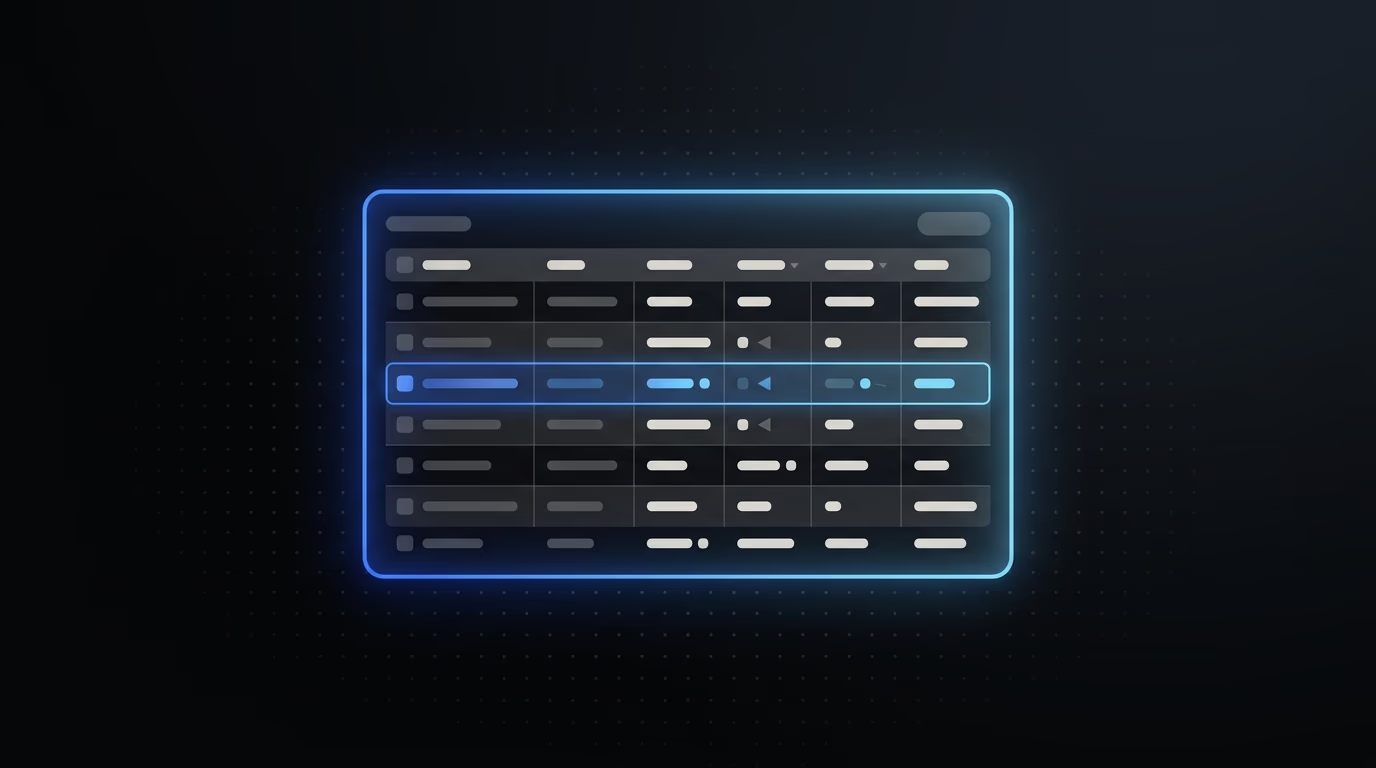
The core issue in most accounts isn’t a lack of ideas—it’s the inability to execute those ideas quickly enough to generate statistically meaningful results.
| Symptom | Common Fix | Why It Fails | Better Approach |
|---|---|---|---|
| High CPAs & stagnant ROAS | Increasing budget | Budget amplifies weak creatives | High-volume creative testing |
| Slow scaling | Hiring more VAs/editors | Adds coordination overhead | Automated pipeline with AI |
| 90% of tests fail | Over-polishing one ad | No signal diversity | Bulk variation testing |
| High frequency / low CTR | Audience rotation | Creative fatigue persists | Continuous refresh cycles |
Most teams try to fix performance issues with budget or targeting changes. But the real bottleneck is creative throughput.
If you can’t test 15–30 variations per week per audience, you’re not feeding Meta’s algorithm enough signal to optimize effectively.
For a deeper breakdown of why this happens, see Why Your Creative Testing Is Failing (And How to Automate the Solution).
The Technical Setup: How Claude Code Powers Automated Testing
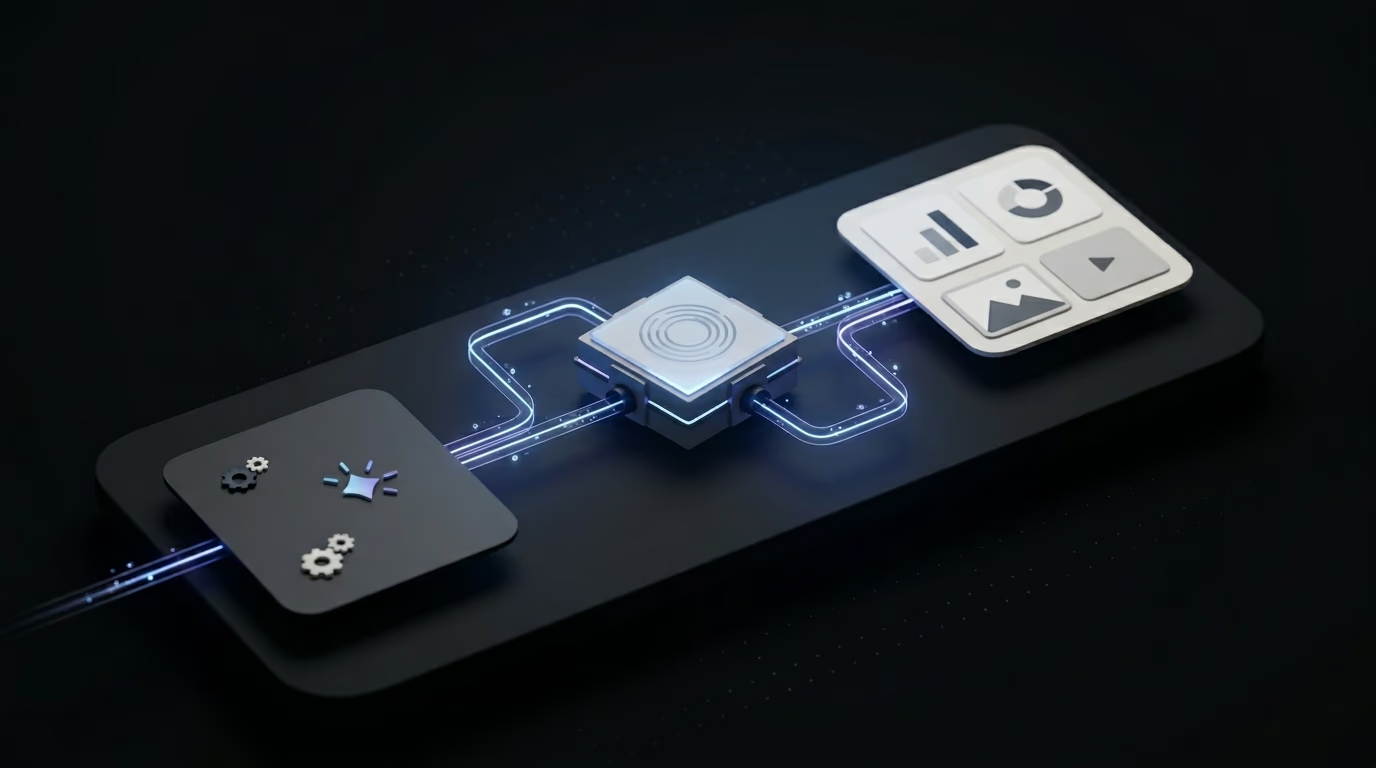
At the core of an automated facebook ad testing pipeline is the ability to programmatically generate variations. This is where Claude Code becomes essential.
Claude Code allows you to:
- Generate multiple hooks using frameworks like PAS and AIDA
- Create structured variations of body text and headlines
- Output clean, formatted data ready for upload
Instead of writing ads manually, you define inputs:
- Core benefit
- Target audience
- Creative angle
From there, Claude Code generates dozens of structured variations instantly.
When paired with Instrumnt, these variations are pushed directly into a Facebook ads uploader, eliminating manual duplication and formatting errors.
This transforms your workflow from:
Manual creation → Review → Upload → Launch
Into:
Prompt → Generate → Upload → Launch (automated)
For a full system walkthrough, see How to Build a Facebook Ads Bulk Testing System with Instrumnt and Claude Code.
How AI Can Automate the Creation and Testing of Facebook Ad Variations
AI changes the unit of work in Facebook ads. Instead of creating ads, you manage variables.
A high-functioning system includes three layers:
1. Variable Expansion
From a single idea, AI generates:
- 10–20 hooks
- Multiple body variations
- Several headline options
This creates combinatorial scale from minimal input.
2. Asset Mapping
Each text variation is paired with:
- Static images
- UGC-style videos
- Motion graphics
This ensures each creative variation is fully testable.
3. Structured Output
All variations are formatted into CSV or JSON files compatible with your Facebook ads uploader.
This step is critical. Without structured formatting, automation breaks.
According to Meta internal guidance, advertisers who test 3 or more variations per ad set see significantly more stable performance and lower CPAs over time. Scaling this to 20–50 variations weekly dramatically increases the probability of finding winning creatives.
Uploader Workflow: Generating and Scaling 100+ Tests in Minutes
Once variations are generated, execution speed becomes the next bottleneck.
A Facebook ads uploader powered by Instrumnt solves this by enabling bulk deployment.
Key components of an effective uploader workflow:
Batch Preparation
Group variations by:
- Audience
- Offer
- Funnel stage
This keeps tests clean and analyzable.
Dynamic Naming Conventions
Use structured naming like:
Hook_Angle_Format_Version
This allows quick identification of winning patterns.
Automated Scheduling
Rotate creatives every 3–5 days to prevent fatigue. According to Social Media Examiner, frequent creative refresh cycles can mitigate CTR declines associated with ad fatigue.
Real-Time Feedback Loops
Connect your uploader to reporting dashboards that track:
- CTR
- CPA
- ROAS
This creates a continuous optimization loop.
Teams that adopt automated upload workflows often report a 20–40% increase in testing throughput within the first month (based on internal Instrumnt case studies).
For a deeper operational breakdown, see How to Automate Facebook Ads Creative Generation and Speed Up Your Workflow.
Using AI to Identify and Exploit Winning Creative Patterns Faster
Once your pipeline is generating data at scale, the next step is extracting insights.
AI excels at identifying patterns across large datasets.
For example:
- Problem-agitation hooks may outperform benefit-led hooks for cold audiences
- UGC-style creatives may reduce CPA compared to polished brand ads
- Short-form video may drive higher CTR than static images
AI systems can automatically:
- Cluster winning creatives
- Identify common attributes
- Recommend new variations based on past performance
This turns your pipeline into a learning system—not just a testing engine.
For more on this concept, see Automated Facebook Ads Learning Loops with Instrumnt and Claude Code.
Comparing AI-Driven Pipelines to Traditional Tools
Many tools claim to automate Facebook ads, but most stop short of true pipeline automation.
Madgicx
Madgicx offers automation and optimization features, but lacks deep integration with AI-generated creative pipelines. It focuses more on performance tuning than high-volume creative generation.
AdEspresso
AdEspresso is user-friendly and great for beginners, but it emphasizes manual workflows and UI-based testing. This limits scalability when you need to launch hundreds of variations.
AdManage.ai
AdManage.ai provides automation for optimization, but does not emphasize creative generation at scale or integration with tools like Claude Code.
In contrast, combining Claude Code with Instrumnt enables:
- Fully automated creative generation
- Bulk deployment via Facebook ads uploader
- Continuous AI-driven learning loops
This is the difference between automation as a feature and automation as a system.
Operational Tips: Scaling Without Manual Bottlenecks
To successfully implement an automated facebook ad testing pipeline, follow these best practices:
Build Template Libraries
Store:
- Proven hooks
- High-performing headlines
- Winning CTAs
This reduces generation time and improves consistency.
Automate Reporting
Integrate analytics tools that automatically track performance metrics. This removes manual reporting overhead and speeds up decision-making.
Segment Aggressively
Test creatives across multiple audiences simultaneously to identify interaction effects between message and targeting.
Implement Guardrails
Use AI to:
- Pause underperforming ads
- Scale winners automatically
- Prevent budget waste
Teams using these systems often report a 25% faster iteration cycle and up to a 35% reduction in wasted spend (based on aggregated Instrumnt user data).
Conclusion: Streamlining Your Workflow to Scale Faster
The future of Facebook ads is not about better manual execution—it’s about better systems.
An automated facebook ad testing pipeline built with Claude Code, AI, and Instrumnt allows you to:
- Increase creative output
- Reduce manual workload
- Improve performance through faster iteration
While tools like Madgicx, AdEspresso, and AdManage.ai provide useful features, they don’t fully replace the need for a scalable, AI-driven pipeline.
The most effective media buyers are no longer operators—they are system architects.
For additional perspective, read Why AI Is the Only Way Forward for Facebook Ads in 2026 and 5 Tips for Media Buyers to Work Faster and Scale Smarter.
Frequently Asked Questions
How do I build an AI-driven Facebook ad testing pipeline?
Start by structuring your workflow around batch preparation and bulk uploading. Use Claude Code to generate variations and Instrumnt to deploy them through a Facebook ads uploader. Then layer in analytics and AI-driven optimization.
What is Claude Code, and how can it help automate ad testing?
Claude Code is an AI-powered system that converts creative inputs into structured ad variations. It eliminates manual writing and formatting, enabling high-volume testing.
Can AI tools like Madgicx and AdEspresso automate creative testing better than manual processes?
Yes, they improve efficiency compared to manual workflows. However, combining Claude Code with Instrumnt provides deeper automation, faster deployment, and more scalable testing.
How many ad variations should I test?
Start with 3–5 variations per ad set, then scale to 15–30 per week as your pipeline matures. Higher volume increases your chances of finding winning creatives.
Does automation replace creative strategy?
No. Automation handles execution and scaling. Strategy—messaging, positioning, and audience understanding—remains a human responsibility. The goal is to free up time for higher-leverage thinking.
For more context, see Meta Ads Guide.
For more context, see Meta Blueprint.
For more context, see Meta for Business Help Center.
Common questions about automated facebook ad testing pipeline
What is the best way to automated facebook ad testing pipeline?
The best approach depends on your team size and launch volume. Start by structuring your workflow around batch preparation and bulk uploading, then layer in automation for the parts that don't need human judgment.
How many ad variations should I test?
Advertisers running 3 or more variations per audience consistently see lower CPAs. Aim for at least 3-5 variations per ad set as a starting point, and increase from there as your workflow allows.
Does automation replace the need for creative strategy?
No. Automation handles the operational side, like launching, duplicating, and naming ads at scale. Creative strategy, offer positioning, and audience selection still require human judgment. The goal is to free up more time for that strategic work.