The Creative Format Myth Nobody Wants to Admit
When marketers discuss facebook ad creative formats, the conversation usually revolves around image ads, video ads, carousel ads, and collection ads. The assumption is that selecting the right format is the primary driver of performance.
In practice, that assumption often leads teams in the wrong direction.
Many Facebook ads accounts cycle through formats repeatedly while performance remains flat. An image becomes a video. A video becomes a carousel. A carousel becomes a collection ad. Yet conversion rates barely move.
The reason is simple: format is usually a container, not the core driver.
A useful benchmark comes from WordStream's Facebook advertising benchmark research, which has historically reported an average Facebook click-through rate of roughly 0.90% across industries. Source: WordStream Facebook Ads Benchmarks. This statistic illustrates how tightly performance often clusters when underlying strategy remains unchanged.
A second widely cited data point comes from Nielsen Catalina Solutions research showing creative execution can account for approximately 47% of sales lift in cross-media campaigns. Source: Nielsen Catalina Solutions sales lift studies. Whether the exact percentage varies by environment is less important than the conclusion: creative quality has a dramatically larger impact than format selection.
The implication is that a weak message inside a video often loses to a strong message inside a static image.
What Meta Explains—and What Gets Overlooked
Meta's educational resources correctly explain the differences between image, video, carousel, and collection formats. Those explanations help advertisers understand how information is presented to users.
What often gets overlooked is that Meta's auction system does not reward a format simply because it belongs to a particular category.
Meta evaluates predicted outcomes at the impression level. The platform attempts to estimate which ad is most likely to generate the desired action based on historical signals, engagement patterns, contextual information, and conversion probability.
That means Facebook ads performance is usually tied to signal quality rather than format labels.
A video may outperform an image because it communicates the value proposition more effectively. A carousel may outperform a video because it creates clearer product comparison. The format itself is rarely the root cause.
This distinction matters because many advertisers mistake correlation for causation. They observe a winning video and conclude that video is the answer. In reality, the winning element may have been the hook, offer positioning, or audience-message fit.
For a deeper discussion of signal interpretation and reporting quality, see The ROAS Lie: Why Your Reporting Dashboard Is Stealing Your Marketing Budget.
Why Creative Systems Outperform Format Decisions
The most successful advertisers treat formats as delivery mechanisms within a broader testing system.
Instead of asking which format wins, they ask:
- Which message resonates most?
- Which emotional trigger creates action?
- Which offer structure improves conversion?
- Which audience responds to a particular angle?
Those questions generate learning.
Format selection alone generates very little learning because it changes only one surface-level variable.
A robust creative system continuously produces variations across:
- Hooks
- Headlines
- Offers
- Visual structures
- Calls to action
- Social proof mechanisms
- Problem framing
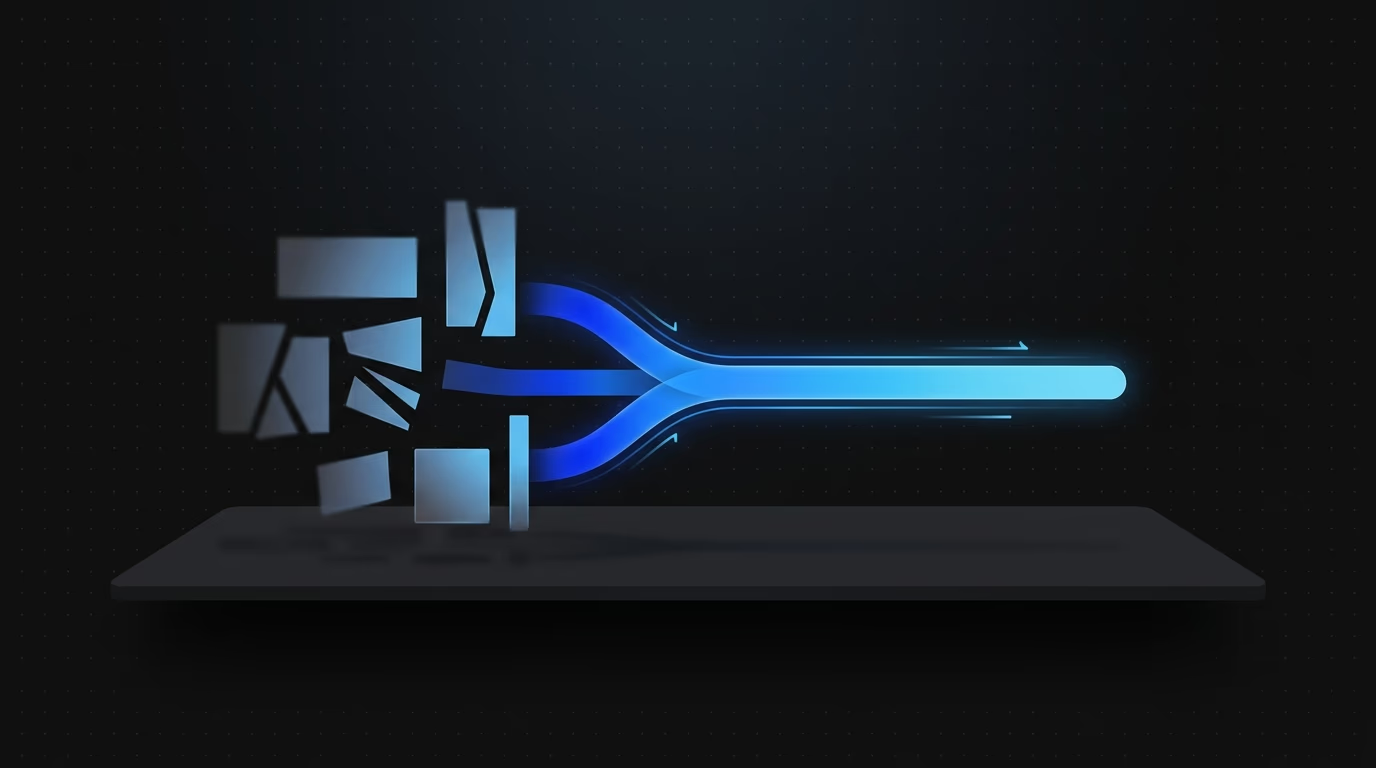
The resulting volume of experiments creates a feedback loop that improves future decisions.
This is why teams increasingly focus on testing velocity rather than format debates.
What Benchmarks Really Suggest About Performance Variance
Benchmark studies are often misinterpreted.
When marketers see average CTR, CPC, or CPA statistics, they assume the gap between top and bottom performers is explained by tactical choices such as image versus video.
The evidence usually points elsewhere.
WordStream's benchmark data indicates relatively narrow CTR distributions compared with the dramatic performance improvements advertisers hope to achieve. Source: WordStream Facebook Ads Benchmarks.
Meanwhile, Meta-cited research frequently emphasizes the importance of creative quality. Industry summaries of Meta research often report that creative contributes more than half of campaign outcome variation. Source: Meta for Business creative effectiveness research.
The common thread across these studies is that creative execution dominates format selection.
This helps explain why advertisers that focus exclusively on image-versus-video debates often fail to produce meaningful gains.
The bigger opportunity lies in producing more high-quality experiments.
The Hidden Constraint: Creative Throughput
Most underperforming accounts do not suffer from a format problem.
They suffer from a throughput problem.
Creative production is slow.
Testing volume is low.
Learning cycles take too long.
As a result, teams reach conclusions based on tiny sample sizes.
Suppose a team launches two videos and one image ad. If one video wins, the organization may decide that video is the superior format.
The conclusion feels logical but is statistically weak.
The winning result may have been driven by message quality, audience alignment, timing, or randomness.
High-performing teams solve this problem by dramatically increasing the number of experiments they run.
A Facebook ads uploader becomes valuable because it enables deployment at scale. Instead of launching a handful of creatives, teams can launch dozens or hundreds of structured variations.
That increased testing velocity generates stronger signals and faster learning.
For a practical example of scaling throughput, see Breaking the Creative Bottleneck: How One Growth Team Scaled Facebook Ads Throughput with AI.
Building a Repeatable Creative Testing Engine

The strongest advertising organizations build systems rather than collections of campaigns.
A repeatable testing engine typically follows four stages.
Stage 1: Generate Multiple Angles
Every campaign concept should produce several messaging angles.
Examples include:
- Fear of loss
- Social proof
- Aspiration
- Convenience
- Cost savings
- Competitive differentiation
The objective is not finding a winner immediately. The objective is generating enough variation to discover patterns.
Stage 2: Isolate Variables
When too many variables change simultaneously, performance becomes difficult to interpret.
Strong testing frameworks isolate:
- Hook
- Headline
- Visual concept
- Offer
- Call to action
This improves diagnostic quality.
Stage 3: Scale Production With AI
AI reduces production friction.
Instead of manually creating every variation, marketers can generate multiple hooks, headlines, positioning statements, and test matrices in minutes.
Claude Code is increasingly used to structure testing plans, naming conventions, creative matrices, and experimentation workflows.
The result is faster iteration without sacrificing organization.
Stage 4: Capture Learnings
Winning ads should not be treated as isolated successes.
Every result should generate reusable knowledge.
Patterns discovered today should influence future creative development.
This creates compounding improvement over time.
Systems, Platforms, and the Competitor Landscape

The market for Facebook ads tools reflects different philosophies about performance improvement.
Hunch focuses heavily on structured experimentation and dynamic creative workflows. The platform helps advertisers manage complexity at scale.
Smartly.io emphasizes automation, enterprise operations, and large-scale campaign execution. Its strengths are often tied to efficiency and scale.
AdManage.ai focuses on workflow simplification and operational management, helping teams execute campaigns more efficiently.
Each platform addresses a different operational challenge.
The larger strategic question is whether the system improves learning velocity.
Instrumnt positions itself around connecting generation, execution, testing, and feedback into a continuous optimization loop. Rather than treating campaigns as isolated projects, the goal is to transform every experiment into future decision-making intelligence.
That distinction becomes increasingly important as testing volume grows.
Practical Implementation With Facebook Ads Uploader, Claude Code, and AI
Execution is where most strategies fail.
A Facebook ads uploader helps eliminate repetitive setup work. Bulk deployment allows teams to focus on experimentation rather than manual creation.
Claude Code helps organize testing architecture by generating structured experiment plans, naming systems, creative matrices, and workflow documentation.
AI accelerates ideation by expanding one concept into multiple variations.
Instead of producing a single advertisement, teams can produce twenty or fifty structured tests.
Instrumnt can then serve as the connective layer that links generation, execution, measurement, and learning.
The outcome is not merely more ads.
The outcome is faster knowledge creation.
When Facebook Ad Creative Formats Actually Matter
None of this means formats are irrelevant.
Facebook ad creative formats matter when communication requirements differ.
Video often works well when products require demonstration, explanation, or storytelling.
Carousel formats can excel when multiple products, features, or use cases need comparison.
Collection formats can improve browsing and discovery experiences in ecommerce environments.
Static images can communicate simple messages quickly and efficiently.
The key point is that these advantages become meaningful only after sufficient testing volume exists.
Without a disciplined experimentation framework, marketers frequently draw conclusions from incomplete information.
Creative fatigue also deserves attention.
Many performance declines are caused by audience saturation rather than format limitations.
Refreshing messaging often produces larger gains than switching containers.
For more on this topic, see Facebook Ad Creative Fatigue Scenario: When Winning Ads Stop Working Overnight.
FAQ
Are Facebook ad formats the main driver of performance?
No. Format influences presentation, but creative quality, messaging strength, audience fit, and testing velocity generally have a greater impact on results.
Which Facebook ad format is best for beginners running small budgets?
There is no universal winner. Beginners typically benefit more from testing multiple creative approaches than from obsessing over format selection.
How does creative testing differ from simply switching ad formats in Facebook Ads Manager?
Creative testing evaluates hooks, offers, visuals, and messaging. Format switching changes only the container. The former produces meaningful learning while the latter often produces limited insight.
Can AI improve Facebook ads performance?
Yes. AI improves performance indirectly by accelerating idea generation, increasing testing throughput, improving workflow consistency, and helping teams identify patterns more quickly.
Related Reading
If you want to explore the topic further, consider:
- 5 Tips for Media Buyers to Work Faster and Scale Smarter
- Scaling Facebook Ad Testing: Why AI Is the Key to Breaking Through Your Creative Bottleneck
- Why Most Facebook Ads Are Created Wrong (And How AI Fixes It)
The central lesson remains the same: facebook ad creative formats matter far less than the system used to generate, test, interpret, and scale creative ideas. Teams that optimize learning velocity consistently outperform teams that simply switch between images, videos, carousels, and collections.
For more context, see Meta Partner Directory.
For more context, see Meta's creative fatigue recommendations.
For more context, see inBeat's creative fatigue guide.