The Meta Ad Library is not competitive intelligence. It's content.
Anyone searching for meta ad library alternatives is usually trying to solve a deeper problem than finding another database of ads.
They want to understand why competitors succeed, discover better Facebook ads, generate stronger creative ideas, and move from research to execution faster.
The Meta Ad Library is useful because it offers visibility into active advertising, but visibility is not the same as insight.
Most marketers believe they are doing competitive research when they browse ads. In reality, they're consuming content.
The experience feels productive because there is always another advertiser, another creative, another hook, and another offer.
That is exactly why it becomes difficult to leave.
The Meta Ad Library has become the advertising equivalent of doomscrolling. It encourages marketers to copy what they can see instead of understanding the systems producing successful campaigns.
If you're looking for meta ad library alternatives, the answer usually is not another library.
It's a better workflow.
For another perspective on this problem, see The Facebook Ad Library Won’t Find Winners.
Why copying competitors became the default strategy

Open the Meta Ad Library and search for any established advertiser.
You'll often find dozens or hundreds of active creatives.
It feels like free access to their playbook.
That naturally leads to a familiar workflow:
- Screenshot ads
- Save them into Notion
- Label them as inspiration
- Create something that looks similar
The problem is that you're only seeing outputs.
You aren't seeing targeting, audience segmentation, budget allocation, landing pages, testing history, attribution quality, or conversion data.
According to Nielsen research, creative quality can account for up to 56% of sales lift in advertising effectiveness (Nielsen, The Power of Creative). This means the visible ad is only a fraction of the performance equation.
Meta’s own marketing research also shows that advertisers who consistently rotate and test creative variations can significantly improve delivery outcomes because machine learning systems benefit from more diverse creative signals (Meta for Business Creative Best Practices).
A third industry benchmark from IAB research indicates that digitally optimized campaigns with structured testing outperform static creative approaches by double-digit percentage improvements in efficiency metrics across performance channels (IAB Digital Ad Effectiveness Research).
These statistics reinforce a critical point: what you see in the Meta Ad Library is not what drives performance.
You're looking at outcomes without inputs.
That is observation—not competitive intelligence.
And this is where modern Facebook ads workflows begin to diverge from outdated research habits.
Instead of collecting screenshots, high-performing teams use systems like a Facebook ads uploader combined with AI-assisted analysis to shorten the gap between insight and execution.
The illusion of transparency inside the Meta Ad Library
The Meta Ad Library gives marketers enough information to feel informed while omitting the context that actually determines performance.
You can usually see:
- Active ads
- Creative formats
- Messaging
- Some delivery metadata
You cannot see:
- CPA
- ROAS
- Conversion rate
- Audience segmentation logic
- Budget distribution
- Testing history
- Incrementality
That missing context changes everything.
A creative that has been running for months might be a winner, a compliance placeholder, a low-budget retargeting asset, or a seasonal campaign with no scaling intent.
Inside the interface, they look identical.
The platform tells you what exists.
It does not tell you what works.
This is where many teams get stuck in a loop of shallow research instead of building real intelligence systems.
Modern teams using AI tools like Claude Code can begin structuring what they see into usable datasets rather than static screenshots. When paired with platforms like Instrumnt, that structured data can flow directly into testing pipelines instead of sitting in folders.
Why AI pattern recognition beats screenshot collections
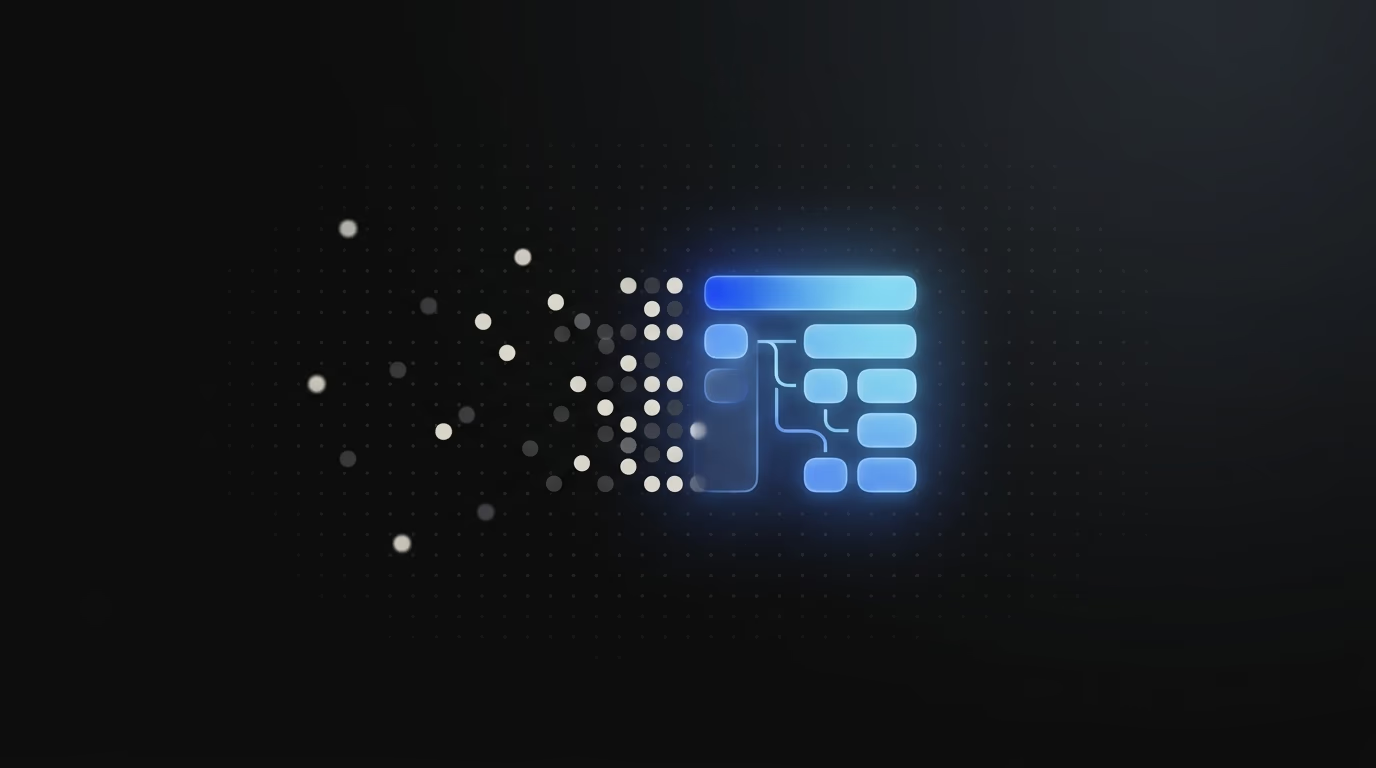
The biggest shift in modern performance marketing is not more research.
It is better abstraction.
Thousands of screenshots eventually become noise unless they are structured.
Patterns create knowledge.
Instead of asking:
What are competitors running?
Ask:
Which hooks, offers, creative formats, and positioning strategies repeat across successful advertisers?
This is where AI becomes useful.
Not because AI magically creates winning Facebook ads.
But because AI can cluster messy observations into repeatable systems.
With Claude Code, marketers can analyze exported ad datasets to:
- Cluster hooks by intent
- Group value propositions
- Identify recurring objections
- Categorize creative formats
- Detect emerging creative themes before saturation
This transforms research from passive observation into active hypothesis generation.
For a deeper breakdown of this workflow, see Automated Facebook Ads Learning Loops with Instrumnt and Claude Code.
When paired with a Facebook ads uploader, these insights can be deployed immediately into structured experiments rather than waiting on manual campaign setup.
This reduces the delay between insight and learning, which is often the real bottleneck in scaling performance.
Comparing Paragone, AdEspresso, and Madgicx through workflow fit
Most comparisons of Meta Ad Library alternatives focus on features.
A more useful lens is workflow fit.
Paragone
Paragone is useful for monitoring competitor activity and automating parts of campaign operations.
It improves visibility and workflow automation but does not fundamentally solve creative intelligence.
It helps you see more, not necessarily understand more.
AdEspresso
AdEspresso is strong for campaign structure, testing organization, and execution.
It is most useful after ideas already exist.
It improves management efficiency but does not generate deeper insight into why ads work.
Madgicx
Madgicx focuses heavily on AI-assisted optimization and campaign scaling.
Its strength lies in improving performance of existing campaigns.
However, optimization is downstream of creative strategy.
Without strong creative inputs, optimization systems plateau quickly.
In practice, these tools complement rather than replace a creative intelligence system.
That system is increasingly powered by AI workflows, structured data pipelines, and execution tools like Instrumnt that connect analysis directly to deployment.
Turning research into original Facebook ads faster
The real bottleneck in performance marketing is not access to information.
It is conversion of information into experiments.
Most teams still follow a slow loop:
- Browse Meta Ad Library
- Save screenshots
- Discuss ideas internally
- Rebuild creatives manually
- Launch campaigns late
By the time ads go live, the signal is already stale.
Meanwhile, competitors are iterating.
A faster system connects research, AI analysis, creative generation, and deployment.
With Claude Code, teams can translate structured insights into creative variations.
With a Facebook ads uploader, those variations can be deployed in batches instead of manually.
With Instrumnt, results can be fed back into the system to refine future hypotheses.
Execution speed becomes a competitive advantage.
Building a repeatable creative operating system
Winning teams do not rely on better inspiration.
They rely on better systems.
From observation to instrumentation
Instead of tracking competitors, track your own creative performance with structured data.
From screenshots to structured data
Organize insights by:
- Hooks
- Angles
- Formats
- Outcomes
From inspiration to hypotheses
Every observation becomes a testable assumption.
From manual launches to repeatable deployment
Use a Facebook ads uploader to remove operational friction and increase testing velocity.
Platforms like Instrumnt connect research, AI, and execution into a continuous loop where learning compounds over time.
For more context on scaling workflows, see Scaling Facebook Ad Testing: Why AI Is the Key to Breaking Through Your Creative Bottleneck.
The actionable implication
The Meta Ad Library is not useless.
It is simply incomplete.
It provides visibility without context, which is why it is often mistaken for intelligence.
The strongest performance advantage does not come from finding better examples.
It comes from building systems that turn signals into experiments faster than competitors.
If you're evaluating meta ad library alternatives, the real question is not where to browse next.
It is how quickly you can:
- Extract patterns instead of collecting screenshots
- Generate original Facebook ads using structured insights
- Use AI and Claude Code to cluster creative signals
- Deploy tests via a Facebook ads uploader
- Close the loop with performance data through Instrumnt
Libraries show you what exists.
Systems determine what works next.
For more context, see Nielsen.
For more context, see Meta Marketing API documentation.
For more context, see Smartly.io.
Common questions about meta ad library alternatives
What is the best way to meta ad library alternatives?
The best approach depends on your team size and launch volume. Start by structuring your workflow around batch preparation and bulk uploading, then layer in automation for the parts that don't need human judgment.
How many ad variations should I test?
Advertisers running 3 or more variations per audience consistently see lower CPAs. Aim for at least 3-5 variations per ad set as a starting point, and increase from there as your workflow allows.
Does automation replace the need for creative strategy?
No. Automation handles the operational side, like launching, duplicating, and naming ads at scale. Creative strategy, offer positioning, and audience selection still require human judgment. The goal is to free up more time for that strategic work.