Most Media Buyers Are Just Guessing (Here’s Why)
Most Facebook ads teams think they’re doing competitor research.
They’re not.
They’re collecting ads.
Big difference.
Screenshots aren’t analysis. They’re just a mood board.
If your workflow stops at hooks, headlines, and formats, you’re ignoring the only part that actually drives results: where the click goes.
I’ve audited a lot of ad accounts. Same pattern every time. Huge swipe files. Clean Notion boards. Zero lift in performance.
Because they copied the surface.
Not the system.
The landing page is where the system lives.
If you’re not mapping competitor landing pages, you’re not analyzing anything. You’re guessing.
The Hidden Layer: Why Ads Without Landing Pages Mislead You
An ad makes a promise. The landing page either cashes it or kills it.
Looking at ads alone is like judging a movie from the trailer.
This is why most “winning” ads don’t translate when you reuse them. The hook looks solid. The angle feels proven. You launch it—and it flops.
Not because the ad was bad.
Because it only worked with the page behind it.
That context matters more than people admit:
- The offer structure (discount, bundle, trial)
- How tightly the message matches the page
- The layout and friction points
- The proof doing the heavy lifting
Creative drives a huge portion of performance. Nielsen found that creative accounts for roughly 56% of campaign ROI (Nielsen, "The Nielsen CMO Report").
But most teams define “creative” as just the ad.
That’s incomplete.
It includes the landing experience.
Ignore that, and you’ll keep misreading what actually worked.
If you want a deeper breakdown of why ad-only analysis fails, read this: /blog/facebook-ads-landing-analysis.
The Missing Workflow: From Facebook Ad to Full Funnel Mapping
This isn’t a data problem.
It’s a workflow problem.
Anyone can open the Meta Ad Library. Anyone can click through ads. That’s not the bottleneck.
The bottleneck is what happens after you land on the page.
A real workflow answers:
- What exact promise does the ad make?
- Where does the landing page reinforce or shift that promise?
- What actually drives the conversion?
- How are objections handled, specifically?
Most teams don’t answer these. They just collect examples and move on.
That’s why nothing improves.
No structure means no pattern recognition. No patterns means no leverage.
If you want to see what a real system looks like, this goes deeper: /blog/find-competitor-ad-funnels.
Step-by-Step: How to Find Competitor Landing Pages (Manual vs Scalable Methods)
Let’s make this practical.
If you’re trying to learn how to find competitor landing pages Facebook ads, here’s the actual process.
Manual method (baseline)
- Open the Meta Ad Library
- Search your competitor
- Click active ads
- Click through to the landing page
- Document the funnel
That’s enough to get started.
Scalable method (what serious teams do)
- Collect ads in batches (not one-off browsing)
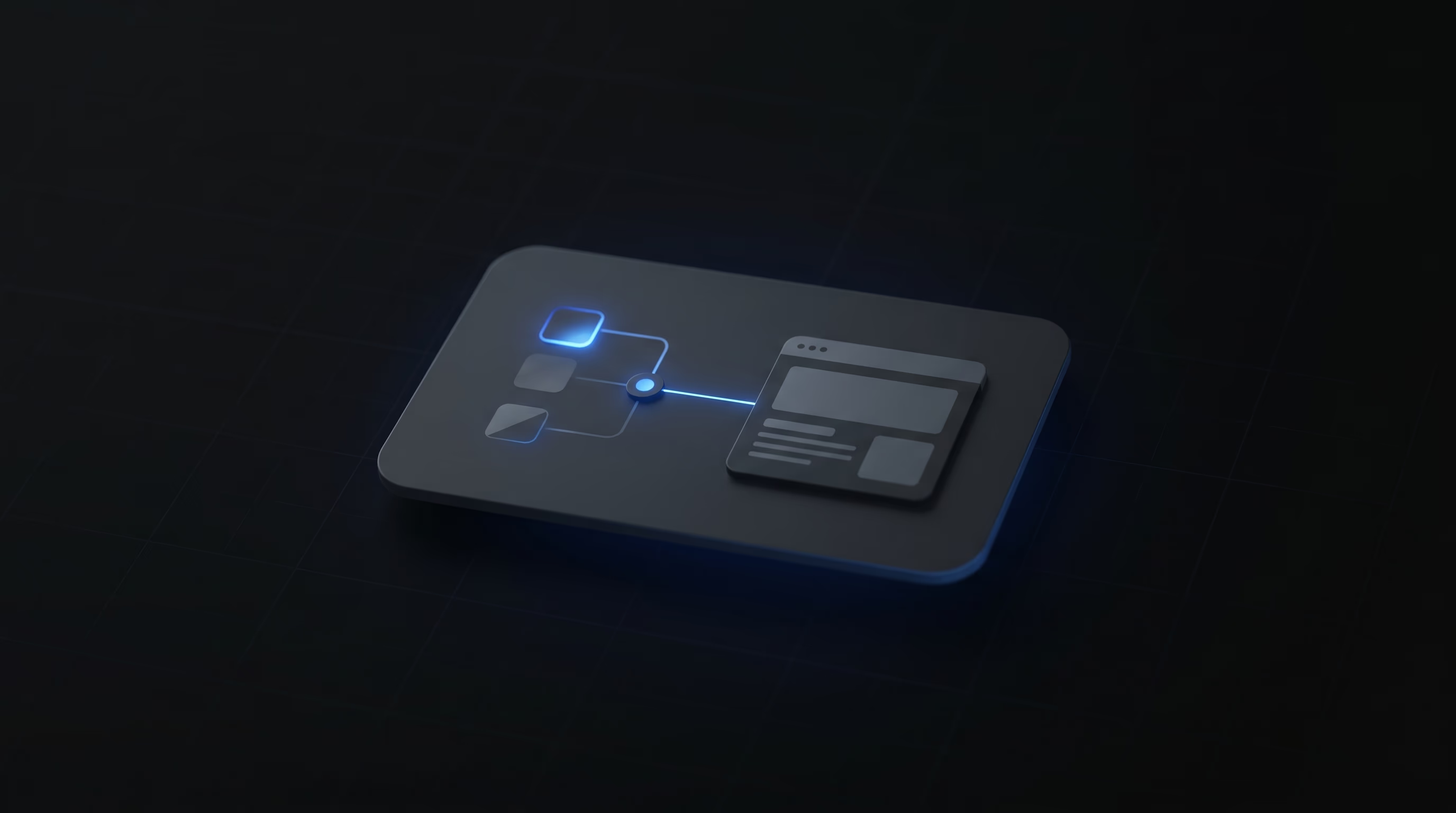
- Map each ad to its landing page
- Capture key elements (offer, proof, structure)
- Store in a structured format (not screenshots)
- Tag patterns across funnels
This is where most teams fall apart.
They stop at step two.
The advantage comes from steps three through five.
And importantly—you don’t need expensive tools to start.
Manual works.
Tools just speed it up.
Competitor Comparison: Smartly.io vs Revealbot vs Madgicx on Funnel Visibility
Let’s address the obvious question.
Don’t tools already solve this?
Not really.
Here’s where they fall short.
Smartly.io is built for scale. Great for enterprise workflows, creative production, and execution. But it doesn’t show you competitor funnels. It assumes you already know what to run.
Revealbot is strong at automation rules. Budget changes, pausing logic, performance triggers. All useful. All downstream.
Madgicx leans into AI and creative insights. It helps you see what’s working at the ad level. But it still lives at the ad layer.
None of them answer the core question:
Why did this funnel convert?
They optimize execution.
They don’t generate upstream insight.
That gap is where most performance is lost.
From Insight to Output: Where Most Teams Break
Let’s say you actually do the work.
You find the landing page.
You map the funnel.
Now what?
This is where it usually dies.
People save screenshots. Maybe write a few notes.
Then nothing ships.
Insight without execution is just procrastination with better branding.
The move is turning one funnel into multiple testable ideas.
For example:
Take one offer and reframe pricing three ways.
Take one headline and spin out five hooks.
Take one proof section and test authority vs social proof vs hard data.
Now you’re not copying.
You’re expanding.
That shift—from understanding to iteration—is the whole game. This breaks it down further: /blog/analyze-competitor-facebook-ads.
From Insight to Output: Turning One Landing Page Into 10+ Ad Variations (AI + Claude Code)
This is where AI actually matters.
Not writing one ad.
But scaling outputs.
Once you’ve mapped a funnel, tools like Instrumnt let you structure that insight into reusable inputs.
This is where Claude Code comes in.
Instead of manually rewriting variations, you feed structured funnel data into AI and generate:
- Multiple hooks from one core angle
- Variations of offers
- Different proof formats
- Alternate CTAs
Now you’re not guessing.
You’re systematically expanding a proven concept.
And this matters because of how Facebook ads perform at scale.
According to Meta, advertisers who test multiple creative variations per audience see improved cost efficiency and lower CPAs (Meta Marketing Science, "Creative Diversification Study").
Translation: volume wins.
Not perfect ideas.
Execution Layer: Using a Facebook Ads Uploader to Launch Tests at Scale
Insight is useless without execution.
This is where most workflows collapse.
You generate ideas.
But they never go live.
This is why the Facebook ads uploader layer matters.
Instead of manually building ads one by one, systems built around Instrumnt let you:
- Upload variations in bulk
- Standardize naming and structure
- Launch faster without bottlenecks
This removes the biggest friction point in most teams: time.
Because if it takes hours to launch tests, you won’t test enough.
And if you don’t test enough, you don’t win.
If you want to go deeper into this, read: /blog/facebook-ads-bulk-testing-system.
The Counterargument: “I Don’t Need Funnels, I Just Need Good Ads”
This sounds reasonable.
Until you look at performance data.
Average Facebook ads CTR across industries sits around 0.90% (WordStream, "Facebook Ads Benchmarks").
Most ads fail immediately.
So when someone says “I just need better ads,” what they’re really saying is:
“I’ll outguess everyone else.”
That’s not a strategy.
That’s gambling.
Good ads don’t exist in isolation. They’re tied to:
- The promise they make
- The page they lead to
- The friction they remove
Ignore the landing page, and you’re only seeing part of the system.
The Only Implication That Matters
Stop treating competitor research like content collection.
Start treating it like system design.
Finding competitor landing pages from Facebook ads is step one.
Turning that into a repeatable testing engine is the job.
The teams that win aren’t more creative.
They just test more, faster, with better inputs.
And that starts by looking past the ad.
Into the funnel.
That’s where the real signal is.
Related reading
If you want to keep building this system, these will help:
- Why AI Is the Only Way Forward for Facebook Ads in 2026
- How One Team Extracted Competitor Funnels and Turned Them Into a Scalable Facebook Ads Engine
Common questions about how to find competitor landing pages facebook ads
How can I find the landing page behind a Facebook ad?
Use the Meta Ad Library to locate active ads, then click through directly to the landing page. From there, document the structure, offer, and messaging to understand how the funnel works.
Do I need paid tools to analyze competitor funnels or can I do it manually?
You can start manually using the Meta Ad Library and structured notes. Paid tools help scale the process but don’t replace the need for analysis.
How do I turn competitor landing page insights into better performing ads?
Extract key elements (offer, proof, messaging), then use AI tools like Instrumnt and Claude Code to generate multiple variations. Launch them quickly using a Facebook ads uploader to test at scale.