The Hidden Gap: Why Ad Library Research Stops Before the Landing Page

Open any serious Facebook ads account and ask a simple question: how many competitor landing pages have we actually analyzed this quarter?
Most teams don’t know.
They can show you saved ads from the Meta Ad Library. They have swipe files, screenshots, maybe a Notion board full of ideas. But when you follow those ads to where the conversion happens—the landing page—the process breaks down.
That’s the gap.
Ad libraries show you what’s running. They don’t show you how those ads convert. And that missing layer matters more than most teams admit.
According to WordStream, the average Facebook ads conversion rate across industries is around 9.21% (WordStream Facebook Ads Benchmarks). That conversion doesn’t happen on the ad—it happens on the landing page.
And landing pages vary dramatically in performance. Unbounce reports that the median landing page conversion rate across industries is 4.3%, with top performers reaching 11% or higher (Unbounce Conversion Benchmark Report). That gap is driven almost entirely by page structure, not the ad itself.
In fact, businesses that analyze competitor landing pages often find a significant boost in their performance when they identify key patterns behind successful campaigns. When you’re only studying the ad, you’re guessing at the outcome.
This is why most teams copy hooks or visuals without understanding why they worked. The real performance driver sits one click deeper, and most workflows never reach it.
How to Actually Find Competitor Ad Landing Pages
Before solving the scale problem, you need the right collection method. Here are the three approaches teams use, from simplest to most powerful.
Method 1: Manual Ad Library Clicking (floor, not ceiling)
Open the Meta Ad Library, search your competitor, filter to active ads, and click through each ad to its destination URL. Works for auditing 5–10 ads from one competitor. Breaks immediately at any meaningful volume.
The core problem: the Ad Library doesn’t show destination URLs directly. You have to click each ad, wait for it to open, and capture the URL manually. For a competitor running 50+ active ads, this takes hours — and many ads rotate destinations based on audience segment, time of day, or A/B test.
Method 2: URL Parameter Scraping with Tools
The more systematic approach uses URL extraction tools like SimilarWeb, SEMrush’s Traffic Analytics, or Ahrefs to identify which URLs are receiving paid traffic from your competitor. This gives you destination URLs without manually clicking every ad.
The workflow:
- Enter your competitor’s domain in any of these tools
- Filter for paid traffic sources (Facebook/Meta)
- Export the landing page URLs receiving that traffic
- Deduplicate and sort by volume
This surfaces the pages competitors are actively investing in — which is a stronger signal than just "this ad exists." A page receiving consistent paid traffic is a page that’s converting well enough to justify continued spend.
Method 3: AI-Assisted Pattern Extraction at Scale
The most powerful approach combines URL collection with AI analysis. Once you have a list of competitor landing pages:
- Use a scraping tool (Firecrawl, Playwright, or a simple Python script) to capture the text content of each page
- Feed the content into Claude Code with a structured extraction prompt
- Extract consistent attributes across all pages: headline formula, offer structure, CTA placement, proof type, page length, primary objection addressed
The output isn’t a collection of screenshots. It’s a structured dataset of competitor conversion patterns.
Example extraction prompt for Claude Code:
For each landing page below, extract:
- Headline type (question / bold claim / benefit statement / how-to)
- Offer structure (free trial / demo / direct purchase / lead capture)
- Primary pain point addressed (first paragraph)
- CTA text and position (above fold / below fold / multiple)
- Proof type used (testimonials / logos / stats / before-after)
- Approximate page length (short <500w / medium 500-1500w / long >1500w)

Return as a CSV.
Once you have this as data, patterns emerge that no swipe file ever reveals.
Why Manual Competitor Analysis Breaks at Scale

The manual workflow breaks not because the steps are wrong, but because the volume is wrong.
Here’s what actually happens as competitor count grows:
| Symptom | Common Fix | Why It Fails | Better Approach |
|---|---|---|---|
| You only collect a few landing pages | Assign someone to research | They hit a ceiling fast | Automate discovery and capture |
| Insights are scattered | Create shared folders | No consistent structure | Standardize how pages are stored and labeled |
| Teams copy what looks good | Build swipe files | No context behind results | Extract patterns instead of saving examples |
| Iteration is slow | Add more meetings | Decisions lag behind reality | Push insights directly into testing |
Tools like Revealbot, AdManage.ai, and Paragone help manage campaigns after ads are live. They’re useful, but they don’t solve the upstream problem: how to find all ad landing pages of competitors in a scalable way.
That’s why competitor research rarely translates into better performance. It’s incomplete from the start.
What to Actually Look For in a Competitor Landing Page
Most teams look at the wrong things. They notice design aesthetics, button colors, and headline tone. Those signals are too surface-level to be actionable.
The structural patterns that actually transfer are:
Offer architecture: Is the conversion ask a demo, a trial, a purchase, a quiz, or a lead form? High-performing pages often use a lower-friction entry point than expected. If a competitor you assumed was selling direct is actually running a "get a free audit" offer, that’s a significant signal.
Information sequencing: Where does the proof appear? How many words before the first CTA? Is there a price objection addressed in the first scroll, or is pricing hidden? These structural choices drive conversion rate more than visual design.
Specificity of claims: Vague pages ("better results") vs specific pages ("23% lower CPA in 14 days") almost always favor the specific. If your competitors are running highly specific claims, either they have the data or they’ve tested their way to knowing specificity converts.
Mobile behavior: A surprising number of high-spend landing pages are poorly optimized for mobile. If a competitor is spending heavily with a desktop-first page, that’s an opportunity.
Ad-to-page message match: Does the page headline match the ad’s core promise? Pages with strong message match between ad and landing consistently outperform those that send users to generic homepages or loosely related product pages.
Systematically extracting these across 20–30 competitor pages produces a competitive intelligence layer that no amount of ad browsing can replicate.
Extracting Patterns from Landing Pages Instead of Copying Them
Most teams treat landing pages like screenshots. That’s the core mistake.
A landing page is a system. At minimum, it includes:
- Offer framing
- Information hierarchy
- Proof placement
- CTA frequency
- Visual flow
If you collect 50 pages as images, you’ve built a library you won’t use.
If you structure those same pages as data, patterns emerge:
- Which hooks correlate with short vs long pages
- Where pricing appears in the scroll
- How testimonials cluster around CTAs
- When video replaces static content
This is where AI—and specifically Claude Code—changes the workflow.
Instead of manually reviewing pages, you extract consistent attributes:
- Headline type
- Offer structure
- CTA density
- Page length
- Proof density
Now you’re not copying competitors. You’re modeling how they convert.
This matters because, according to HubSpot, companies that use data-driven marketing are 6x more likely to be profitable year-over-year (HubSpot State of Marketing Report). By structuring competitor landing pages as data, teams can make decisions backed by evidence rather than guesswork.
Structured landing page data turns guesswork into a repeatable system.
If you want to understand why most creative systems fail before this step, read Why Your Creative Testing Is Failing (And How to Automate the Solution).
Uploader Workflow: Turning Landing Page Insights Into Bulk Creative Tests with Instrumnt
Insight without execution is useless.
This is where most teams stall. They find patterns, then manually build a few ads. That’s not enough. Creative testing is a volume game.
A working system using Instrumnt and a Facebook ads uploader looks like this:
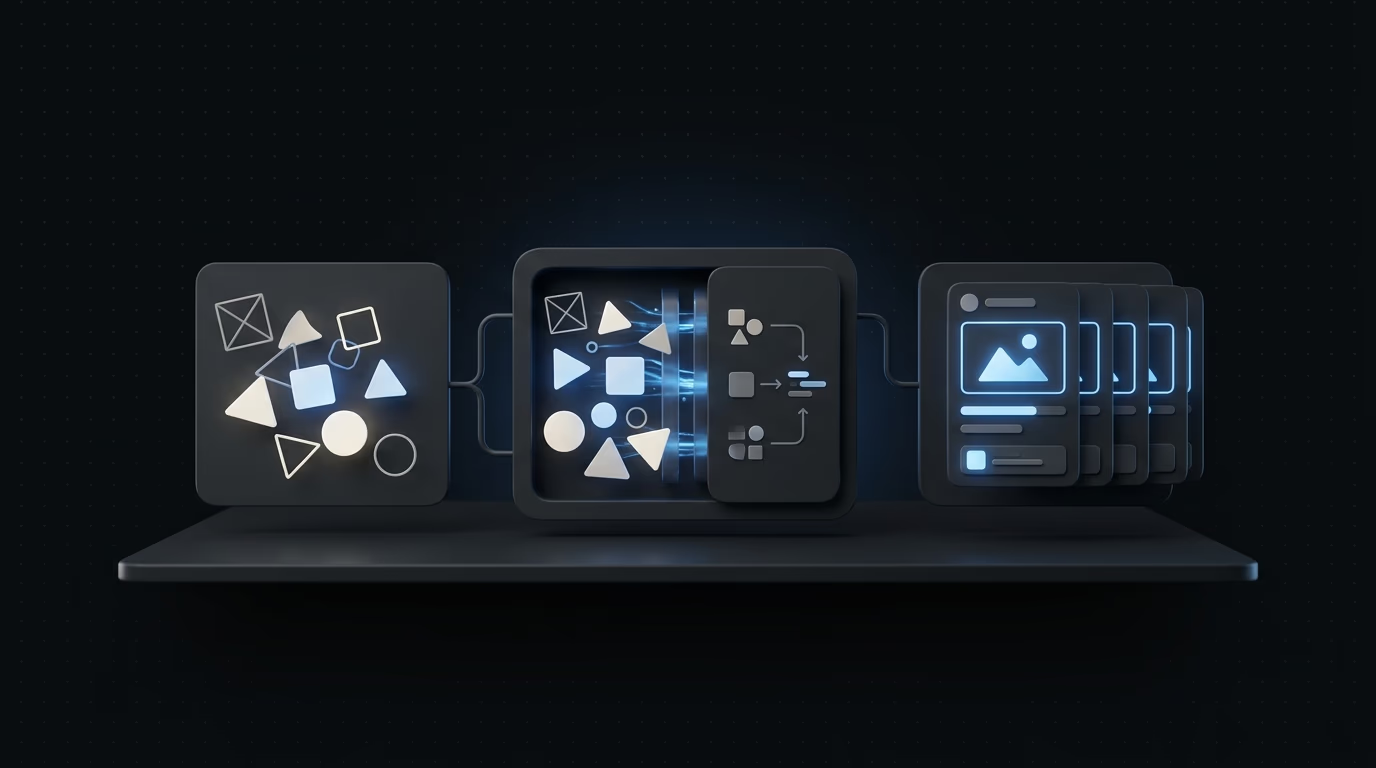
1. Pattern Extraction
Claude Code processes competitor landing pages and outputs structured insights:
- Short headline + heavy proof above the fold
- Long-form educational pages with delayed CTA
2. Creative Expansion
Each pattern expands into multiple variations:
- Different hooks
- Multiple visual angles
- Several CTA framings
One landing page pattern can generate 10–20 ad concepts.
3. Bulk Ad Generation
Instead of building ads manually, a Facebook ads uploader pushes everything live in batches.
This isn’t just about saving time—it’s about removing the ceiling on how many ideas you can test.
If you want a deeper breakdown of this process, see How to Build a Facebook Ads Bulk Testing System with Instrumnt and Claude Code.
4. Structured Naming and Mapping
Every ad ties back to its source:
- Landing page type
- Offer structure
- Hook variation
Now performance isn’t random. You can trace results back to inputs.
5. Deployment into Meta
Once structured, campaigns are deployed at scale.
At this point, competitor research is no longer a side task—it feeds directly into your testing pipeline.
Closing the Loop: Using Performance Data to Refine Competitor-Derived Angles
Launching ads is just the beginning.
Once campaigns run, you see which patterns actually work in your account:
- Which landing page structures drive CTR and CPA
- Which hooks fail despite looking strong in competitor ads
- Which combinations scale
Now the system improves itself:
- Winning patterns get expanded
- Weak ones get removed
- New competitor pages feed into the pipeline
This creates a compounding advantage.
If you want to understand how this loop evolves over time, Automated Facebook Ads Learning Loops with Instrumnt and Claude Code breaks it down in detail.
Why AI-Driven Automation Outperforms Traditional Testing Methods
Traditional competitor research is static.
You collect examples, review them, and maybe apply insights later.
This system is continuous:
- New landing pages are discovered automatically
- Claude Code structures them into usable data
- Insights become ad variations instantly
- A Facebook ads uploader deploys them in bulk
- Performance data feeds back into the system
That loop runs continuously.
Meanwhile, most tools in the market—including Revealbot, AdManage.ai, and Paragone—focus on optimization after launch. They don’t address how ideas are generated at scale.
That’s the real bottleneck.
If you can’t produce and test ideas quickly, optimization tools won’t fix the problem.
The System in Practice
Once implemented, a few things change:
- Competitor research becomes proactive instead of reactive
- Landing pages become structured inputs
- Creative production becomes predictable
- Testing volume increases without hiring more people
More importantly, insights compound.
You stop asking, “what are competitors doing?” and start asking, “what should we test next?”
The research layer and the execution layer need to be connected. FB Ads Library Won't Show You Winners covers how to extract structured variables from competitor ads — the same approach applied to landing pages. And Facebook Ads Uploader: Instrumnt vs Competitors covers the deployment side: once you have patterns worth testing, how to push 20–50 variations live without manual setup.
The Meta Ad Library is the starting point for ad discovery — it surfaces the visible ads that link to the landing pages this system is designed to capture and analyze. For the conversion side, Unbounce's conversion benchmark report provides industry-level context for the landing page performance data referenced throughout this post, and is worth revisiting as you score and prioritize the pages you extract.
Common questions about find all ad landing pages of competitors
What is the best way to find all ad landing pages of competitors?
The best approach depends on your team size and launch volume. Start by structuring your workflow around batch preparation and bulk uploading, then layer in automation for the parts that don't need human judgment.
How many ad variations should I test?
Advertisers running 3 or more variations per audience consistently see lower CPAs. Aim for at least 3-5 variations per ad set as a starting point, and increase from there as your workflow allows.
Does automation replace the need for creative strategy?
No. Automation handles the operational side, like launching, duplicating, and naming ads at scale. Creative strategy, offer positioning, and audience selection still require human judgment. The goal is to free up more time for that strategic work.