
A little after 9:00 a.m. on a Monday, the growth team at a mid-market ecommerce brand opened its weekly performance review.
Nothing appeared broken. Spend was stable. Tracking worked. Campaign structures looked familiar. Yet Facebook ads performance had clearly stalled.
Cost per acquisition was rising. Click-through rates were drifting downward. Revenue still existed, but every incremental conversion felt harder to acquire.
This facebook creative testing framework scenario follows how the team diagnosed a performance plateau, rebuilt its testing operation, increased creative throughput, and reduced the time required to identify winning ads.
The Plateau: Why Stable Spend Stopped Producing Better Results
The team started by reviewing everything that normally gets blamed.
They checked audiences, attribution settings, placements, bidding strategies, landing pages, and campaign architecture.
Nothing explained the decline.
What stood out was creative concentration. Three ads were responsible for most conversions, and those same ads had been carrying results for weeks.
A key statistic changed the conversation. According to Nielsen and Meta Creative Impact Research, creative quality can account for up to 56% of campaign sales lift. Source: Nielsen and Meta Creative Impact Research.
If creative influences such a large share of advertising outcomes, then a lack of creative testing can become a major growth constraint.
The account was not constrained by budget. It was constrained by learning velocity.
The team also revisited lessons from Breaking the Creative Bottleneck: How One Growth Team Scaled Facebook Ads Throughput with AI and Why Your Facebook Ads Are Not Working (It’s Not Targeting, Bidding, or Budget).
Creative Audit: Discovering That Testing Volume Was the Real Constraint
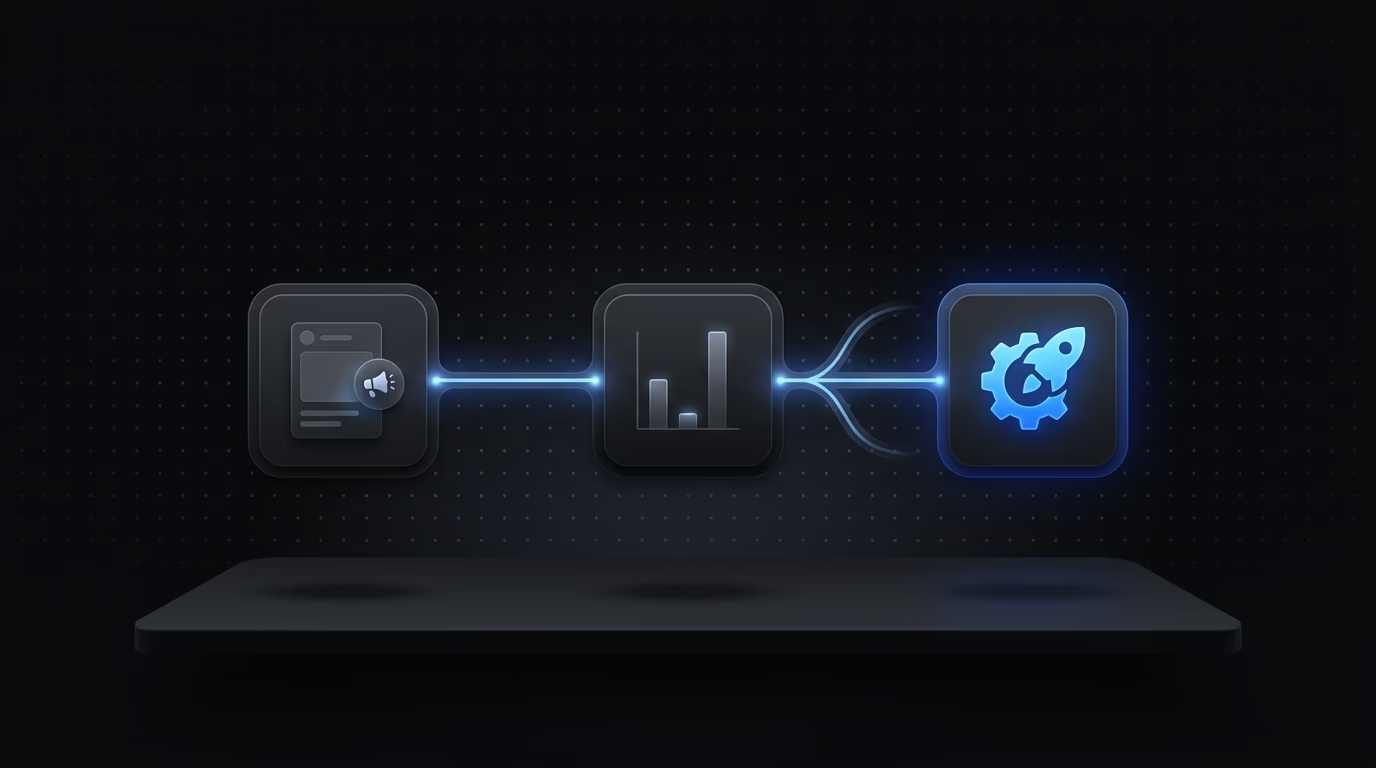
To understand the problem, the team mapped every step between idea creation and campaign launch.
An idea started in Slack. Someone converted it into a brief. A designer created assets. A copywriter wrote variations. A media buyer manually rebuilt everything inside Ads Manager.
Individually, every step seemed reasonable. Collectively, the process was painfully slow.
Creative concepts frequently waited days for production, approvals, or implementation.
During the review, the team uncovered more than forty documented creative ideas from previous meetings. Only a small fraction had ever been tested.
The organization had no shortage of ideas. It had a shortage of execution capacity.
Rather than asking how to optimize campaigns, the team started asking how to accelerate experimentation.
They documented every bottleneck:
- Long approval cycles
- Manual campaign setup
- Inconsistent naming conventions
- Missing test documentation
- Delayed reporting reviews
The audit revealed that creative throughput was the limiting factor. Winning ideas were trapped in spreadsheets instead of reaching live campaigns.
The discussion reinforced a broader lesson. Many Facebook ads teams focus on optimization after launch while ignoring the operational system required to generate learning before launch. The best-performing organizations are often not the ones with the largest budgets. They are the ones capable of testing more meaningful ideas every month.
Failed Experiment: A Hypothesis That Looked Promising but Produced No Lift

Before redesigning the system, the team examined a recent failure.
A competitor had launched polished lifestyle videos. Stakeholders believed the brand needed similar creative.
The resulting test changed multiple variables simultaneously:
- New visual style
- New offer positioning
- New headlines
- New calls to action
Results underperformed.
The problem was not simply that the test lost. The problem was that nobody learned why.
Because multiple variables changed together, the team could not isolate the cause.
From that point forward, the team adopted four testing rules:
- One primary hypothesis per test.
- One major variable changed at a time.
- Success metrics defined before launch.
- Written conclusions after every experiment.
The goal shifted from predicting winners to building a reliable learning system.
The failed experiment became one of the most valuable lessons in the entire project. It exposed how often teams confuse activity with experimentation. Launching ads is not the same thing as generating knowledge.
Rebuilding the Facebook Creative Testing Framework Around Learning Velocity
The new facebook creative testing framework centered on four operational stages.
Stage 1: Hypothesis Generation
Every Friday the team reviewed recent winners.
Ads were categorized by hook type, offer structure, visual style, customer objection addressed, and format type.
Patterns emerged quickly. Problem-focused hooks consistently outperformed feature-heavy messaging. User-generated style concepts often produced stronger engagement than highly polished creative.
New ideas were no longer based on guesswork. They were based on evidence.
Stage 2: Structured Test Design
Random ad creation disappeared.
Each testing batch answered a specific question.
One batch tested hooks while keeping visuals constant. Another tested visual treatments while keeping copy identical. A third tested offers while maintaining the same creative format.
This structure made interpretation dramatically easier.
Stage 3: Measurement
The reporting process became simpler.
Rather than monitoring dozens of metrics, the team focused on CTR, CPA, and conversion rate.
The team also introduced external benchmarks. According to WordStream Facebook Advertising Benchmarks, the average Facebook ads click-through rate across industries is approximately 0.90%. Source: WordStream Facebook Advertising Benchmarks.
This statistic provided context when evaluating engagement trends and helped the team determine whether declining CTR reflected normal variation or genuine creative fatigue.
The team used Sotrender to compare creative groups and identify performance patterns across campaigns. However, they learned that reporting tools only create value when connected to a structured testing process.
Stage 4: Documentation
Every completed test ended with written analysis.
The team documented hypotheses, variables tested, results, lessons learned, and recommended next experiments.
Unexpectedly, many future winners emerged from insights gathered during earlier failures.
Documentation transformed isolated tests into a compounding knowledge system.
The team also borrowed ideas from Automate Creative Testing for Meta Ads, particularly around repeatable workflows and consistent experiment records.
Operational Scale: Publishing Large Test Batches Without Bottlenecks
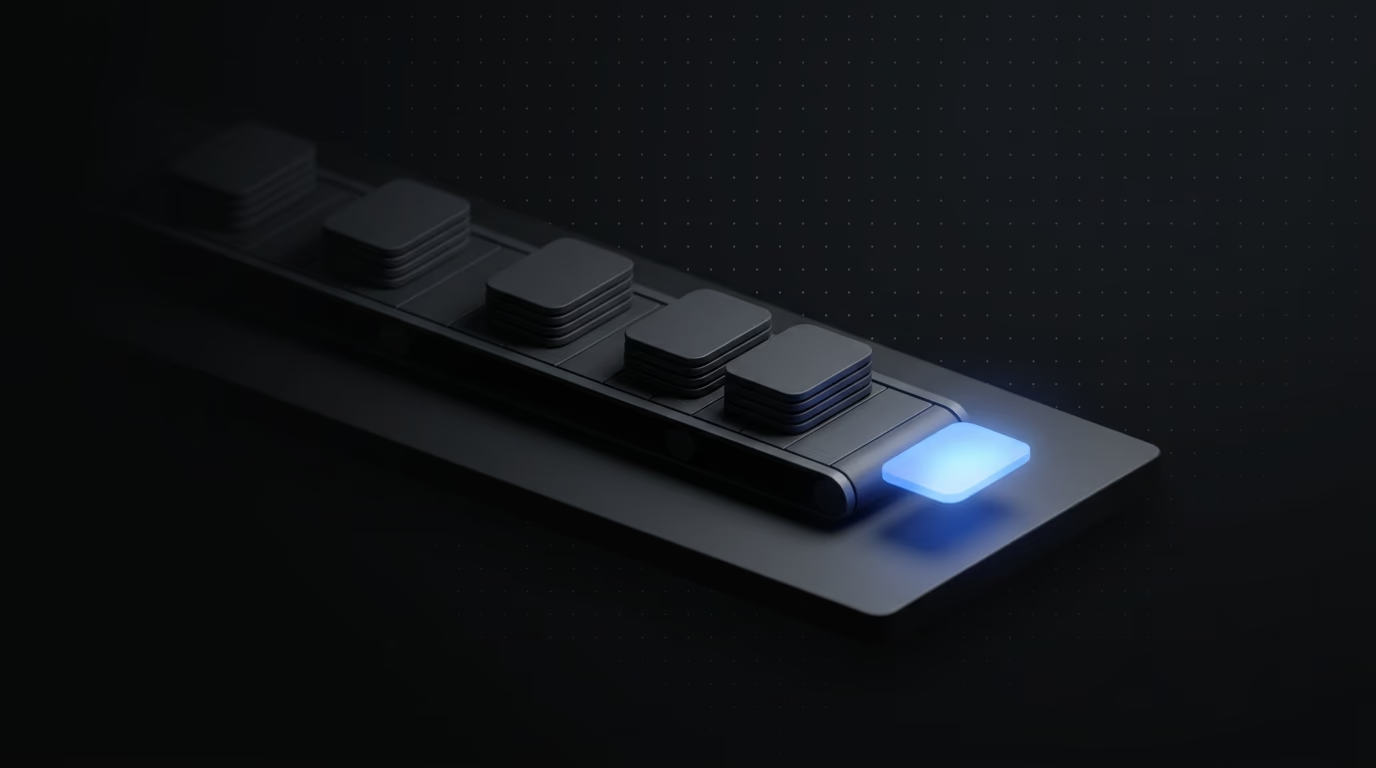
Once testing became more disciplined, another bottleneck appeared.
The team suddenly had more ideas than publishing capacity.
Manual ad creation inside Ads Manager slowed everything down.
They evaluated multiple workflow approaches.
Large enterprise advertisers frequently use Smartly.io to improve operational efficiency across complex advertising programs. The team reviewed those operational concepts but focused primarily on solving its own throughput challenges.
They also reviewed Ads Uploader workflows designed to reduce repetitive implementation work.
Ultimately, they built a process centered on Instrumnt and a Facebook ads uploader workflow optimized for batch publishing.
Instead of creating ads individually, they prepared structured templates and launched larger groups of variations simultaneously.
The impact was immediate. Hours previously spent on repetitive setup shifted toward analysis, creative development, and experimentation.
The Facebook ads uploader did not magically improve performance. It improved speed.
Faster publishing created faster feedback loops. Faster feedback loops created better decisions.
The team also explored ideas from How to Scale Meta Ads with Bulk Uploading.
A surprising insight emerged. Operational friction was creating hidden costs. Every extra click, approval, or manual upload delayed learning. Removing those delays effectively increased testing capacity without increasing headcount.
AI-Powered Testing Operations With Instrumnt
Once operational friction decreased, attention shifted toward analysis.
The team combined Instrumnt, AI workflows, and Claude Code to build a structured learning environment.
The system helped them:
- Analyze historical winners
- Cluster recurring creative themes
- Generate new hypotheses
- Maintain testing logs
- Build future experiment matrices
- Reduce manual research effort
Importantly, AI did not replace media buyers.
Humans still decided what to test, how to allocate budget, and when to scale.
The value came from accelerating research and pattern recognition.
Instead of manually reviewing months of campaign history, teams could surface insights in minutes.
This approach aligned closely with concepts explored in Automated Facebook Ads Learning Loops with Instrumnt and Claude Code and Scaling Facebook Ad Testing: Why AI Is the Key to Breaking Through Your Creative Bottleneck.
Claude Code became particularly useful for organizing findings from dozens of experiments. Rather than searching through notes, the team maintained a searchable history of outcomes, hypotheses, and recommendations.
The result was a more intelligent feedback loop. Each test improved the quality of future tests. Over time, the organization became better at generating high-probability ideas because its learning system continued to accumulate evidence.
How the Team Reduced Time to Winning Creative
Three months later, results looked different.
There was no miracle ad. No hidden targeting trick.
Performance improved because the organization learned faster.
| Metric | Before | After |
|---|---|---|
| New creatives launched per month | 6 | 28 |
| Average test cycle | 21 days | 7 days |
| Documented hypotheses | Inconsistent | Every test |
| Creative review cadence | Monthly | Weekly |
| Time to identify winners | Slow and subjective | Structured and repeatable |
The most important improvement was not a single KPI.
It was the reduced cost of failure.
Weak ideas were identified quickly. Lessons were documented. New experiments launched immediately.
Learning compounded over time.
The team no longer depended on a handful of winning ads. Instead, it relied on a system capable of continuously producing new candidates, testing them, and scaling what worked.
What Other Teams Can Take From This Scenario
The lesson is not that the team discovered a secret Facebook ads tactic.
The breakthrough came from recognizing that creative throughput was the real constraint.
Many advertisers assume growth requires larger budgets, more audiences, or increasingly complex campaign structures.
Sometimes the bottleneck is operational.
Ideas move too slowly through the organization. Creative fatigue is inevitable. Winning ads eventually stop winning.
Teams that can generate hypotheses, launch experiments, document findings, and scale successful concepts consistently gain an advantage.
That is ultimately what a facebook creative testing framework should accomplish.
Ads Uploader, Smartly.io, and Sotrender all appeared during the team's evaluation process, but the larger lesson was that tools only create leverage when they support a disciplined operating system.
Organizations that combine strong processes, a reliable Facebook ads uploader workflow, AI-assisted analysis, and disciplined documentation create a durable advantage that is difficult to replicate.
Common Questions About Facebook Creative Testing Framework
How many Facebook ad creatives should be tested at the same time?
Most advertisers benefit from testing three to five meaningful variations around a single hypothesis. The right number depends on budget, audience size, and production capacity.
What is the fastest way to identify a winning Facebook ad creative without increasing budget?
Reduce the time between idea generation and launch. Structured experimentation, disciplined measurement, batch publishing, and an efficient Facebook ads uploader workflow generally accelerate learning faster than simply increasing spend.
How can AI and Claude Code improve a Facebook creative testing framework?
Claude Code can help organize historical performance data, identify recurring patterns, generate hypothesis ideas, maintain documentation, and support analysis workflows. Combined with AI-powered systems in Instrumnt, teams can spend less time searching for insights and more time executing tests.
For additional context, advertisers often review Meta for Business resources, advertising standards documentation, and workflow automation tools when building scalable creative testing systems.
For more context, see Meta for Business Help Center.
For more context, see Meta Advertising Standards.
For more context, see Ads Uploader.