The Performance Plateau: When the Creative Pipeline Runs Dry
On a Tuesday morning performance review, the growth team noticed something odd in their Facebook ads dashboard.
Spend had increased steadily over the previous six weeks. Traffic looked healthy. But performance had stalled. Cost per acquisition crept upward, and new winning ads showed up less often.
At first the team blamed creative fatigue. They rotated out older ads and launched a few replacements.
Nothing changed.
During the meeting, one analyst pulled up a simple chart: how many new ads the team actually launched each week.
The number surprised everyone.
Despite managing a large ad budget, the team was launching only eight to ten new ad variations per week. For an account spending heavily on Facebook ads, that was barely a testing program.
Industry benchmarks show the average Facebook ad CTR is around 0.90% and average CPC sits near $0.94, which means incremental improvements depend heavily on creative testing volume rather than small optimizations (WordStream).
The team assumed they were running dozens of experiments. In reality, Meta's delivery system was getting very little creative input.
The issue wasn’t targeting. It wasn’t bidding strategy.
It was the Facebook ads creative pipeline.
Ideas came from brainstorming sessions. Designers produced some assets. Media buyers uploaded finished ads into Ads Manager. Each step existed, but the flow between them kept breaking. By the time creatives reached the account, most potential variations had disappeared.
The algorithm wasn’t short on budget.
It was short on experiments.
Tracing the Real Bottleneck Between Ideas and Live Ads
At a glance, the pipeline looked straightforward:
- Marketing proposes creative ideas.
- Designers produce assets.
- Media buyers upload ads.
But once the team mapped the workflow step by step, the gaps became obvious.
Most ideas weren’t structured. Someone might drop a sentence into Slack: “Ad about saving time on reporting.” That was the whole brief. Designers interpreted it one way. Media buyers framed it another.
The second constraint was production. Designers usually made one or two variations per idea. Maybe the headline changed slightly. The concept stayed the same.
Then came the final slowdown: uploading ads.
Ads were built manually inside Ads Manager. A media buyer duplicated an ad, swapped the image, edited the headline, adjusted settings, and repeated the process. Even if someone worked quickly, there was a practical limit.
Many teams misread this situation. They start looking for new reporting dashboards or bidding platforms.
Tools like Marin Software and Hunch are useful for analytics and forecasting. But neither changes how quickly creative ideas become live ads. Meta’s own documentation outlines how ad structures and formats work, but not how to scale creative throughput (Meta Ads Guide).
That was the real constraint here.
The team didn’t lack insights.
They lacked experiments.
Research from Nielsen and Meta shows creative quality drives up to 56% of campaign ROAS variation, reinforcing how critical consistent testing is.
Once they diagrammed the process, three choke points were clear:
- ideas rarely expanded beyond a single concept
- designers produced too few variations
- manual uploads limited how many ads actually launched
Fixing one step wouldn’t solve it. The pipeline itself needed redesigning.
Mini Example: Expanding a Single Hook Into Multiple Creative Directions

The first change was simple.
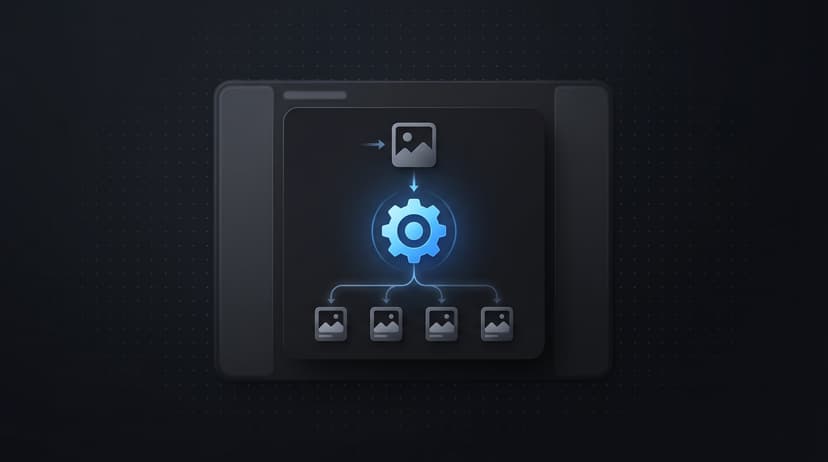
Instead of treating each idea as a single ad, the team treated it as a starting point for variations.
One hook from a planning session read:
“Reduce reporting time for paid ads teams.”
In the past, that might become one or two ads—a static image and maybe a short video.
This time the team pulled the idea apart.
They asked: what different angles could this hook support?
They landed on several directions:
- speed and productivity
- team collaboration
- cost efficiency
- operational simplicity
- automation and AI
Each direction generated multiple ad concepts.
For example, the “speed” angle alone produced:
- a headline focused on hours saved each week
- a visual metaphor showing a faster campaign pipeline
- a short video walking through the workflow
- a comparison graphic of manual vs automated reporting
Within an hour, that single hook turned into more than a dozen distinct creative directions.
Advertisers running three or more variations per audience have been shown to reduce CPA by up to 30%, which highlights the impact of this shift.
The structural change mattered.
Ideas were no longer single outputs. They were inputs for a chain of experiments.
But expanding ideas only helped if the team could actually launch the resulting ads.
That exposed the next constraint.
Uploader Workflow: Feeding the Pipeline with Instrumnt
Once creative variation increased, the team hit a familiar wall: launching everything.
Manual uploads couldn’t keep up.
A media buyer would open Ads Manager, duplicate ads, swap headlines, upload images, tweak settings, and repeat the process. Even small batches took time. As variation volume increased, the upload stage slowed the whole system again.
The team needed infrastructure.
Specifically, a Facebook ads uploader.
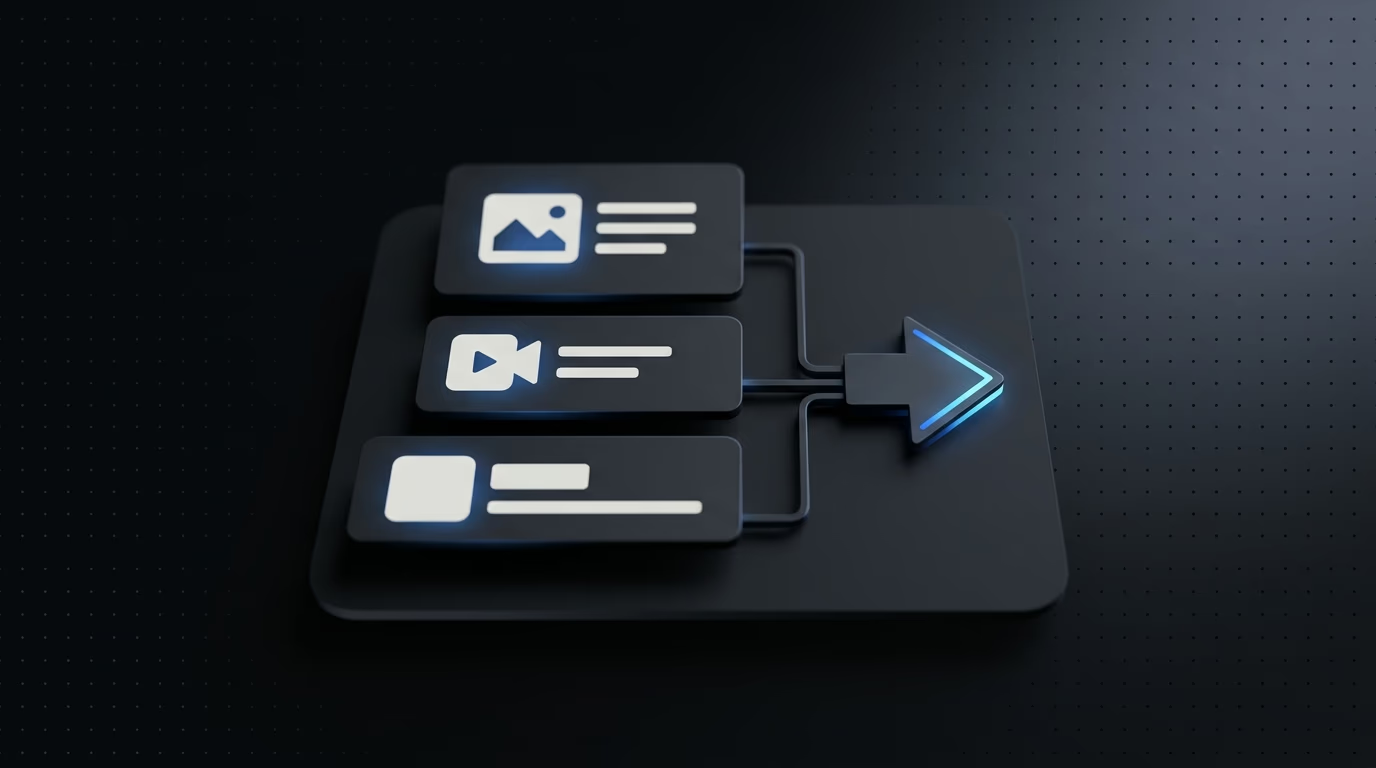
Instead of building ads one by one, they organized creatives in a structured sheet and launched them through Instrumnt.
Using a dedicated Facebook ads uploader changed the workflow:
- dozens of ad variations could be prepared in one file
- headlines, visuals, and descriptions could be mapped across combinations
- large batches of Facebook ads could launch in minutes
Teams that batch ad creation report saving 4–6 hours per week per account, which removes a major operational bottleneck.
The effect was immediate.
Uploads stopped acting as the gatekeeper for testing.
For a growth team running many experiments, this change felt similar to moving from manual deployments to automated infrastructure in engineering. The repetitive work disappeared.
If you want to see how bulk launch workflows fit into broader campaign scaling, the mechanics are explained in this guide on How to Scale Meta Ads with Bulk Uploading.
In practice, Instrumnt became the bridge between creative generation and delivery. Designers produced modular assets. Strategists mapped variation logic. The uploader assembled everything into real campaigns. For deeper platform guidance, Meta provides operational resources in its help center (Meta for Business Help Center).
The pipeline finally flowed end to end.
AI-Powered Creative Iteration with Claude Code
The team had fixed production and uploading. One weak spot remained: idea generation.
Previously, brainstorming sessions drove most concepts. Some weeks produced strong hooks. Other weeks produced almost nothing.
That unpredictability made the pipeline fragile.
So the team added AI-assisted iteration to the front of the system.
Using Claude Code, they built a simple weekly workflow:
- Feed in performance summaries from the previous week’s Facebook ads.
- Generate new creative angles based on winning hooks.
- Expand each angle into headline and visual directions.
Instead of starting Monday with a blank page, the marketing team started with dozens of structured concepts.
Those ideas moved directly into production and then into the Facebook ads uploader.
This approach connects closely to a broader shift discussed in Scaling Facebook Ad Testing: Why AI Is the Key to Breaking Through Your Creative Bottleneck. AI shortens the feedback loop between performance data and creative experimentation.
For this team, the benefit wasn’t just more ideas.
It was consistency.
Every week the pipeline produced a predictable volume of experiments.
How the New Pipeline Changes Weekly Testing Velocity
Three months after rebuilding the system, the team reviewed the account again.
The biggest change wasn’t performance metrics at first.
It was activity.
The account contained far more experiments.
Instead of launching a handful of ads each week, the team deployed structured batches of variations. Meta’s delivery system suddenly had a larger pool of creatives to evaluate.
The difference looked like this:
| Metric | Before Pipeline Redesign | After Pipeline Redesign |
|---|---|---|
| New ads launched per week | 8–10 | 40–60 |
| Creative ideas per week | 3–4 | 15–20 |
| Time spent on manual uploads | High | Minimal |
| Speed of identifying winning creatives | Slow | Faster |
Notice what didn’t change.
The team didn’t suddenly invent better marketing messages. They didn’t discover a new targeting trick for Facebook ads.
What changed was the system.
Ideas expanded into multiple directions. Designers produced modular assets. Instrumnt handled bulk launches through a structured Facebook ads uploader.
Once those pieces connected, the Facebook ads creative pipeline stopped starving the algorithm.
And when the algorithm has more experiments to evaluate, it learns faster.
That’s usually what unlocks the next stage of scaling Facebook ads.
FAQ
What is a Facebook ads creative pipeline?
A Facebook ads creative pipeline is the system that moves ideas from concept to live ads, including ideation, design, and upload. Weak pipelines limit testing volume and slow performance gains.
How many ad variations should you test per week?
Most high-performing accounts test dozens of variations weekly. Data suggests running at least three variations per audience can significantly improve CPA outcomes.
Why does creative volume matter more than targeting?
Creative is the primary driver of performance in modern Meta campaigns. With algorithms handling targeting, growth depends on feeding the system enough high-quality variations to learn from.
Where to go next
A healthy creative pipeline needs two things working in parallel: a steady input of ideas and a fast path to deployment. Facebook Ads Uploader: Instrumnt vs Competitors covers the deployment side in detail — how to choose the right uploader for your team's volume. If your ideas are coming from competitor research, Automate Creative Testing for Meta Ads shows how to turn those inputs into a structured testing cadence.
Two external references are worth keeping close as you build. Nielsen's research on creative effectiveness is the source behind the widely cited figure that creative accounts for the majority of campaign performance — a useful grounding point when making the case internally for investing in pipeline infrastructure. And Meta's creative guidelines documents the format and placement specifications that your pipeline output needs to meet before it reaches delivery.