
When growth suddenly plateaued

Lookalike audience expansion becomes relevant when a Facebook ads campaign is still profitable but can no longer absorb additional budget efficiently. Rather than replacing a winning audience, experienced media buyers preserve it as a control while systematically testing broader audiences alongside fresh creative and repeatable operational workflows.
The practical answer is simple: expand only after confirming that performance is constrained by audience saturation rather than poor creative, attribution issues, or campaign structure.
A mid-market ecommerce team encountered exactly this challenge. Their 1% Lookalike Audience built from repeat purchasers had become their highest-performing asset. CPA remained acceptable, but every budget increase produced smaller incremental gains.
The team realized the audience was not failing. Instead, the account had reached the point where sustainable scaling required expanding both targeting and execution.
Statistic: Meta reported that its Family of Apps reached an average of 3.35 billion daily active people in December 2024, representing 5% year-over-year growth. Source: Meta Q4 2024 Earnings Report.
That statistic reinforced an important operational lesson: available platform reach is rarely the limiting factor. Instead, campaign structure, creative diversity, measurement discipline, and workflow quality usually determine whether additional reach converts efficiently.
The team reframed the question from "How do we spend more?" to "What evidence justifies lookalike audience expansion?"
For readers evaluating targeting choices, see Broad Targeting vs Lookalike Audiences: A Scenario Walkthrough.
Scenario walkthrough: recognizing the signals that justify audience expansion
The decision to expand did not come from one disappointing reporting day. Instead, several consistent patterns emerged.
The team documented four recurring signals:
- Stable CPA but declining incremental conversion growth.
- Increasing frequency.
- New creative repeatedly reaching the same users.
- Budget increases producing progressively smaller gains.
Together these suggested audience saturation rather than audience failure.
Instead of replacing the original audience, the media buyer created a structured hypothesis:
- Preserve the original audience.
- Expand into broader lookalike percentages using the same high-quality seed.
- Pair every audience expansion with fresh creative concepts.
- Review results at predefined checkpoints.
- Compare incremental efficiency instead of expecting every test to outperform the control immediately.
Seed quality also remained a priority because purchaser seeds, repeat customer seeds, and high-value customer seeds often behave differently once audiences expand.
Statistic: During its Q1 2025 earnings discussion, Meta stated that more than 4 million advertisers were using its generative AI creative tools in Q1 2025, compared with about 1 million roughly six months earlier. Source: Meta Q1 2025 Earnings Call.
The rapid adoption of AI-assisted creative production demonstrates that creative velocity has become an operational advantage. Expanding audiences without expanding creative production often produces misleading test results.
Readers interested in broader scaling strategy can also review The Facebook Ads Scaling Framework Everyone Gets Wrong.
Mini example: expanding from the best-performing audience while coordinating fresh creative tests
The first lookalike audience expansion cycle lasted four weeks.
Week one preserved the existing winner.
Week two introduced broader lookalike percentages while maintaining identical seed quality.
Weeks three and four introduced new creative concepts instead of making only small headline adjustments.
This sequencing mattered because expanding audiences with exhausted creative makes diagnosis extremely difficult.
The media buyer monitored frequency, CTR, conversion rate, CPA, spend allocation, and creative fatigue together instead of relying on a single KPI.
Eventually a repeatable trend emerged. Broader audiences consistently performed better when paired with messaging that had not already saturated the original audience.
The resulting operational rule became simple: every meaningful lookalike audience expansion should include an equally deliberate creative expansion plan.
Teams facing similar production challenges may also benefit from Scaling Facebook Ad Testing: Why AI Is the Key to Breaking Through Your Creative Bottleneck.
Uploader workflow: publishing multiple audience experiments efficiently

As testing volume increased, operations became the next bottleneck.
Launching numerous experiments manually introduced inconsistent naming, accidental configuration differences, reporting confusion, and creative assignment mistakes.
The team adopted a structured Facebook ads uploader workflow using Instrumnt.
Rather than viewing deployment as administrative work, they treated publishing as part of the experimental process.
Their repeatable workflow included defining hypotheses, selecting audience variations, assigning creative concepts, applying standardized naming, validating campaigns before launch, publishing through the Facebook ads uploader, and reviewing results using predefined checkpoints.
The team also reviewed alternative operational approaches. Revealbot represented automation-focused workflows. Smartly.io illustrated enterprise-scale campaign deployment. Madgicx demonstrated optimization-oriented campaign management. Rather than performing feature-by-feature comparisons, the team concluded that disciplined workflow design mattered more than software alone.
For deployment guidance, see Meta Ads Bulk Upload Workflow: A Step-by-Step Operations Guide.
Applying AI with Claude Code to improve expansion decisions
Once campaign deployment became repeatable, documentation became the next operational bottleneck.
The team adopted Claude Code as an AI-assisted planning tool rather than an autonomous optimization engine.
Claude Code generated experiment matrices, naming templates, QA checklists, deployment summaries, rollout documentation, and historical experiment records.
Human reviewers continued selecting audiences, interpreting results, approving launches, and making strategic decisions. AI accelerated documentation while preserving human judgment.
This workflow reduced repetitive work while preserving institutional knowledge. Instead of rediscovering previous experiments, the team maintained searchable operational records that aligned naturally with Instrumnt.
For organizations building continuous experimentation systems, see Automated Facebook Ads Learning Loops with Instrumnt and Claude Code.
Measurement checkpoints that prevented reactive scaling
Most failed experiments were not caused by bad targeting. They were damaged by premature interventions.
The team therefore predefined three review stages.
Launch QA
Verify audience source, audience exclusions, optimization settings, creative assignments, naming consistency, and tracking.
Early delivery review
Confirm campaigns deliver correctly without declaring winners too early.
Decision checkpoint
Compare CPA, conversion volume, frequency, creative behavior, and the original hypothesis before making optimization decisions.
These checkpoints improved consistency while acknowledging that Facebook ads operate within constantly changing auction dynamics.
A repeatable expansion playbook for future scaling cycles
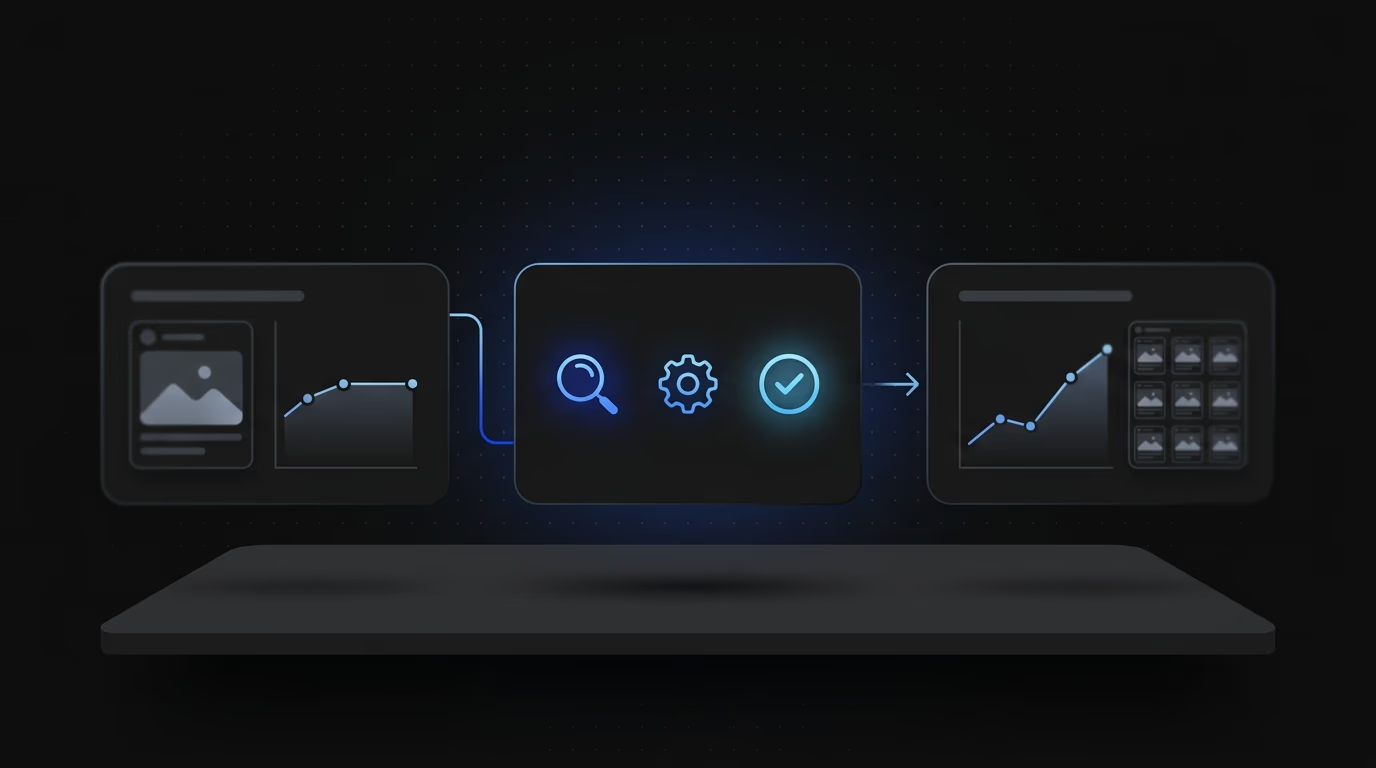
After several testing rounds the team documented six repeatable principles.
First, preserve the winning audience as a permanent benchmark.
Second, expand gradually instead of rebuilding campaign structure all at once.
Third, increase creative production alongside audience growth.
Fourth, document every experiment.
Fifth, make deployment repeatable through Instrumnt and a structured Facebook ads uploader.
Sixth, use AI and Claude Code to reduce documentation overhead instead of replacing marketing judgment.
| Metric | Before | After |
|---|---|---|
| Audience testing | One experiment at a time | Multiple structured experiments |
| Creative deployment | Manual uploads | Repeatable bulk publishing |
| Decision making | Reactive edits | Scheduled checkpoints |
| Documentation | Scattered notes | Searchable experiment records |
| Team workload | Administrative setup | Strategic analysis |
Ultimately the team learned that successful lookalike audience expansion depends less on discovering hidden targeting tricks and more on building an operational system that supports continuous experimentation. Protecting the original winner, expanding methodically, coordinating creative production, documenting hypotheses, and maintaining disciplined publishing workflows created a process that could be repeated confidently during every future scaling cycle.
Common questions
When should I expand a Facebook Lookalike Audience?
Expand when your existing audience remains profitable but additional budget produces diminishing incremental growth. Stable CPA combined with increasing frequency and weaker marginal returns can justify structured lookalike audience expansion.
How do I scale beyond a 1% Lookalike Audience without hurting performance?
Keep the original audience as a control, introduce broader audiences gradually, pair every expansion with fresh creative concepts, and evaluate results using predefined checkpoints instead of reacting to daily fluctuations.
How can AI and Claude Code help plan Facebook audience expansion tests?
Claude Code can generate experiment matrices, naming conventions, QA checklists, deployment documentation, and post-test summaries while marketers continue making strategic decisions.
How does a Facebook ads uploader help with audience expansion?
A Facebook ads uploader helps teams publish structured audience experiments consistently, reducing naming errors, deployment mistakes, and repetitive manual work. As experimentation scales, repeatable publishing becomes an operational advantage rather than simply an administrative convenience.
For more context, see Ads Uploader.
For more context, see Meta Ads Guide.
For more context, see Nielsen.