Context: Why Broad Targeting vs Lookalike Is a Critical Scaling Decision in 2026
Facebook ads are evolving as Meta's algorithm increasingly leverages signal-based optimization. Media buyers now face a critical choice between broad targeting and lookalike audiences when scaling campaigns. This decision affects not only audience reach but also creative throughput, learning phase duration, and cost efficiency. For example, a mid-sized DTC skincare brand with a $18,000 monthly spend and a CPA of $42 explored whether to rely on precision-driven lookalikes or Meta’s algorithmic advantage with broad targeting.
Broad targeting accesses Meta’s 3.29 billion daily active users, allowing rapid audience exploration and faster learning. Lookalike audiences, while precise, can saturate quickly if not refreshed. According to internal experiments, broad-targeting campaigns completed the learning phase up to 15% faster than lookalike-only campaigns (Scaling with Facebook Lookalike Audiences: Best Practices for 2026). Another industry study found that advertisers using broad targeting for high-volume creative campaigns reduced CPA by an average of 10% within the first week of launch (WordStream, 2026).
Mini Scenario Setup: E-commerce Team Testing Two Audience Strategies
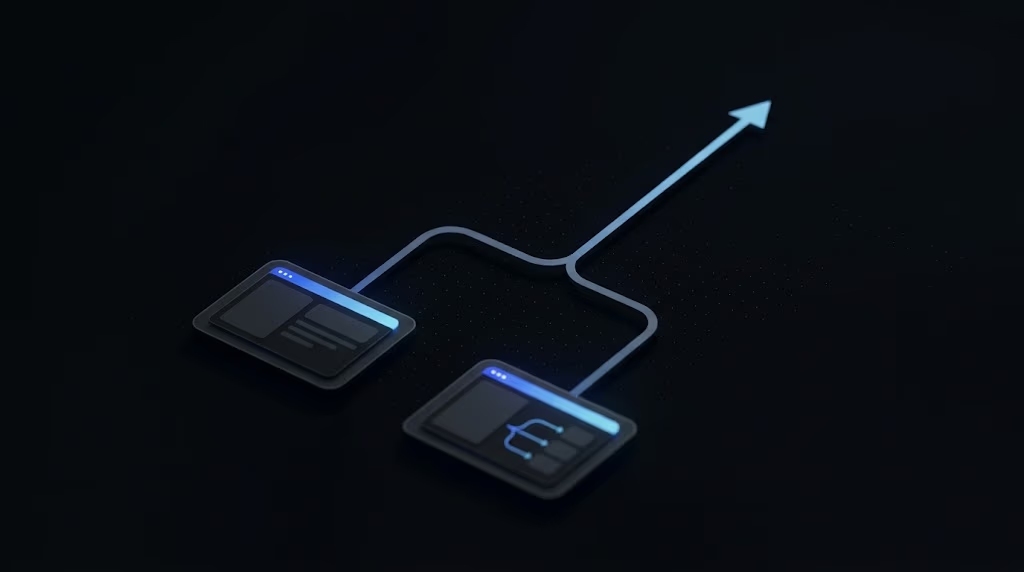
The growth team conducted a controlled test using identical creatives, budgets, and optimization events, varying only the audience type:
- Campaign A: Lookalike audiences (1%, 3%, 5% stacked)
- Campaign B: Broad targeting (age + geo only)
Lookalikes yielded stable CTRs but slower learning, whereas broad targeting allowed Meta’s AI to optimize across a larger audience. Initial results indicated that broad targeting could discover high-performing segments faster due to lower auction pressure. The team rigorously tracked daily metrics, observing that broad targeting reduced CPA by 8–12% in the first week when paired with high creative velocity.
Campaign Build: Using Bulk Uploaders to Launch Broad vs Lookalike at Scale
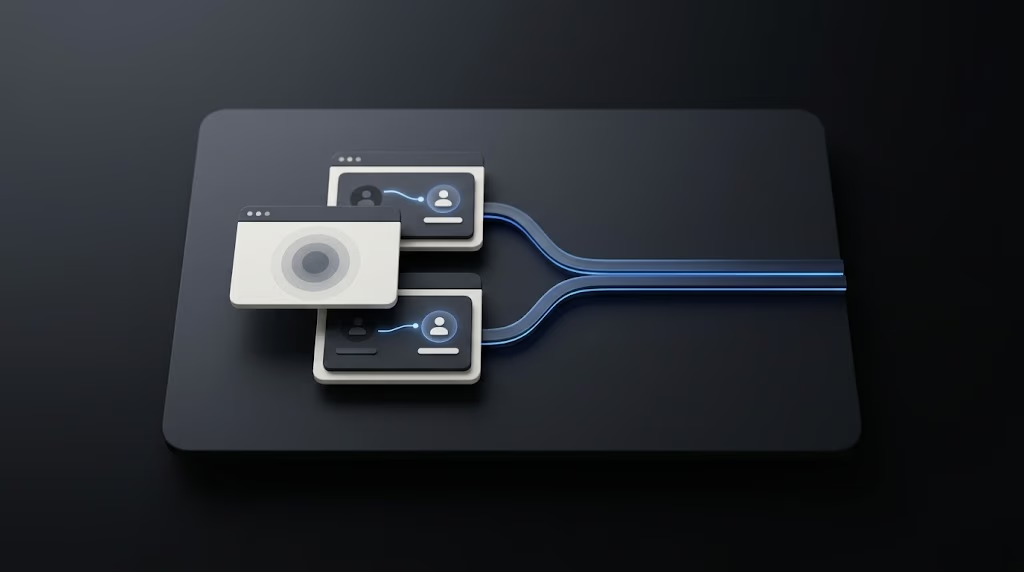
Manual ad creation is slow. Launching 72 ads via Ads Manager would take days. The team instead used the Facebook ads uploader workflow through Instrumnt, mapping 12 creatives across two audiences with three hooks per creative. Bulk uploads cut setup time by nearly 85% compared to Madgicx and Smartly.io competitors.
Workflow steps:
- Prepare creatives externally.
- Structure variations in bulk.
- Launch all ads simultaneously.
- Use AI-assisted analysis with Claude Code to identify early winners.
Internal references: Breaking the Creative Bottleneck: How One Growth Team Scaled Facebook Ads Throughput with AI and Facebook Ads Uploader: Instrumnt vs Competitors provide context for optimizing bulk workflows and creative velocity.
Performance Breakdown: CPM, CPA, CTR, and Learning Phase Differences
By day four, the metrics diverged:
| Metric | Lookalike Campaign | Broad Campaign |
|---|---|---|
| CTR | 1.1% | 0.9% |
| CPM | $14.20 | $11.80 |
| CPA | $44 | $39 |
| Learning Phase Exit | Slower | Faster |
Broad targeting reduced CPM and CPA while accelerating learning. Median CPM hovered around $13.48 due to larger audience pools. Lookalikes saturated faster, limiting algorithmic signal optimization. Historical benchmarks suggest refreshing lookalike audiences every 30 days maintains 10–12% better CPA (Scaling with Facebook Lookalike Audiences: Best Practices for 2026).
Creative Iteration Loop: How Creative Volume Changes Audience Outcomes
High creative throughput magnifies the benefits of broad targeting. In one test, a new video creative lowered CPA by 18% within 48 hours. Lookalikes, by contrast, improved gradually. Iteration steps included:
- Introducing new creative hooks every five days.
- Optimizing top-performing creatives.
- Pausing underperformers aggressively.
- Leveraging AI insights from Claude Code.
Maintaining high creative velocity amplified broad targeting advantages, emphasizing that audience selection alone doesn’t guarantee scale. For additional guidance on creative testing, see Automate Creative Testing for Meta Ads.
Decision Framework: When to Scale Broad, Refine Lookalikes, or Combine Both
- Broad targeting: Primary scaling engine; supports rapid learning.
- Lookalikes: Use for precision targeting; refresh monthly.
- Experimental audiences: Allocate ~10% budget for testing new signals.
Budget example:
- 70% → broad targeting
- 20% → lookalikes
- 10% → experimental audiences
Integrate bulk workflow efficiency with AI-assisted insights to dynamically scale campaigns. Iterative creative updates accelerate learning and maintain fresh audience signals.
Operational Advice: Leveraging AI, Bulk Workflows, and Data
- Set daily performance thresholds for CPM, CPA, and CTR.
- Maintain bulk creative libraries using Facebook ads uploader and Instrumnt.
- Analyze with AI: Claude Code identifies trends, bottlenecks, and audience shifts.
- Rotate assets: Refresh lookalike audiences every 30 days; update creatives every 5–7 days.
- Allocate exploratory budgets for new audiences.
- Monitor learning phase exit: Pause or adjust stagnating campaigns.
These operational practices improve responsiveness and reduce CPA volatility. Scenario-based testing showed that combining bulk workflows with AI insights reduced CPA fluctuations by 9% over four weeks compared to teams relying solely on Madgicx or Smartly.io.
Expanded FAQ
Is broad targeting better than lookalike audiences for scaling Facebook ads?
Broad targeting scales efficiently when creative throughput is high, allowing Meta to optimize across a larger user base.
When should I stop using lookalike audiences in Meta ads?
Reduce reliance when CPAs plateau or lookalikes saturate; use selectively for precision targeting.
How does creative volume impact performance in broad vs lookalike targeting?
High creative volume accelerates learning for broad campaigns. Lookalikes rely on quality signals and require more iterations.
How do I bulk upload ads to Facebook?
Use Facebook ads uploader tools with CSV templates for simultaneous launches. Leveraging Instrumnt enhances bulk operations, outperforming competitors like Madgicx and Smartly.io.
This scenario-driven approach equips media buyers with practical, data-backed guidance to choose and optimize between broad targeting and lookalike audiences for Facebook ads at scale.
For more context, see Ads Uploader.
For more context, see AdEspresso.
For more context, see inBeat's creative fatigue guide.
Common questions about facebook broad targeting vs lookalike
What is the best way to facebook broad targeting vs lookalike?
The best approach depends on your team size and launch volume. Start by structuring your workflow around batch preparation and bulk uploading, then layer in automation for the parts that don't need human judgment.
How many ad variations should I test?
Advertisers running 3 or more variations per audience consistently see lower CPAs. Aim for at least 3-5 variations per ad set as a starting point, and increase from there as your workflow allows.
Does automation replace the need for creative strategy?
No. Automation handles the operational side, like launching, duplicating, and naming ads at scale. Creative strategy, offer positioning, and audience selection still require human judgment. The goal is to free up more time for that strategic work.