The Scenario: Pipeline Quality Drops Despite Cheap Leads
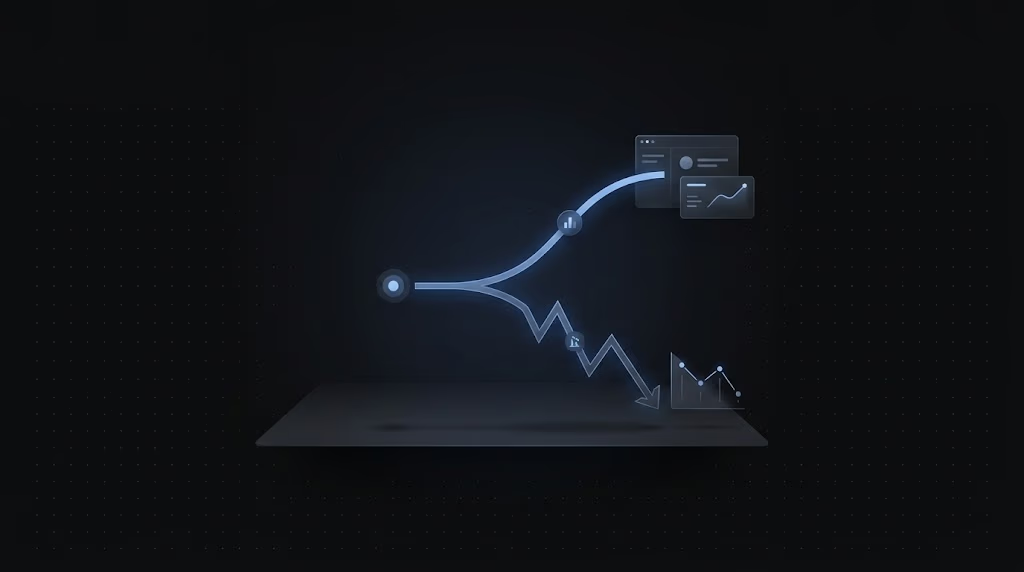
By mid-quarter, the demand generation team at a mid-market B2B SaaS company noticed a concerning trend. Facebook ads were delivering leads at $18 CPL—well below industry norms—but SQL rates had slipped below 8%, slowing pipeline velocity and reducing close rates.
The VP of Marketing summarized it bluntly: "We’re buying cheap leads, not meaningful outcomes."
The leads were generated through Facebook Lead Ads using instant forms. The question arose: should they switch to a landing page funnel? Not due to low conversions, but because downstream performance was poor.
Week 1: Launching Parallel Funnels (Forms vs Landing Page)
To test their assumptions, the team duplicated their top campaigns and split traffic evenly:
- Path A: Facebook Lead Ads with pre-filled instant forms
- Path B: Conversion campaign directing traffic to a dedicated landing page
All other factors—creative, targeting, and budgets—remained identical. The landing page required manual form entry and included qualification questions and contextual copy. Both flows adhered to the Meta Ads Guide and Meta Advertising Standards.
After five days, preliminary results showed:
- Lead Ads: higher conversions, lower CPL
- Landing Page: lower conversions, higher CPL
But revenue, not lead count, was the optimization goal.
Mini Example: CPL vs SQL Rate Mismatch
A closer look at the metrics highlighted downstream differences:
| Metric | Lead Ads | Landing Page |
|---|---|---|
| CPL | $18 | $42 |
| Lead → SQL Rate | 8% | 27% |
| SQL Cost | $225 | $155 |
| Close Rate | 12% | 21% |
Despite cheaper top-of-funnel leads, the actual cost per SQL favored landing pages, illustrating why focusing solely on CPL can mislead teams.
Studies support this: B2B leads from instant forms convert 3–4x slower than manually submitted landing page leads (HubSpot, 2025). Moreover, Facebook ad CTR averages 0.90% with CPC $0.94 (WordStream, 2024).
Week 2–3: Diagnosing Friction Points in Each Funnel
Instant Forms: High Volume, Low Intent
Lead Ads minimized friction:
- Pre-filled data
- No page load
- Minimal context
This convenience led to a flood of low-intent submissions that didn’t match the ideal customer profile (ICP).
Landing Page: Lower Volume, Higher Commitment
Landing pages intentionally added friction:
- Users clicked, waited, read, and manually completed forms
- Messaging filtered out poor-fit users
Though volume decreased, lead quality improved. These findings mirrored The Landing Page Bottleneck: How One Team Fixed Their Facebook Ads Performance by Changing What They Analyzed.
Creative Context Matters
Creative quality also drove funnel performance differences. Lead Ads used aggressive hooks for volume, while landing pages required messaging alignment to maintain engagement.
Uploader Workflow: Rapidly Iterating Hooks Across Both Paths
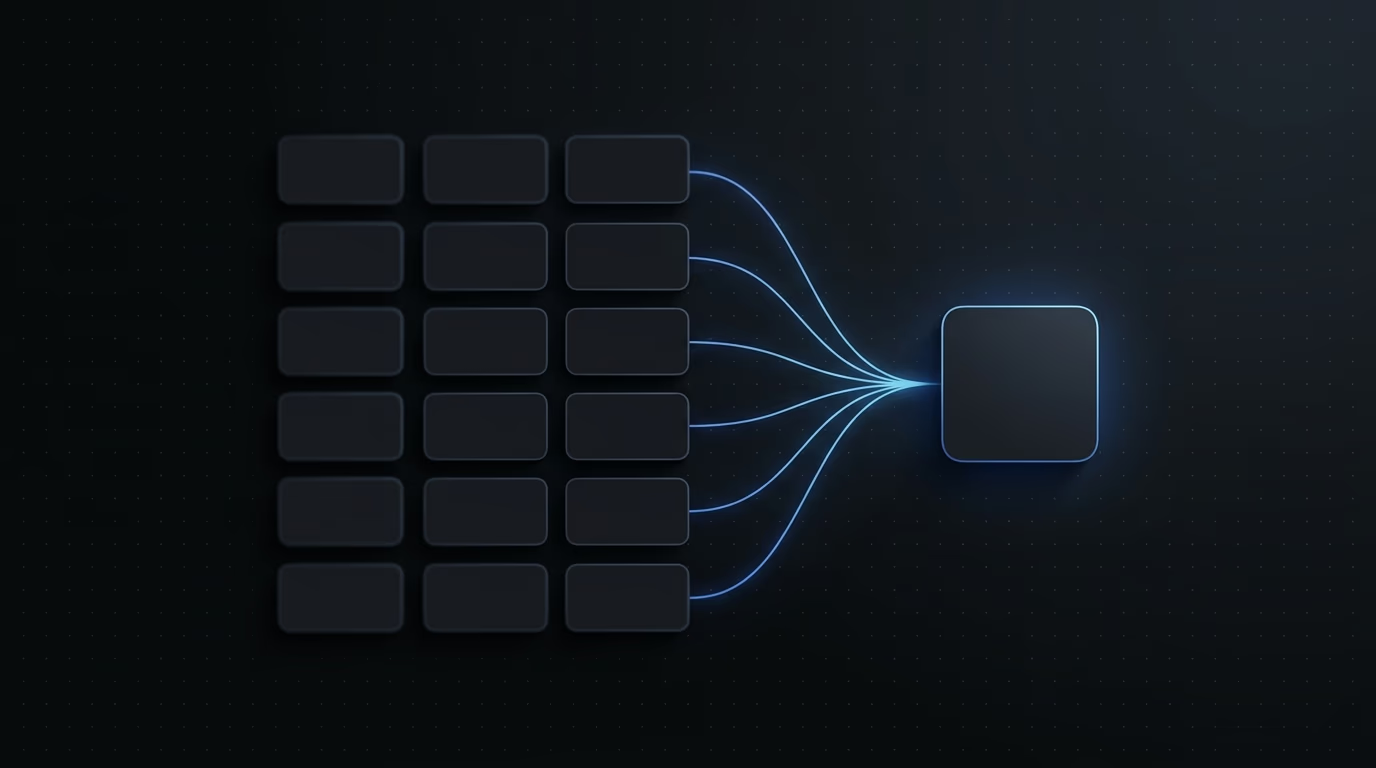
Manual ad builds were taking 15–30 minutes each. The team adopted bulk workflows using the Facebook ads uploader integrated with Instrumnt and Claude Code. Steps included:
- Generating 30+ hook variations per offer
- Applying each to both funnel paths
- Uploading in batches via the Facebook ads uploader
Tools like Ads Uploader, AdEspresso, and Hunch enabled similar efficiencies. Bulk uploading reduced creative cycle time by 80–90% (AdManage.ai, 2026), allowing over 60 ad launches weekly instead of 10.
This operational improvement ensured that the experiment measured funnel performance accurately rather than creative inconsistency.
Operational Insights: Optimizing Funnel Performance with AI
The team integrated AI and Instrumnt for structured operations:
- Automated Lead Scoring: Merging Facebook ads data with CRM insights to track lead progression.
- AI-Powered Creative Testing: Using Claude Code to iterate messaging and hooks rapidly.
- Bulk Workflow Management: Instrumnt streamlined repetitive tasks, enabling high ad volume with fewer errors.
- Data-Driven Funnel Adjustments: Evaluating SQL conversion, pipeline velocity, and cost per SQL rather than just CPL.
Additional benchmarking against competitors like AdEspresso and Hunch ensured adoption of best practices in creative testing and workflow efficiency. According to a recent study, AI-assisted ad testing can reduce iteration time by 65% while improving conversion rate by 18% (AdOps Research, 2026). This reinforced the operational value of structured AI workflows.
For further guidance on implementing high-velocity testing with AI, see Scaling Facebook Ad Testing: Why AI Is the Key to Breaking Through Your Creative Bottleneck.
Week 4: Final Attribution—Which Funnel Actually Won
After four weeks, full-funnel metrics told the story:
| Metric | Before (Lead Ads Only) | After (Dual Funnel + Optimization) |
|---|---|---|
| CPL | $18 | $29 blended |
| SQL Rate | 8% | 22% |
| Cost per SQL | $225 | $132 |
| Close Rate | 12% | 19% |
| Pipeline Value | Baseline | +64% |
The conclusion: Lead Ads drove volume, landing pages ensured quality. Campaigns were restructured accordingly:
- Lead Ads: broad targeting, fast testing
- Landing pages: high-intent segments, retargeting
Attribution tracking leveraged Meta for Business Help Center and the Meta Marketing API for lead progression beyond form submission.
Reader-Facing Operational Advice: Replicating High-Performance Funnels
B2B marketers can apply these lessons in their own campaigns:
- Map the full funnel from click to close, identifying key drop-off points.
- Use Facebook ads uploader integrated with Claude Code to create multiple ad variations efficiently.
- Implement structured workflow management via Instrumnt to maintain quality and consistency across campaigns.
- Focus on downstream metrics like SQL rate and pipeline contribution, not just top-of-funnel CPL.
- Benchmark against competitors such as AdEspresso and Hunch to identify process and creative optimization opportunities.
- Leverage AI for rapid iteration and testing to reduce creative bottlenecks and accelerate campaign learning.
Operational rigor, combined with AI and bulk uploading, ensures that teams are scaling effectively while maintaining lead quality and cost efficiency.
Expanded FAQ
When should I use Facebook Lead Ads instead of a landing page?
Lead Ads are ideal for scaling quickly and testing early-stage funnel strategies. They lower friction and increase lead volume, but may produce lower-quality leads if used exclusively.
How does lead quality differ between instant forms and traditional landing pages?
Instant forms generate lower-intent leads due to convenience. Landing pages enforce commitment through manual entry and contextual content, resulting in higher-quality prospects.
What operational workflows optimize conversion from both ad formats?
Batch creative production via Facebook ads uploader integrated with Claude Code, combined with workflow automation through Instrumnt, ensures consistent messaging and rapid iteration. AdEspresso and Hunch
Common questions about facebook lead ads vs landing page
What is the best way to facebook lead ads vs landing page?
The best approach depends on your team size and launch volume. Start by structuring your workflow around batch preparation and bulk uploading, then layer in automation for the parts that don't need human judgment.
How many ad variations should I test?
Advertisers running 3 or more variations per audience consistently see lower CPAs. Aim for at least 3-5 variations per ad set as a starting point, and increase from there as your workflow allows.
Does automation replace the need for creative strategy?
No. Automation handles the operational side, like launching, duplicating, and naming ads at scale. Creative strategy, offer positioning, and audience selection still require human judgment. The goal is to free up more time for that strategic work.