If your Cost Per Lead (CPL) hasn’t increased by at least 20% in the last six months, you’re not typical. For everyone else, the reality of 2026 is that Facebook ad fatigue now hits 25% faster than two years ago. That’s driven mainly by the relentless consumption of short-form video (Social Media Examiner, 2025).
Most marketers respond to rising CPL by adjusting targeting or tweaking form fields. But that’s like rearranging deck chairs on the Titanic. When your campaign stalls, the issue is rarely the audience; it’s the creative. Creative quality accounts for up to 56% of a campaign’s ROAS variation (Nielsen and Meta). If your lead gen is underperforming, it’s a throughput problem, not a targeting issue.
The Fatal Flaw in Modern Lead Generation Campaigns

Too many advertisers treat Facebook ads as a static tool: you build a form, select an audience, and hope for the best. In 2026, that’s a dead end. The median Facebook CPM is now $13.48 (Triple Whale, 2025). With costs that high, you can't afford to run stale creative for more than 48 hours.
The typical red flag in a failing lead gen campaign is what’s known as the “decay curve.” CPL might look good for a few days, but it slowly rises until the campaign flatlines. Marketers often mistake this as a sign that their audience is “tapped out.” The reality? They’re just bored. You’re showing the same creative to the same people too many times. Meta’s own research shows that performance degrades the moment frequency increases for cold audiences.
| Symptom | Common Fix | Why It Fails | Better Approach |
|---|---|---|---|
| Rising Cost Per Lead | Narrowing the Audience | Increases CPM and limits algorithm reach | Increase creative testing velocity |
| Low Lead Quality | Adding 5+ Form Fields | Causes massive drop-off and higher CPL | Use better ad hooks to pre-qualify |
| Fast Performance Decay | Increasing Daily Budget | Forces the same ad to more people faster | Launch 5+ new creative variations |
| Stagnant Lead Flow | Tweaking Bid Strategy | Algorithm already optimizes for leads | Refresh creative hooks every 7 days |
Why “Better Targeting” Won’t Fix High CPL
The industry still obsesses over “laser targeting.” Marketers spend hours on complex lookalike stacks and interest-based layers. But Meta’s AI is shifting toward broad targeting. In 2024 alone, more than 15 million ads were created using Meta’s AI tools (Meta, 2024). The machine knows more than you do.
When you narrow your audience to combat a high CPL, you’re actually making the algorithm’s job harder. You’re reducing the pool of available prospects, which drives up your CPM. Instead of obsessing over finding a “secret” audience, focus on building a creative testing system that lets the algorithm do its thing. If you’re not automating creative testing for Meta ads, you’re working against the platform.
The High-Velocity Creative Pipeline: A Treatment Plan
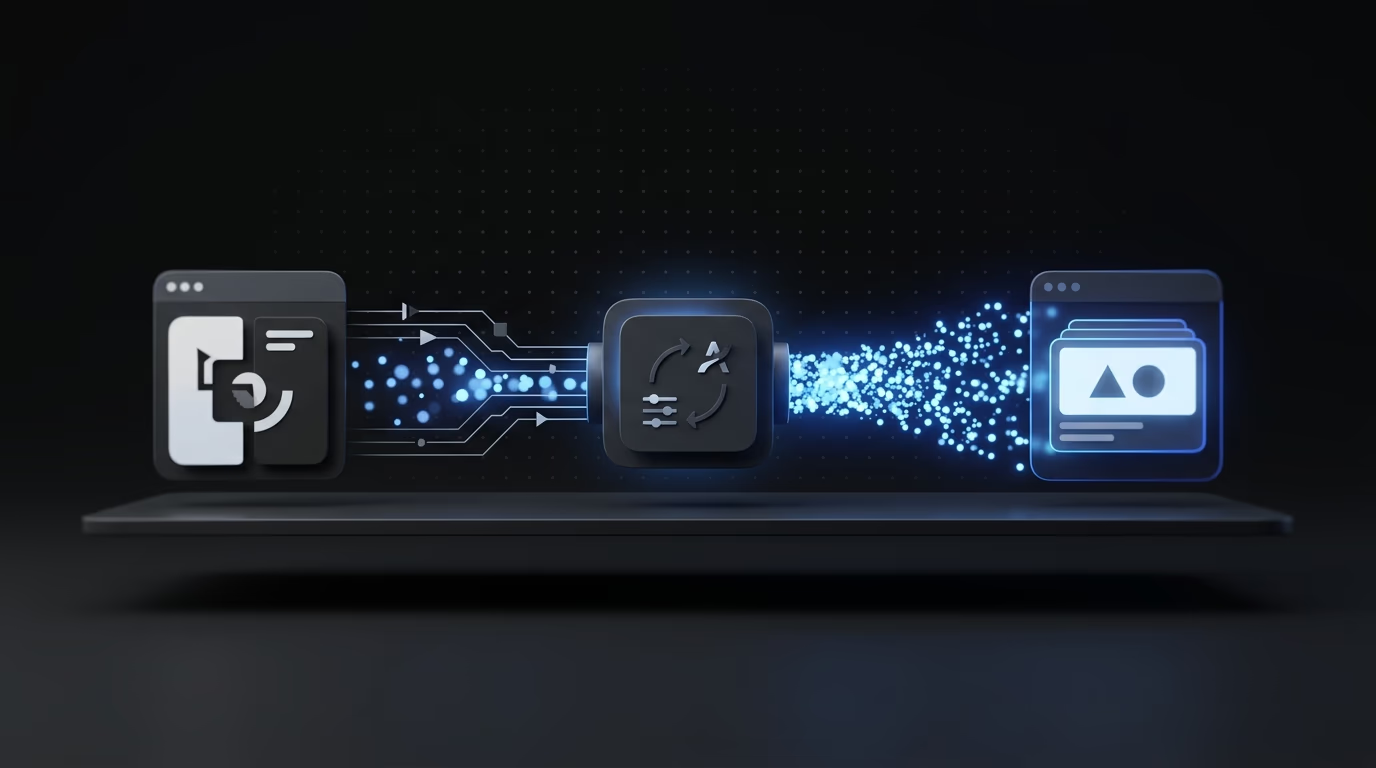
To keep lead gen campaigns profitable in 2026, think like a content studio, not a traditional media buyer. That means launching five to ten creative variations a week, not one or two ads a month. The problem? Most teams can’t scale because manual ad building is too slow.
Building an ad manually takes 15-30 minutes on average (operational benchmarks). So, testing 20 variations takes five hours of clicking through Ads Manager—time better spent on strategy and creative direction. That bottleneck is why so many teams fail to scale. They’re limited by the time it takes to create ads manually.
This is where a Facebook ads uploader becomes crucial. By decoupling the creative creation process from Meta’s interface, you can batch-launch dozens of lead-gen variations in seconds. Tools like Instrumnt let you map lead forms to creative assets in bulk, ensuring you always have a “next up” creative ready the moment your current one fatigues.
Building the 2026 Lead Gen Engine with Instrumnt
The standard workflow for lead generation in 2026 demands a major shift in how you use Meta Ads Guide specifications. Forget building a “perfect” ad. Instead, build multiple variations: three different hooks, two body copy variations, and two lead form headlines.
With Instrumnt, you can create every possible permutation of these components using the Facebook ads uploader. This isn’t just about volume; it’s about finding the combination that resonates with the highest-quality leads. A “short and punchy” lead form may work best with a UGC-style video, while a “detailed and educational” form may require a more polished graphic.
By using bulk workflows, you can test these hypotheses all at once. Why most Facebook ads automation tools are doing it wrong is that they focus too much on bidding rules and not enough on launching fresh creative. Instrumnt addresses this by streamlining the launch process, keeping your testing cadence healthy without overburdening your team.
Real-Time Optimization and the Role of Claude Code
Once your ads are live, the real work begins: optimization. In 2026, manual reporting is a relic. Top teams are now using Claude Code to connect directly with their campaign data via the Meta Marketing API.
Picture this: Claude Code is monitoring your lead quality in real-time. By syncing your CRM data with ad performance, you can see which creative variations produce leads that don’t convert into sales. You can then trigger the Facebook ads uploader to launch more of the high-converting ads while pausing the low-quality “click-bait” creatives.
This kind of integration is what sets the top 1% of advertisers apart. Lead generation becomes a precision operation, not a guessing game. You’re not just buying clicks; you’re managing a real-time customer pipeline.
Final Thoughts: The Path to Lead Gen Mastery
Scaling Facebook ads for lead generation in 2026 isn’t about finding a “hack” in Ads Manager. It’s about speed, volume, and data integration.
- Stop obsessing over targeting. Let the algorithm do the work with broad audiences. Focus on testing creative.
- Increase your testing velocity. Aim for 5-10 new creative variations per week to stay ahead of fatigue.
- Automate manual tasks. Use a Facebook ads uploader like Instrumnt to handle the heavy lifting.
- Connect your data. Use tools like Claude Code to bridge the gap between your ad performance and actual sales.
The average Facebook ad CTR across all industries is 0.90% (WordStream's Facebook Ads benchmarks). To beat that, you need to out-process your competitors. In a world where the algorithm is a commodity, speed is your only sustainable advantage.
Related reading
If you want to keep reading without changing topic, these pages add more context:
Common questions about facebook lead gen ads
What is the best way to facebook lead gen ads?
The best approach depends on your team size and launch volume. Start by structuring your workflow around batch preparation and bulk uploading, then layer in automation for the parts that don't need human judgment.
How many ad variations should I test?
Advertisers running 3 or more variations per audience consistently see lower CPAs. Aim for at least 3-5 variations per ad set as a starting point, and increase from there as your workflow allows.
Does automation replace the need for creative strategy?
No. Automation handles the operational side, like launching, duplicating, and naming ads at scale. Creative strategy, offer positioning, and audience selection still require human judgment. The goal is to free up more time for that strategic work.