

A reliable sign that a Facebook ads program is reaching its limits is not rising spend. It's the moment the team can no longer agree on why a creative worked.
Early testing is easy. You launch a handful of ads, review results, and pick a winner.
Then volume climbs.
Five variants become fifty. Fifty become two hundred. Naming conventions drift. Reports stop lining up. Teams retest ideas they already tried six weeks ago. Different stakeholders point to different explanations for the same result, and nobody is working from the same source of truth.
Most discussions of a facebook ads creative testing framework focus on testing methodology. Test more hooks. Test more formats. Test more angles.
That's rarely the thing breaking.
The failure usually shows up in operations.
A testing framework doesn't collapse because marketers stop generating ideas. It collapses because the systems around testing can't keep up with the volume those ideas create.
Creative quality has an outsized impact on advertising outcomes. Nielsen's annual marketing research found that creative was responsible for 49% of incremental sales impact across studied campaigns (Nielsen Annual Marketing Report, 2023). Meta has also reported that advertiser creative can drive more than half of campaign performance outcomes in many environments, with one Meta analysis attributing up to 56% of sales results to creative factors (Meta for Business research). Those statistics explain why teams push toward more testing, but they also explain why operational discipline becomes essential as testing scales.
The Hidden Bottleneck in Every Facebook Ads Creative Testing Framework

Most teams think scaling creative testing means producing more creative.
In reality, it means protecting signal as volume grows.
A team launching ten variants a week can usually keep track of what it's learning. That same team launching one hundred variants a week often loses confidence in every conclusion.
Common symptoms include inconsistent ad names, duplicate tests, slow launches, conflicting reports, and creative learnings that disappear after campaigns end.
The problem gets worse as AI-assisted creative production increases output. Teams can now generate variants faster than they can organize, deploy, and analyze them.
That's how you end up with a strange outcome: more creative output, less confidence in the results.
When that happens, the issue is rarely strategy. It's usually process.
Why More Creative Volume Often Produces Worse Decisions
When marketers talk about testing, they tend to think in terms of individual ads.
Meta evaluates performance across combinations of creative assets, placements, audiences, optimization goals, and delivery conditions. Products such as Advantage+ increase the number of combinations in play even further.
Without structure, the data fragments.
One team labels creative by concept. Another labels by format. Another tracks creator identity. A quarter later, nobody can answer a simple question: which hooks consistently outperform across campaigns?
At that point many organizations start shopping for another reporting platform.
That usually treats the symptom rather than the cause.
Reporting tools are useful, but they cannot recover information that was never captured properly.
If naming is inconsistent, tagging is incomplete, and deployment workflows vary from operator to operator, the reporting layer simply reflects that mess.
That's why teams struggling with creative throughput should look at deployment and data structure before replacing analytics software.
The same pattern appears in related discussions such as Breaking the Creative Bottleneck: How One Growth Team Scaled Facebook Ads Throughput with AI and When Your Facebook Ads Creative Pipeline Breaks.
The problem is usually not a shortage of ideas. It's the absence of a system that preserves what those ideas teach you.
Building a Scalable Deployment System
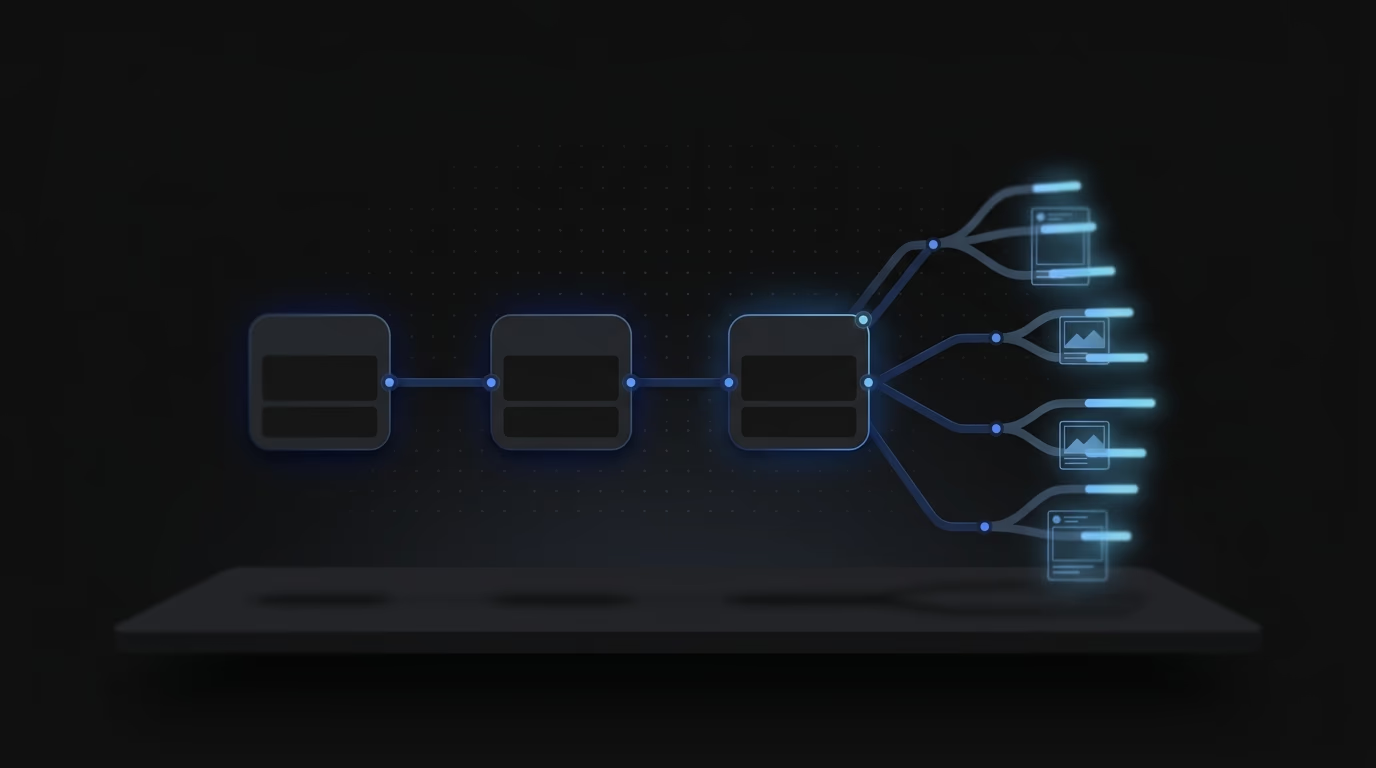
At some point, manual work inside Ads Manager becomes the constraint.
Not creative quality.
Not budget.
Not audience size.
Just operational drag.
If every new variant requires manual setup, duplicated fields, hand-written names, and repeated QA checks, volume eventually overwhelms the team.
This is where a Facebook ads uploader becomes more important than another brainstorming session.
The value of a deployment system is standardization.
Speed matters, but consistency matters more.
Every creative should launch with the same structure, the same metadata, and the same naming rules.
A scalable framework typically includes several components.
Standardized Naming Architecture
Every creative receives the same set of attributes:
- Hook category
- Offer category
- Format type
- Creator or source
- Campaign objective
- Launch date
The goal is simple: anyone reviewing performance later should understand exactly what they are looking at.
Bulk Variant Deployment
Instead of rebuilding ads one by one, teams create variant libraries and launch them through repeatable bulk workflows.
Tools such as Ads Uploader, Smartly.io, and Paragone are frequently evaluated at this stage because the problem is operational rather than strategic. Teams need a reliable way to launch large numbers of variants without introducing naming errors and reporting inconsistencies.
Bulk deployment can dramatically reduce creation time compared with fully manual workflows. More importantly, it reduces variation in how ads are built.
For Meta-focused teams, Meta Ads Bulk Upload Workflow: A Step-by-Step Operations Guide provides a useful example of how process design often has a larger impact than another round of optimization tweaks.
Structured Creative Taxonomy
Every creative should be classified using dimensions that remain useful after the campaign ends.
Examples include:
- Problem-focused hook
- Outcome-focused hook
- Social proof hook
- Founder story hook
- Product demonstration hook
Most teams underestimate this step.
The taxonomy is what turns a collection of ads into a searchable knowledge base.
Once testing volume reaches a certain scale, taxonomy becomes more valuable than individual campaign reporting.
Structured Tagging Creates Learnings That Survive Campaigns
Most creative insights disappear.
Not because they were wrong.
Because nobody can find them later.
A team learns that founder-led videos outperform polished product demonstrations. Three months pass. New campaigns launch. The same test gets run again because the previous learning never became part of a reusable system.
That's not a reporting issue.
It's a knowledge management issue.
A scalable facebook ads creative testing framework treats learnings as assets that can be reused.
Every asset should be tagged using variables that matter to future decisions:
- Hook style
- Offer structure
- Visual format
- Audience stage
- Creator type
- Product category
When tagging is structured, teams can analyze patterns across campaigns instead of reviewing isolated reports.
That becomes increasingly important as creative fatigue sets in. Continuous testing helps, but testing alone doesn't solve the problem.
What matters is understanding which creative characteristics continue working and which ones wear out.
Structured tagging is one way to transform campaign activity into institutional knowledge.
Using Claude Code and Instrumnt to Turn Results Into Knowledge

Most teams already use AI to create content.
Far fewer use it to understand performance.
That's where the larger opportunity sits.
Imagine exporting performance data from hundreds of Facebook ads.
A workflow built around Claude Code can classify creatives according to dimensions such as:
- Hook type
- Emotional angle
- Offer structure
- Call-to-action style
- Visual pattern
- Creator category
Instead of manually reviewing hundreds of rows, the team receives organized classifications that can be analyzed at scale.
Now the questions become easier to answer:
- Which hook families consistently outperform?
- Which offers hold performance longest before fatigue appears?
- Which combinations work across multiple audiences?
- Which concepts repeatedly underperform?
This is where Instrumnt becomes useful.
Rather than treating every experiment as a separate event, Instrumnt can sit inside a workflow that connects deployment, classification, reporting, and learning.
The result isn't another dashboard.
It's institutional memory.
Institutional memory is what allows larger accounts to scale testing volume without losing visibility into what is actually working.
Teams interested in building that type of system can explore related concepts in Automated Facebook Ads Learning Loops with Instrumnt and Claude Code and Scaling Facebook Ad Testing: Why AI Is the Key to Breaking Through Your Creative Bottleneck.
The Testing Flywheel That Prevents Reporting Chaos
Most organizations think creative testing follows a sequence.
Generate ideas.
Launch ads.
Review winners.
Repeat.
The strongest teams operate differently.
Ideas become tagged assets.
Assets become structured variants.
Variants become measurable experiments.
Experiments become classified learnings.
Learnings feed the next round of ideas.
The cycle compounds because each round improves the quality of the next one.
That distinction matters more today than it did a few years ago.
Creative production is no longer the main constraint. AI has made variation cheaper and faster.
Organization, deployment, interpretation, and knowledge retention are now the limiting factors.
Advertisers can generate hundreds of creative variations. That doesn't automatically create an advantage.
An advantage comes from knowing what those variations taught you and being able to apply that knowledge in future campaigns.
That's the lesson many discussions about a facebook ads creative testing framework miss.
The hard part is not producing more ideas.
The hard part is building a system that can absorb, organize, and learn from them.
Once naming conventions, deployment workflows, tagging standards, reporting systems, AI-assisted classification, a Facebook ads uploader process, Claude Code analysis, and Instrumnt-based learning loops work together, testing volume stops creating noise.
It starts creating usable knowledge.
At that point, the framework is no longer just a testing framework.
It's an operating system for creative learning.
Common Questions About Facebook Ads Creative Testing Framework
How many creative variants should I test in a Facebook ads creative testing framework?
The right number depends on budget, audience size, and operational capacity. Most teams are better served by a consistent testing cadence than by chasing a specific number. Start with enough variants to compare meaningful creative differences, then increase volume only when your naming, reporting, and tagging systems remain reliable.
How do I organize Facebook ad naming conventions for high-volume creative testing?
Use a fixed naming architecture that includes creative type, hook category, offer category, creator source, campaign objective, and launch date. Standardized naming improves reporting accuracy and reduces duplicate testing.
Can Claude Code help analyze Facebook ads creative performance and identify winning patterns automatically?
Yes. Claude Code can help classify creative assets, identify recurring themes, group similar concepts, and surface patterns across exported performance datasets. Combined with Instrumnt and structured tagging, it can reduce manual analysis work while making creative learnings easier to reuse across campaigns.
For more context, see Triple Whale's Facebook Ads benchmarks.
For more context, see Meta Blueprint.
For more context, see WebFX Meta benchmarks.