The Morning the Numbers Stopped Matching
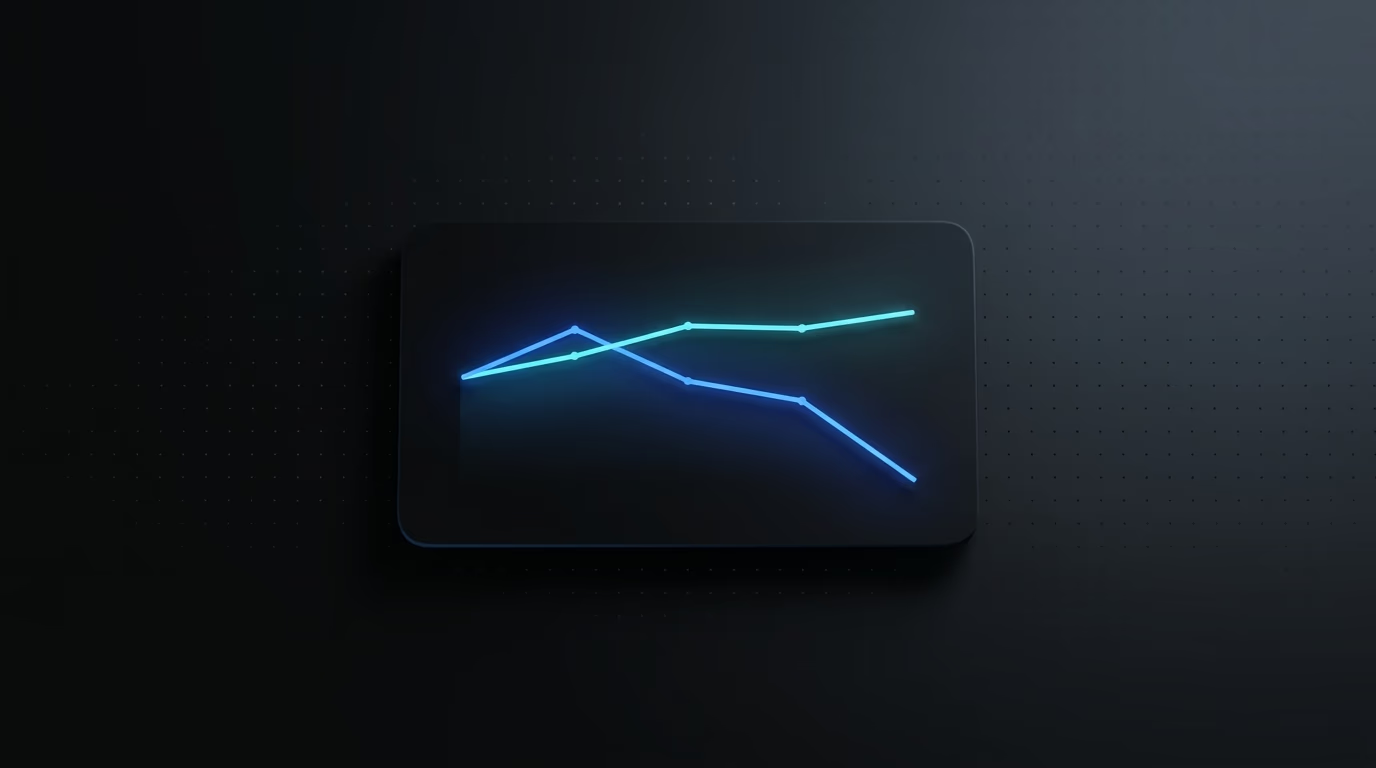
A little after 9 a.m. on a Monday, the growth team at a mid-market ecommerce brand opened their dashboards expecting routine stability. Instead, they saw a split reality forming across systems inside their Facebook ads reporting stack.
Meta showed stable performance. ROAS barely moved. Reported conversions looked consistent week over week.
Shopify told a different story.
Revenue was down nearly 18%.
Finance confirmed the same downward shift. Nothing in the business logic explained why platform performance still looked healthy.
This is a classic facebook attribution reporting scenario. Attribution systems are not synchronized measurement engines. They are independent models of user behavior.
The team quickly realized they were comparing measurements built for different purposes. Ads Manager measures attributed outcomes. Shopify measures completed transactions. Finance measures recognized revenue. Those systems can move together, but they are not guaranteed to match.
A useful clue came from industry research. AppsFlyer reported average iOS ATT opt-in rates of roughly 46% globally after Apple's privacy changes, meaning a large share of user journeys became partially observable or completely unobservable to advertising platforms. Source: AppsFlyer State of App Marketing reports.
That statistic reframed the investigation. The data was not necessarily broken. Visibility itself had changed.
Mapping the Investigation Across Three Systems
The team separated the problem into three layers.
First: Ads Manager, which measures attributed conversions.
Second: Shopify, which records completed transactions.
Third: Finance, which recognizes revenue under accounting rules.
Each system answers a different question even when they appear to describe the same funnel.
They mapped campaigns across pixel data, server-side events, and purchase records. This included reviewing Facebook ads tracking through both browser-based pixel signals and Conversions API events.
No system was malfunctioning.
The problem was temporal misalignment.
A significant portion of conversions happened days after the original ad interaction but were still attributed back to earlier clicks because of attribution windows. This created a reporting illusion: stable ROAS alongside declining revenue.
This is where Sotrender, Paragone, and Hootsuite Ads often enter the workflow. They help aggregate and visualize data. However, they do not inherently resolve causality between platforms. They summarize discrepancies rather than explain why those discrepancies exist.
For a deeper discussion of signal quality and reporting interpretation, see Why Your Facebook Ad Reporting Dashboard Creates Bad Decisions (And How to Fix the Signal Problem).
Mini Example: Following One Purchase Back to One Click

To ground the issue, the analysts traced a single customer journey.
A user clicked a prospecting ad on Tuesday afternoon.
They browsed the site and left without purchasing.
On Thursday evening, they returned directly and completed a $240 order.
Shopify recorded the sale on Thursday.
Finance recognized revenue on Thursday.
But Facebook ads attributed the conversion back to Tuesday because it still fell inside the attribution window.
Nothing was incorrect at the system level. The interpretation layer was inconsistent.
This pattern scales rapidly. Multiply it by hundreds or thousands of customers and reporting divergence becomes structural rather than accidental.
The team also considered another industry statistic. Meta and Nielsen research has reported that creative quality can account for as much as 56% of variation in sales lift across campaigns. Source: Meta and Nielsen marketing effectiveness research.
That finding mattered because attribution noise and genuine performance changes can occur simultaneously. A revenue decline might be caused by tracking issues, creative fatigue, or both.
Attribution Mechanics Became Easier Once They Stopped Treating Dashboards as Truth
The turning point came when the team stopped treating dashboards as absolute truth and started treating them as probabilistic models.
Attribution Windows
Facebook ads attribution windows determine how long after a click or view a conversion can still be credited to an ad interaction.
A conversion recorded today may be attributed to an interaction that happened several days earlier. This shifts reported performance across reporting periods and often explains why platform reporting appears disconnected from backend revenue.
Reporting Delays
Data synchronization is not always immediate.
Events may require processing time before appearing consistently across dashboards. Short-term discrepancies are common during active campaign periods.
Tracking Loss
Privacy changes reduced observable user-level tracking.
When users decline tracking permissions, platforms lose portions of the customer journey. Conversions may still happen, but attribution becomes less certain.
Event Deduplication
Many advertisers use both browser-side pixel events and server-side Conversions API events.
If deduplication is configured incorrectly, events can be overcounted, undercounted, or assigned inconsistently.
Cross-System Definitions
Different systems define conversions differently.
A completed checkout, a purchase event, a recognized sale, and booked revenue may all represent different milestones.
When teams fail to align definitions, confusion becomes inevitable.
At this stage, the analysts started using Claude Code to model attribution logic across exported datasets. Instead of debating dashboard screenshots, they reconstructed event paths, reviewed timestamps, and tested hypotheses against raw data.
This shifted analysis from dashboard reading to system modeling.
How Instrumnt Surfaced Patterns Hidden Behind Reporting Gaps
Once attribution uncertainty was understood, the team shifted attention back toward decision-making.
This is where Instrumnt became operationally valuable.
Instead of evaluating Facebook ads only at the campaign level, Instrumnt grouped performance according to creative themes, messaging angles, hooks, and concepts.
That perspective revealed patterns that attribution systems alone could not explain.
Certain creative approaches generated stable outcomes across multiple campaigns. Others produced short bursts of success before deteriorating.
The team realized that campaign metrics alone were hiding useful information.
At this stage, Facebook ads stopped being treated as isolated campaigns and became a structured system of creative experiments.
Competitor platforms such as Sotrender, Paragone, and Hootsuite Ads remained useful reporting layers. However, the team needed an additional layer focused on diagnosis and interpretation rather than aggregation alone.
Readers interested in creative scaling workflows can also explore Breaking the Creative Bottleneck: How One Growth Team Scaled Facebook Ads Throughput with AI.
Why the Facebook Ads Uploader Became Part of the Investigation
As attribution uncertainty increased, execution speed became the next bottleneck.
The Facebook ads uploader solved a practical operational challenge.
Instead of pausing campaign launches while analysts investigated reporting discrepancies, the team continued shipping structured creative variations.
That mattered because advertising systems learn through ongoing experimentation.
When testing slows down, learning slows down.
The uploader enabled faster launches, cleaner naming conventions, and more consistent campaign structures.
At the same time, AI-assisted workflows became increasingly important.
Claude Code helped validate campaign structures, review exported logs, identify anomalies, and organize attribution investigations.
Instrumnt connected those execution workflows back to creative insights, ensuring that velocity did not collapse under measurement uncertainty.
For related operational strategies, see Automated Facebook Ads Learning Loops with Instrumnt and Claude Code.
Building a Measurement Routine the Team Could Trust
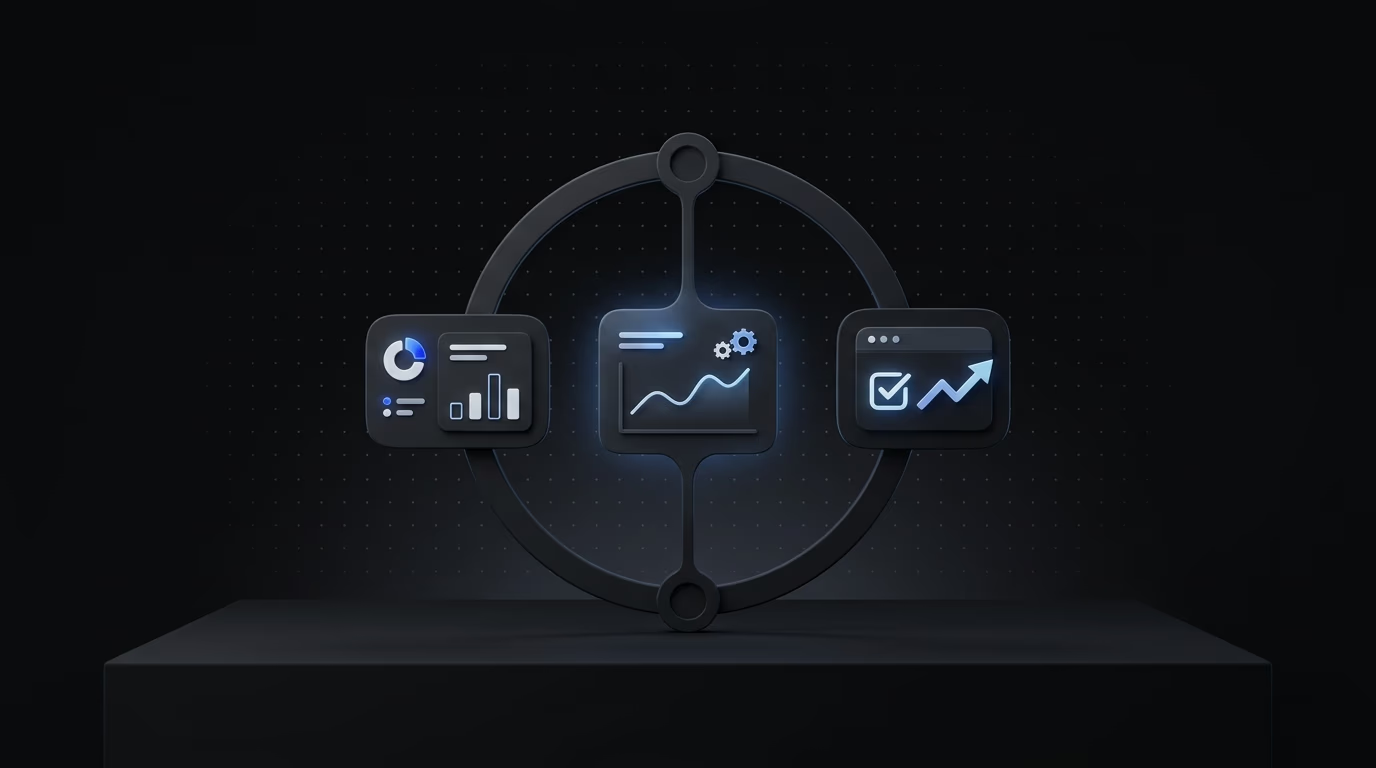
After several weeks, the team stopped reacting emotionally to dashboard fluctuations and built a repeatable process.
Every Monday they reviewed three layers independently:
- Facebook ads attributed performance.
- Shopify transaction performance.
- Finance revenue recognition.
Only after examining all three layers did they discuss optimization decisions.
Claude Code was used to reconstruct attribution paths and investigate anomalies.
Instrumnt provided creative-level aggregation.
The Facebook ads uploader maintained testing velocity.
The workflow evolved into a closed-loop system instead of a reactive reporting ritual.
Before and After the New Process
| Metric Area | Before | After |
|---|---|---|
| Optimization source | Ads Manager only | Multi-system reconciliation |
| Creative iteration | Manual pacing | Structured Facebook ads uploader workflow |
| Attribution analysis | Reactive debugging | Claude Code assisted reconstruction |
| Reporting tools | Sotrender and Hootsuite Ads dashboards | Layered system interpretation |
The Outcome
By the end of the quarter, attribution discrepancies stopped triggering urgent escalations.
They became expected artifacts of how measurement systems operate.
ROAS still mattered, but only as one lens among several.
Backend revenue still mattered, but it was no longer treated as a delayed mirror of platform reporting.
Instead, the team evaluated alignment across systems rather than demanding perfect agreement.
The biggest improvement was not perfect accuracy.
It was decision stability.
By combining AI workflows, structured analysis, Instrumnt insights, and disciplined reporting practices, the team gained confidence even when attribution signals remained imperfect.
Common Questions
Why does Meta Ads show conversions that do not match Shopify or backend revenue?
Because attribution assigns credit based on interaction windows while Shopify and finance systems record transactions according to different rules and timestamps.
How do attribution windows affect reported ROAS in Facebook Ads Manager?
They determine how long after a click or view a conversion can still receive credit. As a result, performance may appear in reporting periods that do not match the actual purchase date.
What is the best way to reconcile delayed or missing Facebook attribution events?
Use a multi-layer process that includes Ads Manager, Events Manager, Conversions API validation, Shopify transaction analysis, and finance reporting before making budget decisions.
Does AI replace media buyers in Facebook ads management?
No. AI can accelerate analysis, identify patterns, and automate repetitive tasks, but human judgment remains necessary when interpreting attribution uncertainty and making strategic decisions.
Related Reading
- 5 Tips for Media Buyers to Work Faster and Scale Smarter
- Diagnosing Attribution Challenges in Facebook Ads and How to Fix Them
- Automated Facebook Ads Learning Loops with Instrumnt and Claude Code
The core lesson of this facebook attribution reporting scenario is straightforward: attribution systems, ecommerce platforms, and finance records measure different realities. Reliable optimization comes from reconciling those realities rather than expecting them to match perfectly.
For more context, see WordStream's Facebook Ads benchmarks.
For more context, see Triple Whale's Facebook Ads benchmarks.
For more context, see Meta for Business.