
The Breaking Point: When Manual Creative Workflows Couldn’t Keep Up

At 11:40 PM on a Thursday, the growth team at a mid-market ecommerce brand was still inside Ads Manager.
They weren’t strategizing.
They were uploading.
The entire day had gone into preparing a new campaign: drafting copy in Google Docs, sorting assets in folders, manually duplicating ads, fixing naming errors, and troubleshooting tiny mistakes that broke the process.
By launch, they had 12 ads live.
It took eight hours.
And they knew it wasn’t enough.
Only 5–10% of tested creatives typically succeed. According to Meta internal data, increasing the number of creatives tested significantly improves the probability of finding a high-performing ad (Meta, 2024).
Meanwhile, audience fatigue was accelerating. Meta reports that after approximately four impressions per user, click-through rates begin to decline while CPC rises, with over 50% of campaigns experiencing performance degradation beyond that point (Meta, 2024).
The problem wasn’t poor ideas.
It was that their workflow couldn’t scale to the volume needed to find winners.
Designing a System That Prioritizes Output Over Control
The shift began not with tools, but with perspective: the team realized they had optimized for control, not output.
Every step was built to prevent errors:
- Manual review of each ad
- One-by-one duplication in Ads Manager
- Incremental iteration instead of batch testing
This slowed them down.
They weren’t producing enough variations to feed Meta’s algorithm.
According to Nielsen, creative quality accounts for up to 56% of variation in return on ad spend (ROAS), making it the single largest performance driver (Nielsen, 2023). At the same time, Meta reports that advertisers running 3–5+ ad variations per audience can reduce CPA by up to 30% (Meta, 2024).
The team wasn’t even close.
So they rebuilt their Facebook ads creative workflow automation system around a single principle: maximize creative throughput, then let the system identify winners.
Three changes made this possible:
- Separate ideation from execution
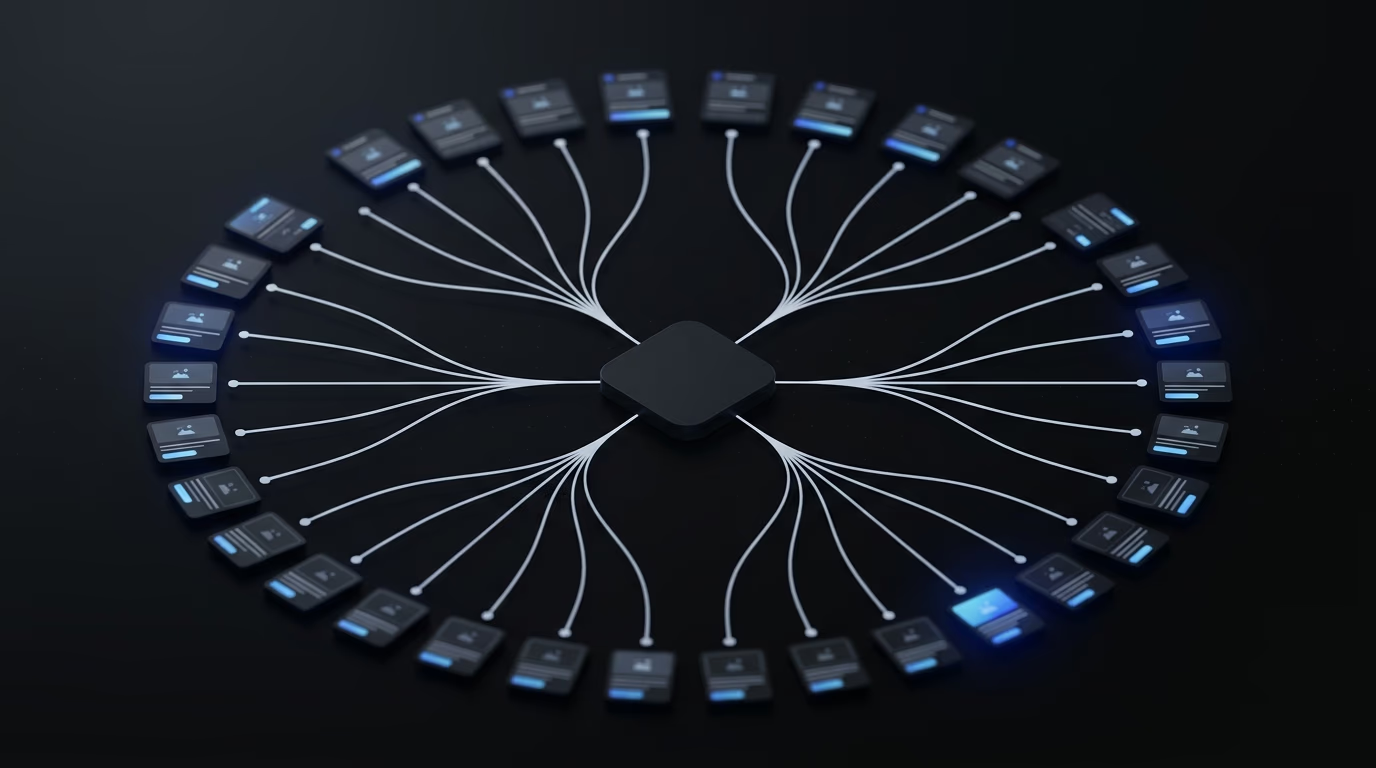
- Automate transformation of ideas into variations
- Remove Ads Manager as the bottleneck
They didn’t need more ideas.
They needed a way to turn one idea into many ads—fast.
If this sounds familiar, it mirrors the broader shift described in Why Your Creative Testing Is Failing (And How to Automate the Solution).
Mini Example: Scaling One Campaign Idea Into 25 Variations Automatically

Before automation, one campaign idea looked like this:
- 1 hook
- 1 headline
- 1 primary text
- 1 video
Total output: 1 ad.
After introducing AI and structured inputs, the same idea became:
- 5 hooks
- 3 headlines
- 2 primary text angles
- 2 formats (video + static)
With AI-assisted generation (using tools like Claude Code), the system produced permutations:
5 × 3 × 2 × 2 = 60 possible ads.
They didn’t launch all 60.
They filtered down to 20–25 strong variations.
This is where AI changed the equation. Instead of relying on manual copywriting and design iteration, the system generated structured variation at scale.
The key insight: Facebook ads performance improves not from perfect creatives—but from testing enough good ones.
Uploader Workflow: How Instrumnt Replaced Manual Ad Setup بالكامل
Execution—not ideation—was the real bottleneck.
Previously, building ads inside Ads Manager looked like this:
- Select campaign
- Duplicate ad set
- Upload media
- Paste copy
- Rename assets
- Double-check errors
This took 15–30 minutes per ad.
The team replaced this with a Facebook ads uploader workflow powered by Instrumnt.
Instead of building ads manually, they prepared:
- CSV files containing all variations
- Asset folders mapped to naming conventions
- Predefined campaign templates
Instrumnt handled transformation and bulk upload.
The result:
- 20 ads launched in under 10 minutes
- Zero naming inconsistencies
- No duplication errors
This is where Instrumnt differs from tools like Revealbot and Smartly.io.
Revealbot and Smartly.io focus heavily on optimization rules and automation after ads are live. But they don’t fundamentally change how creatives are produced and uploaded.
Instrumnt focuses on the input layer—getting more creative into the system faster.
If you want a deeper breakdown of this shift, see How to Build a Facebook Ads Bulk Testing System with Instrumnt and Claude Code.
The Outcome: More Tests, Faster Learnings, and Lower CPA
Six weeks later, the impact was measurable.
Not because one ad won.
Because they consistently found winners.
| Metric | Before | After |
|---|---|---|
| Ads launched per week | 10–15 | 60–80 |
| Time per ad | 20 min | <2 min |
| Active variations per ad set | 2–3 | 6–10 |
| CPA trend | Unstable | Decreasing |
| Learning cycles per week | 1 | 3–4 |
The biggest shift was learning speed.
Instead of waiting a full week to evaluate results, they iterated multiple times per week.
That compounding effect—faster testing, faster feedback, faster iteration—is what drove CPA down.
Competitor Comparison: Instrumnt vs Revealbot vs Smartly.io
To understand why this system worked, it helps to compare approaches:
Revealbot
- Strong in rule-based automation
- Focuses on budget, bidding, and pausing logic
- Limited impact on creative production speed
Smartly.io
- Advanced creative management and templates
- Enterprise-focused workflows
- Still requires structured setup and ongoing management
Instrumnt
- Focuses on creative throughput
- Automates variation generation and upload
- Treats Facebook ads as a system, not individual builds
The difference is subtle but critical.
Revealbot and Smartly.io optimize performance after ads exist.
Instrumnt ensures enough ads exist in the first place.
What Actually Changed (And Why It Matters)
Externally, nothing changed:
- Same budgets
- Same targeting
- Same offers
Internally, everything changed.
Before:
- Creative was scarce
- Testing was slow
- Execution was manual
- Learning was delayed
After:
- Creative was abundant
- Testing was continuous
- Execution automated
- Learning compounded
This is what Facebook ads creative workflow automation actually means.
It’s not about replacing people.
It’s about reallocating effort.
Humans focus on strategy and insights.
AI handles execution.
According to Meta, over 15 million ads were created using AI-assisted tools by more than one million advertisers in 2024, signaling a major shift toward automation in ad creation (Meta, 2024).
Why Most Teams Get This Wrong
Most teams automate the wrong layer.
They focus on:
- Automated bidding
- Campaign rules
- Budget allocation
But leave creative production manual.
That creates a bottleneck.
No amount of optimization can compensate for a lack of creative volume.
Without throughput, the algorithm has nothing to optimize.
This is why many teams plateau—even with
For more context, see Meta Ads Guide.
For more context, see Meta Blueprint.
For more context, see Meta for Business Help Center.
Common questions about facebook ads creative workflow automation
What is the best way to facebook ads creative workflow automation?
The best approach depends on your team size and launch volume. Start by structuring your workflow around batch preparation and bulk uploading, then layer in automation for the parts that don't need human judgment.
How many ad variations should I test?
Advertisers running 3 or more variations per audience consistently see lower CPAs. Aim for at least 3-5 variations per ad set as a starting point, and increase from there as your workflow allows.
Does automation replace the need for creative strategy?
No. Automation handles the operational side, like launching, duplicating, and naming ads at scale. Creative strategy, offer positioning, and audience selection still require human judgment. The goal is to free up more time for that strategic work.