
Why creative testing breaks at scale in Facebook ads
At a certain point, every performance team running Facebook ads hits the same constraint: ideas are not the bottleneck, execution is. A mid-market DTC team might have dozens of approved hooks and creative angles, yet only a fraction actually reach live testing because the system is too slow to deploy them.
Industry benchmarks consistently show how fragile this process becomes. WordStream 2025 benchmark data reports average Facebook ads CTR hovering around 0.9% (WordStream 2025 benchmark), meaning even small drops in engagement quickly signal fatigue. At the same time, Meta Business documentation suggests that creative quality can account for up to 56% of ROAS variance (Meta Business documentation). When iteration slows down, performance instability compounds quickly.
The issue is not strategy. It is throughput inside Facebook ads workflows. Manual duplication in Ads Manager, fragmented QA in Slack, and isolated asset handling all turn what should be a rapid testing loop into a queue-based publishing system.
This is where systems start to fail: not because teams lack intelligence, but because they lack deployment speed.
Core model: The uploader-driven creative iteration loop
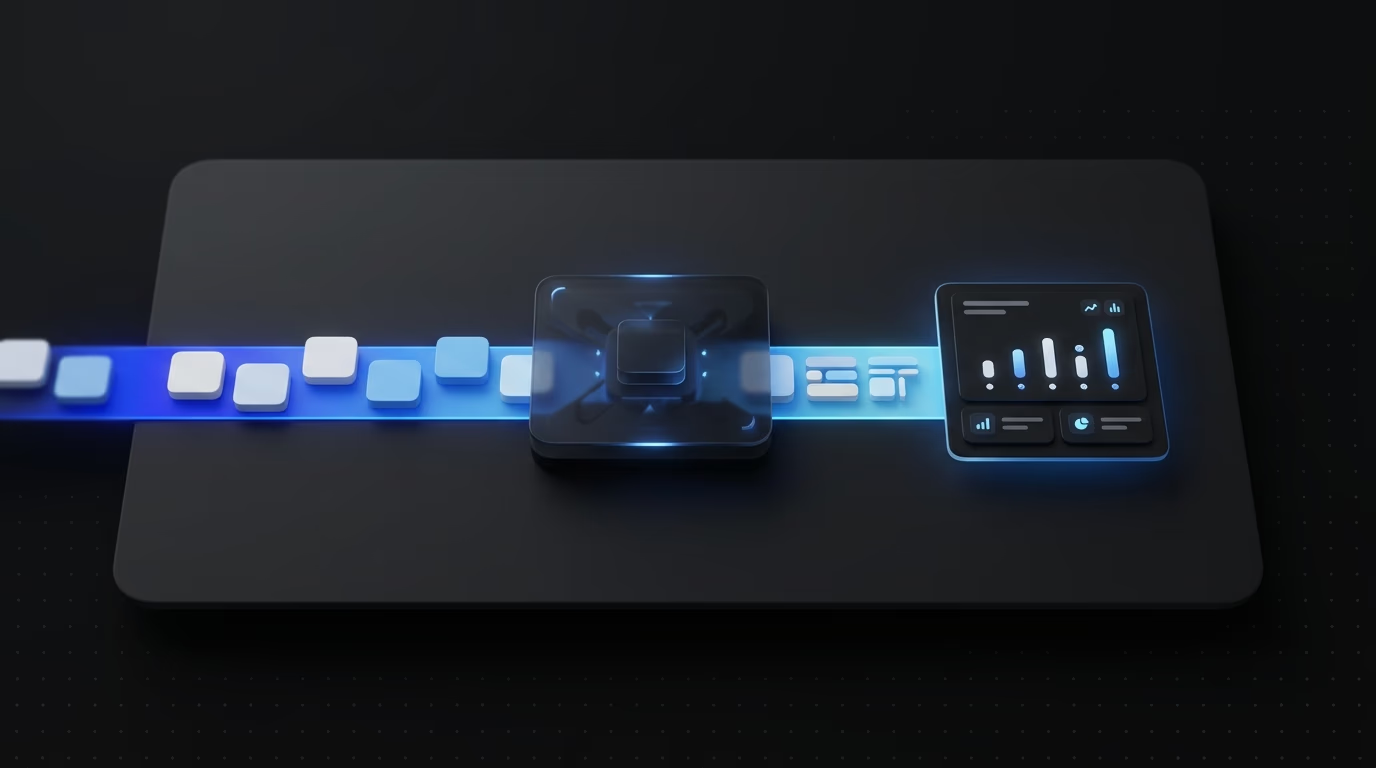
The shift begins when teams stop treating the Facebook ads uploader as a final step and instead make it the center of the system. Rather than building ads one by one inside Ads Manager, creatives are structured upstream into batch-ready testing packs.
Each batch is designed before upload:
- 10–20 creatives grouped by hypothesis (problem, proof, comparison, outcome)
- Audience mapping across cold, warm, and retargeting segments
- Naming conventions tied directly to testing hypotheses
The Facebook ads uploader becomes a deployment engine rather than a construction tool. This reduces launch time by 80–90% compared to manual creation workflows.
Instead of spending 15–30 minutes per ad, teams compress execution into minutes per batch. This changes the fundamental unit of work from "ad creation" to "iteration cycle."
Competitors like Revealbot, AdEspresso, and Madgicx typically focus on optimization layers and reporting dashboards, but they still assume ads are created individually. The uploader-driven model removes that assumption entirely.
For teams looking to operationalize this structure, workflows similar to those described in Automate Creative Testing for Meta Ads (/blog/automate-creative-testing-meta-ads) show how bulk deployment becomes the backbone of testing velocity.
System design: Structuring Facebook ads for bulk deployment
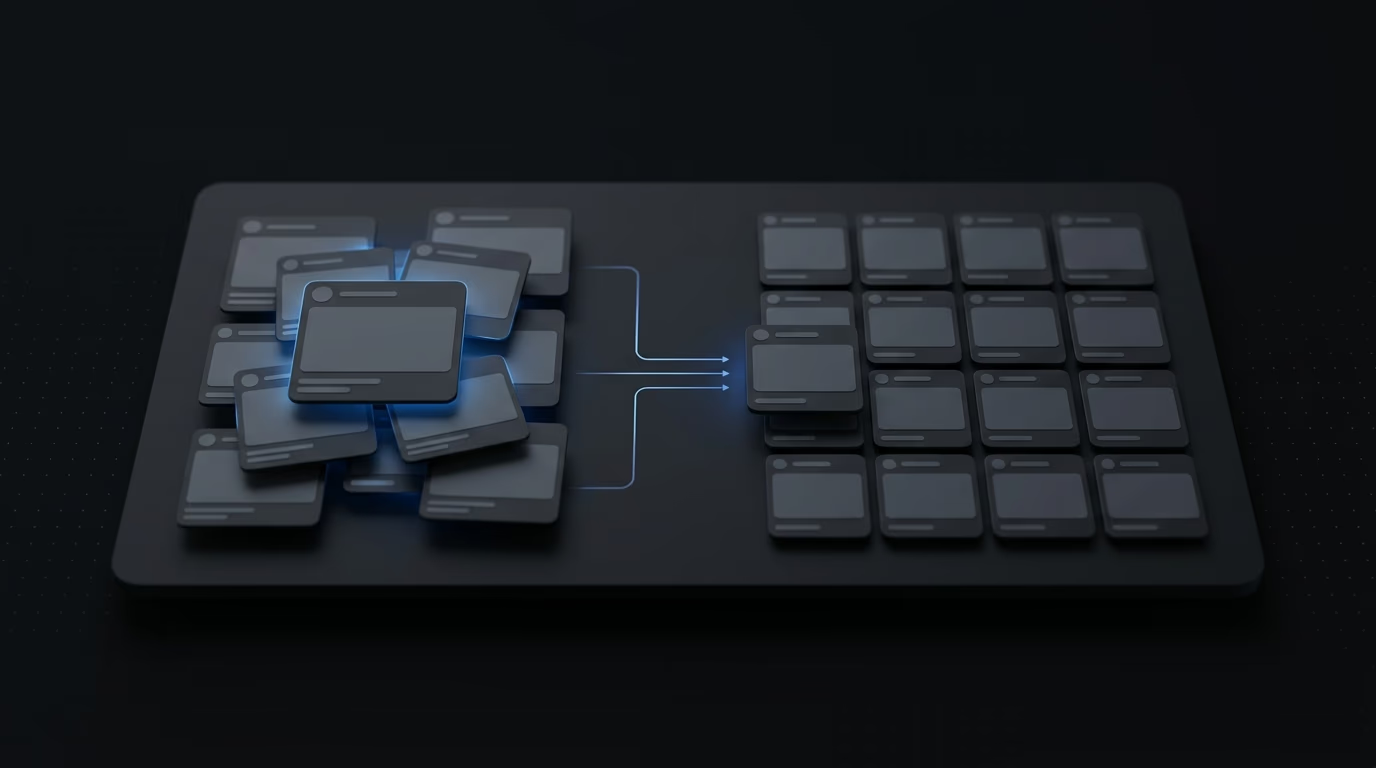
Once the uploader becomes the system core, structure matters more than individual creative quality. Teams begin organizing campaigns as release pipelines rather than static campaigns.
Instead of launching isolated ads, everything is grouped into structured batches:
- Creative themes (pain point, aspiration, proof)
- Format clusters (UGC, static, short-form video)
- Hypothesis tags (expected behavioral outcome)
This structure enables parallel testing at scale. A single release can include 60–120 Facebook ads per week without increasing operational overhead.
Internal frameworks such as How to Scale Meta Ads with Bulk Uploading (/blog/how-to-scale-meta-ads) demonstrate how this shift turns campaign management into a repeatable production system rather than manual setup.
At this stage, AI tools begin to play a role. Teams often use Facebook ads uploader workflows combined with Claude Code to generate structured creative variants, rename assets consistently, and pre-format upload-ready batches. Instead of manually assembling campaigns, operators supervise AI-assisted production pipelines.
Execution example: running multi-audience testing waves
A typical testing cycle starts on Monday morning with a structured batch release.
Three audience layers are defined:
- Cold broad audience
- Interest-based skincare buyers
- Retargeting within 7 days
Each audience receives four hooks, producing 12 Facebook ads in a single upload batch.
Day 1: Launch. The system prioritizes distribution; no early decisions are made. Day 2: Signal divergence begins. One or two hooks show CTR above 1.2%, outperforming the 0.9% benchmark. Day 3: Retargeting efficiency separates as frequency rises above 3.0 and weaker creatives decay.
The key insight is not which ad wins, but how quickly patterns emerge when iteration speed is high.
Teams running this model often reference Scaling Facebook Ads Throughput (/blog/creative-throughput-facebook-ads), which shows how velocity changes statistical reliability in creative testing.
Feedback layer: turning signals into next-cycle hypotheses with Instrumnt
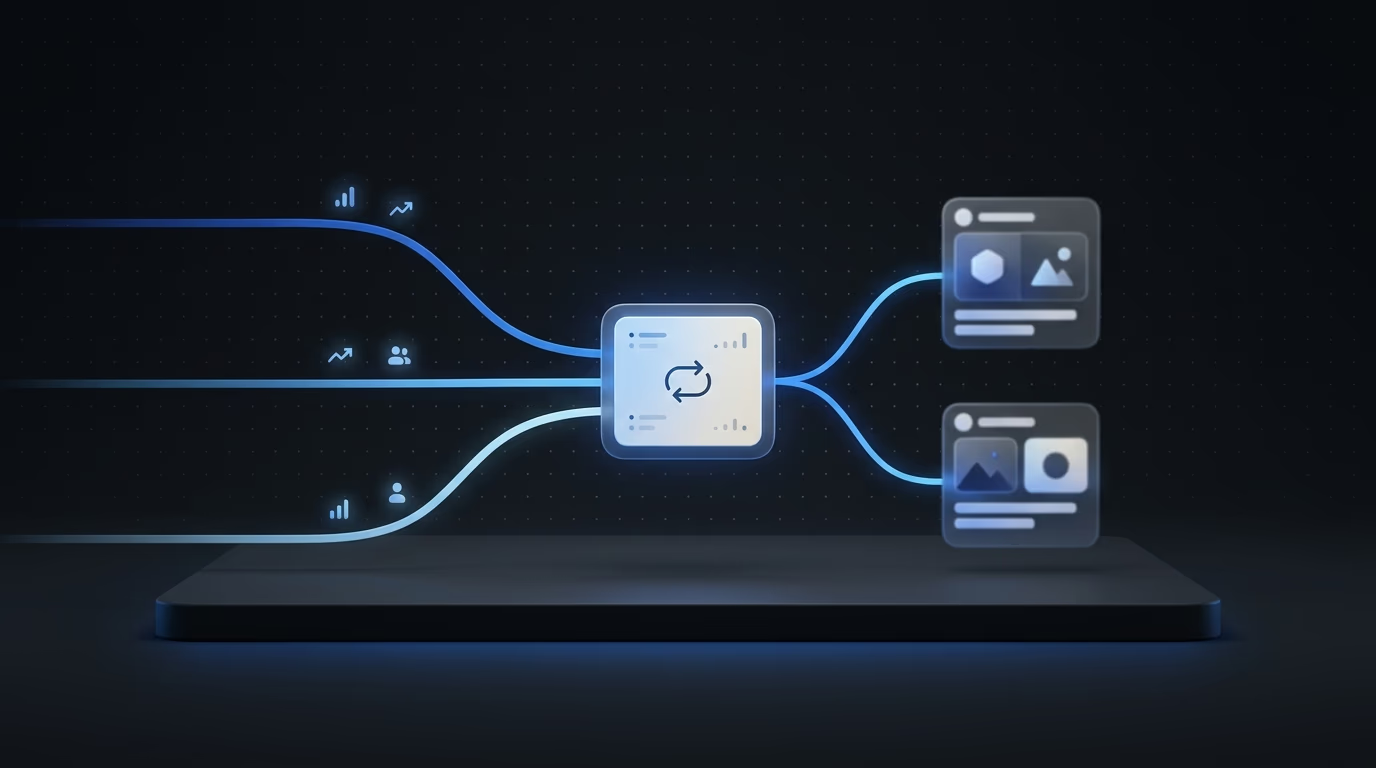
Once deployment is no longer the bottleneck, interpretation becomes the constraint. This is where Instrumnt enters the system.
Rather than reading dashboards manually, teams use Instrumnt as a signal interpreter that converts raw performance data into structured hypotheses.
Instead of metrics like CTR and CPA in isolation, the system outputs directional insights:
- Hook fatigue appears after frequency exceeds 2.5–3.0 in cold traffic
- Video creatives outperform static formats by ~18% in acquisition efficiency
- Single-angle messaging reduces CPA variance across audience types
This reframes Facebook ads reporting from retrospective analysis into forward-looking iteration design.
Teams using this model often pair it with broader insights from Why Your Facebook Ads Are Not Working (/blog/facebook-ads-not-working-creative-diagnosis), where the failure point is diagnosed not as targeting, but feedback delay.
AI augmentation: Claude Code and automated iteration systems
AI changes the structure of the workflow itself. With Claude Code integrated into the pipeline, creative generation and structuring become partially automated.
Instead of manually producing variations, teams prompt AI systems to:
- Generate 20 hook variations per angle
- Normalize naming conventions for upload readiness
- Cluster creatives by hypothesis strength
This turns the Facebook ads uploader into a downstream execution layer for AI-generated batches. AI does not replace strategy; it compresses production time, allowing more iteration cycles per week, which increases the statistical clarity of results.
Metrics and benchmarks: what changes when iteration speed increases
When teams transition from manual builds to uploader-driven iteration, the most important shift is not creative quality but cycle frequency.
Key operational changes observed across high-volume accounts:
- Ads launched per week increase from ~15–20 to 60–120
- Testing cycles shrink from 10–14 days to 3–5 days
- Creative fatigue detection becomes proactive rather than reactive
These changes matter because iteration speed amplifies signal reliability. Even small improvements compound faster when feedback loops shorten.
Meta Business documentation notes that creative refresh frequency is one of the strongest predictors of sustained performance, while WordStream benchmark data (0.9% CTR baseline) highlights how narrow performance margins actually are in practice.
Tooling landscape: Revealbot, AdEspresso, Madgicx comparison
Most tools in the ecosystem focus on optimization rather than structural iteration redesign.
Revealbot emphasizes rule-based automation for scaling budgets and pausing ads. AdEspresso focuses on simplifying campaign creation and A/B testing interfaces. Madgicx builds dashboards and AI-assisted optimization layers.
All three improve management efficiency, but they still assume ads are created individually. None fundamentally replace the uploader-driven creative iteration model where batch deployment is the primary system.
This gap is why newer workflows increasingly combine AI tools, Instrumnt-style signal interpretation, and bulk upload pipelines rather than relying on single-platform solutions.
FAQ: practical questions about Facebook ads uploader workflows
How does an uploader-based workflow improve Facebook Ads creative testing speed?
It removes manual ad creation inside Ads Manager and replaces it with structured batch deployment, cutting setup time from hours to minutes.
Does bulk uploading change ad performance?
No. Meta’s delivery system treats bulk uploaded Facebook ads the same as manually created ones.
What is the real constraint in creative testing systems?
It is not ideas or targeting. It is the speed of deploying, measuring, and feeding results back into the next iteration cycle.
How do AI tools like Claude Code fit into this system?
They accelerate creative generation, naming, and structuring so teams can focus on interpreting signals rather than assembling assets.
Related reading
- 5 Tips for Media Buyers to Work Faster and Scale Smarter
- Why Most Facebook Ad Management Platforms Are Doing It Wrong (And What You Should Do Instead)
- Scaling Facebook Ad Testing: Why AI Is the Key to Breaking Through Your Creative Bottleneck
- Automate Creative Testing for Meta Ads
For tooling context, see Revealbot, AdEspresso, and Madgicx comparisons in the tooling ecosystem discussion above.
For more context, see Smartly.io.
For more context, see Meta Marketing API documentation.
For more context, see Madgicx.