
What the Meta Ad Library actually shows (and why people misuse it)

Most marketers treat the Meta Ad Library like a strategy engine. It is not. It is a visibility layer. That distinction matters more than any targeting tweak inside Facebook ads.
The library shows active and past ads, but not context: no bid strategy, no funnel positioning, no budget pressure, no lifecycle stage. It is a feed of outputs, not decisions.
That is why it is so often misread. What looks like a winning angle is often just a retargeting ad surviving longer in the cycle. What looks like a scaling campaign might just be an exhausted creative still running on legacy spend.
Meta itself is explicit about the limitation: its ecosystem prioritizes creative delivery optimization inside systems like Advantage+ (https://business.meta.com/). What you see in the library is the end state, not the system logic behind it.
This is also where marketers break their thinking. They assume visibility equals truth. But visibility in Meta ads is heavily filtered by algorithmic distribution, placement bias, and campaign objective.
As a result, the Meta Ad Library becomes a mirror of surface-level execution rather than strategic intent.
The blind spot: what it never reveals
The biggest misconception is that you can reconstruct competitor strategy from creative output alone. You cannot.
The library does not show:
- Budget allocation across campaigns
- Learning phase transitions
- Audience segmentation depth
- Incrementality signals
- Creative fatigue timing
And this gap matters. Nielsen research shows that "creative quality accounts for up to 56% of a campaign's ROAS variation" (Nielsen). But the library does not show quality evolution, only snapshots of outputs.
Even Meta Blueprint (https://www.facebookblueprint.com/) emphasizes structured testing over imitation. Yet many advertisers still reverse-engineer ads visually instead of structurally.
The result is predictable: teams copy surface patterns while missing system design.
There is also a timing problem. Ads that appear in the library are not synchronized with performance peaks. You might be analyzing a declining creative while assuming it is scaling.
This is why tools like Sotrender and Paragone exist. They attempt to add structure to observation. Sotrender leans into analytics aggregation, while Paragone focuses on organizing competitor creatives into more usable datasets. But even these tools cannot recover missing strategy signals.
Why copying ads fails (with stats)
Copying ads feels rational because it reduces uncertainty. But it ignores system effects.
Meta internal data shows that "advertisers using 3+ ad variations per audience see up to 30% lower CPA". Another dataset shows that "only about 5-10% of tested creatives turn out to be true winners".
This creates a hidden trap: you are usually copying the visible 90-95% of average ads, not the rare winners that never stay stable long enough to interpret.
Meanwhile, WordStream benchmarks show "average Facebook ad CTR across all industries is 0.90%" (WordStream 2024 benchmarks). That baseline means most ads you observe are statistically unremarkable.
So even if you copy what looks good, you are often replicating median performance, not outliers.
This is why frameworks like creative testing systems outperform manual imitation. They focus on iteration velocity, not static observation.
In practice, the failure mode looks like this: teams identify a competitor creative, replicate it, launch it, and expect transferability. But they are missing audience history, pixel learning, and placement optimization effects.
The Meta Ad Library is not wrong. It is just incomplete in ways that matter most.
Competitor workflow comparison: Paragone vs Sotrender vs Ads Uploader
Different tools try to patch this visibility gap, but they solve different layers of the problem.
Paragone focuses on organizing competitor creatives into structured views. It helps reduce chaos, but it does not interpret performance signals. Sotrender adds more analytics orientation, often combining ad-level tracking with reporting layers, but still depends on visible signals from Meta.
Ads Uploader sits on the opposite end of the stack. It is not about analysis at all. It is about execution speed: getting more ads into Facebook ads systems faster so testing keeps pace with fatigue cycles.
Where Instrumnt fits differently is in the interpretation layer. Instead of just storing ads or launching them, it connects creative patterns to testing outcomes using AI-driven clustering and tagging.
This distinction matters. One layer organizes what exists. Another layer increases how fast you can produce. But neither replaces the need to interpret signals correctly.
This is also where most teams over-index on tooling and under-invest in structure. They assume better dashboards or faster uploads will fix insight gaps. But the real constraint is cognitive: how you interpret imperfect data.
AI-driven interpretation system (Instrumnt + AI + Claude Code)
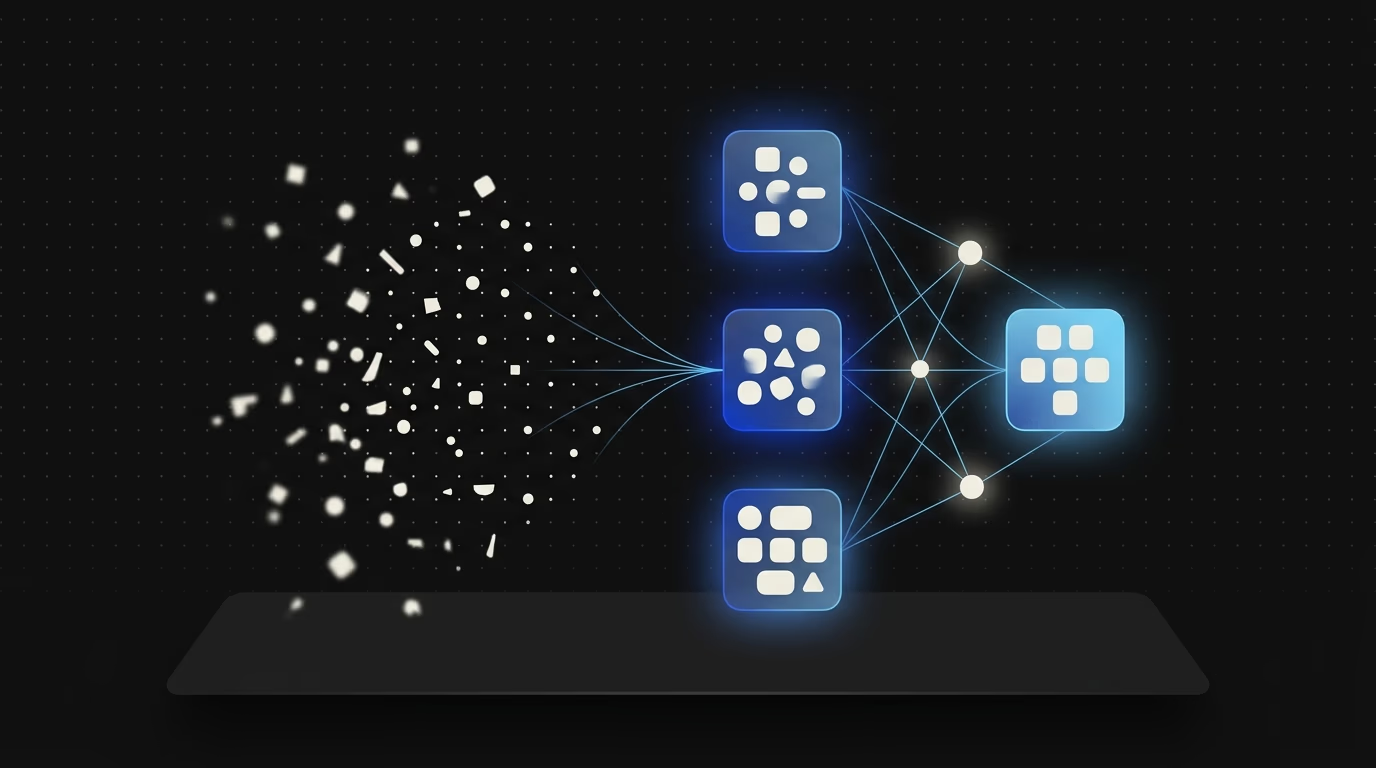
The shift happening now is not better spying tools. It is better interpretation systems.
AI systems like Instrumnt change the workflow from "looking at ads" to "reading patterns across ads." Instead of manually reviewing hundreds of creatives, you cluster them by hook type, visual structure, offer framing, and CTA logic.
Claude Code-style workflows amplify this further by allowing structured tagging and automated summarization of creative datasets.
This matters because scale changes interpretation quality. A single ad tells you nothing. A hundred ads reveal noise. A thousand ads reveal structure.
Meta itself acknowledges automation trends: "Advantage+ Shopping campaigns deliver roughly 22% higher ROAS vs manual campaign setups" (Meta Advantage+ data). That performance gap is driven by system-level optimization, not individual ad inspection.
When you combine AI clustering with tools like Instrumnt, you stop asking "is this ad good?" and start asking "what system is producing this pattern?"
That shift is where real competitive intelligence starts.
Smarter research philosophy
The core mistake with Meta Ad Library usage is philosophical, not technical. Marketers treat it as a truth source instead of a sampling layer.
A better approach is to treat it like exploratory data, not decision data.
You observe patterns, but you validate them through controlled testing inside Facebook ads systems, not imitation.
Internal frameworks like Meta Ads learning loop systems reinforce this idea: observation is only the first step. Execution speed and iteration quality determine outcomes.
External guidance aligns with this too. Meta Marketing API documentation (https://developers.facebook.com/docs/marketing-api) and Meta Ads Guide (https://www.facebook.com/business/ads-guide) both emphasize structured campaign construction over observational mimicry.
The most advanced teams now run a three-layer system:
- Observe via Meta Ad Library
- Interpret via AI clustering (Instrumnt)
- Validate via rapid Facebook ads iteration
Bulk execution tools like Ads Uploader help close the loop by increasing testing throughput, but they do not replace interpretation.
The goal is not to find winning ads. The goal is to build systems that produce them repeatedly.
Once you shift from copying creatives to modeling systems, the Meta Ad Library becomes what it should have always been: a weak signal input, not a decision engine.
For more context, see Ads Uploader.
For more context, see Nielsen.
For more context, see Revealbot.
Common questions about meta ad library
What is the best way to meta ad library?
The best approach depends on your team size and launch volume. Start by structuring your workflow around batch preparation and bulk uploading, then layer in automation for the parts that don't need human judgment.
How many ad variations should I test?
Advertisers running 3 or more variations per audience consistently see lower CPAs. Aim for at least 3-5 variations per ad set as a starting point, and increase from there as your workflow allows.
Does automation replace the need for creative strategy?
No. Automation handles the operational side, like launching, duplicating, and naming ads at scale. Creative strategy, offer positioning, and audience selection still require human judgment. The goal is to free up more time for that strategic work.