Why the Meta Ad Library Feels Useful (But Rarely Drives Results)

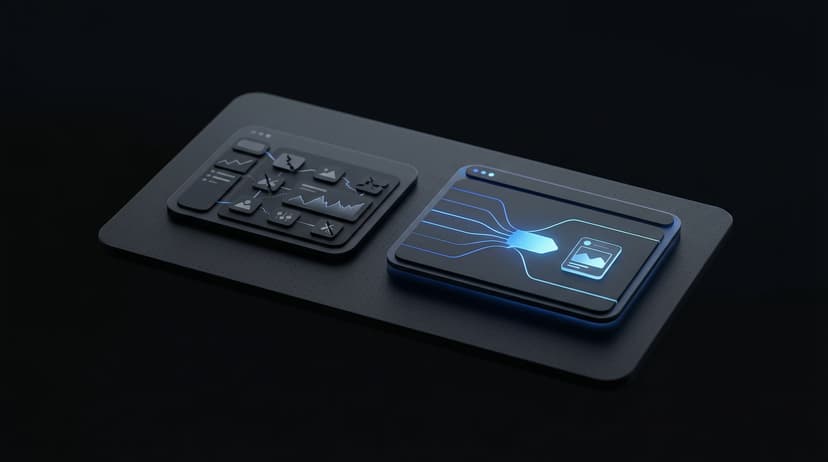
The meta ad library is often treated as a shortcut to better Facebook ads. It feels like you’re gaining an edge—seeing exactly what competitors are running, how long ads stay active, and which formats dominate.
But this feeling is misleading.
According to a 2023 report by HubSpot, 61% of marketers say generating traffic and leads is their biggest challenge—despite widespread use of competitive research tools. The issue isn’t access to data. It’s the inability to turn that data into execution.
Another study by Social Media Examiner (2022) found that fewer than 10% of marketers consistently extract actionable insights from competitor ad research without a defined system. In other words, most teams are looking—but not learning.
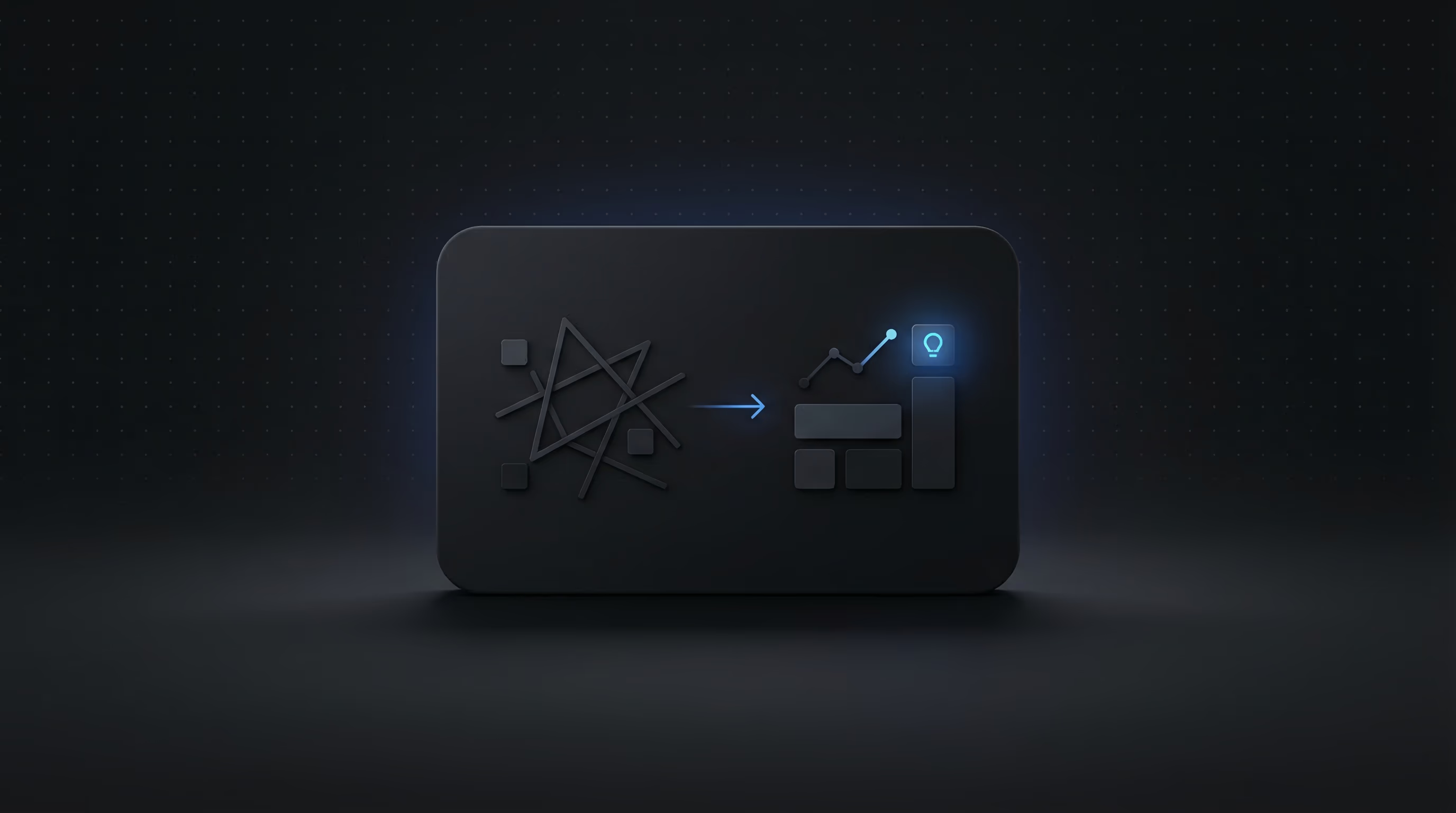
The meta ad library gives you visibility, not answers. Without a structured way to interpret what you’re seeing, you’re left with inspiration at best—and false confidence at worst.
The False Comfort of Browsing Ads Without a System
Scrolling through ads feels productive. You save screenshots, bookmark examples, maybe even share them internally.
But none of that translates into better performance.
The core problem is this: browsing is passive, while performance requires active hypothesis testing.
High-performing Facebook ads teams don’t just observe—they operationalize. They turn patterns into experiments, and experiments into scalable systems.
Without that step, you’re stuck in a loop:
- See an ad
- Assume it works
- Copy loosely
- Launch one variation
- Get inconclusive results
Meanwhile, top teams are launching 10–50 variations per idea.
If you’re not converting insights into volume, you’re not competing.
For a deeper breakdown of why this happens, see Why Your Creative Testing Is Failing (And How to Automate the Solution).
What the Meta Ad Library Actually Gives You — and What It Hides
To use the meta ad library effectively, you need to understand its limits.
What you can see:
- Creative formats (video, image, carousel)
- Messaging angles
- Approximate ad longevity
- Variation volume (sometimes)
What you cannot see:
- CTR (click-through rate)
- CPA (cost per acquisition)
- ROAS (return on ad spend)
- Audience targeting
- Budget allocation
- Testing velocity
This missing layer is critical.
A 2024 Nielsen study found that creative quality alone drives up to 49% of sales lift in digital advertising. But the process behind that creative—testing, iteration, scaling—is what determines whether you ever reach that lift.
The meta ad library shows outputs. It hides the system that produced them.
Why AI Beats Human Eyes for Pattern Detection in Ad Research
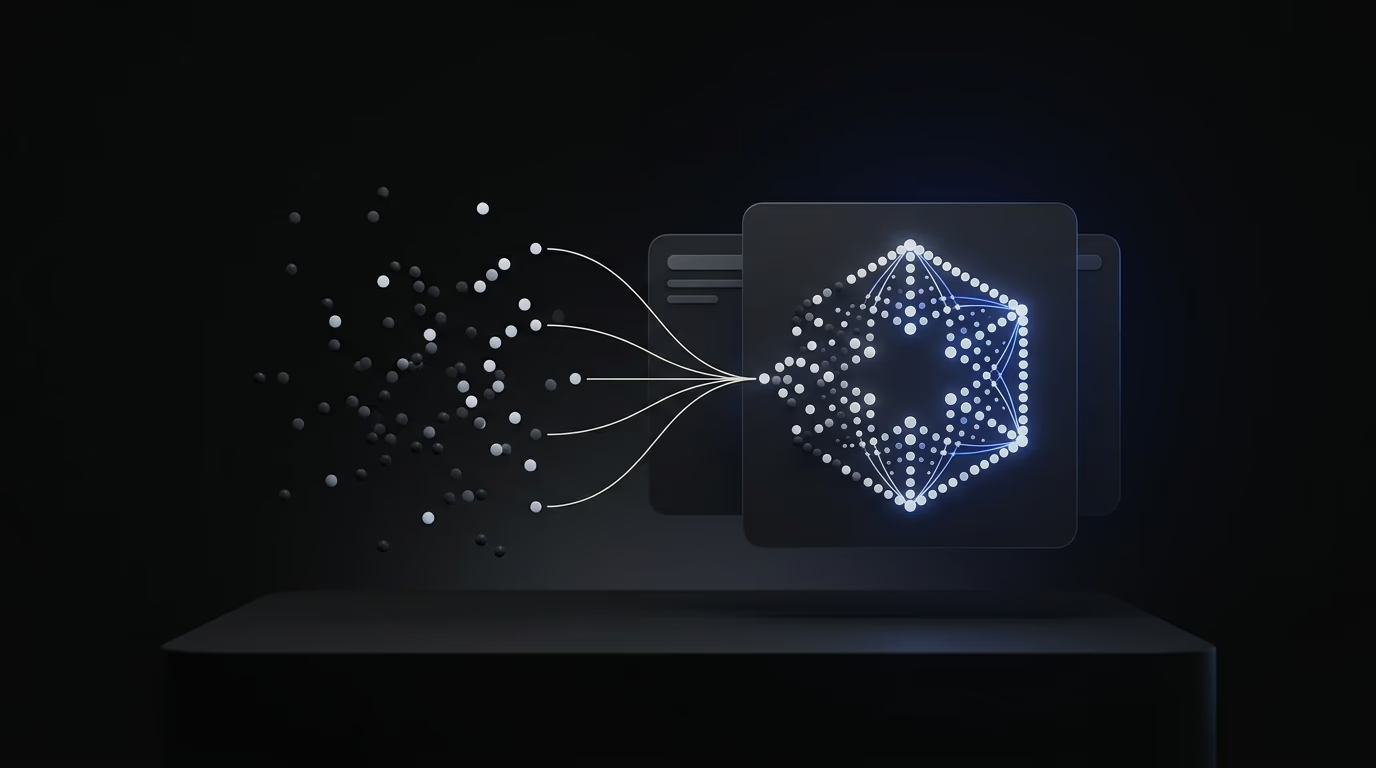
Humans are good at spotting obvious patterns. But competitor ad ecosystems are complex and high-volume.
This is where AI changes the game.
Tools like Claude Code can process hundreds or thousands of ads at once, identifying:
- Repeating hooks
- Structural patterns in copy
- Visual composition trends
- Offer positioning
Instead of guessing what works, you’re extracting probabilistic signals.
According to McKinsey (2023), companies that integrate AI into marketing and sales see 10–20% increases in efficiency and measurable improvements in campaign performance.
But the real advantage isn’t just analysis—it’s speed.
AI compresses what used to take days into minutes. And when paired with Instrumnt, those insights don’t stay theoretical—they become executable.
Instrumnt vs Revealbot vs Madgicx: Where Most Tools Fall Short
Most Facebook ads tools focus on execution, not insight generation.
- Revealbot excels at automation—budget rules, campaign triggers, and scaling logic. But it doesn’t help you figure out what to test.
- Madgicx uses AI to optimize performance, but it primarily works on existing creatives rather than generating new ideas from competitor data.
- AdEspresso is accessible and useful for A/B testing, but it lacks the infrastructure for high-volume creative generation.
Instrumnt fills a different role.
It connects research to execution.
When combined with Claude Code, it turns raw observations from the meta ad library into structured creative variations that can be deployed through the Facebook ads uploader.
If you want to compare workflows in detail, see Facebook Ads Uploader Comparison: Instrumnt vs AdEspresso vs Madgicx vs Revealbot.
From Ad Library to Testing Pipeline: Turning Observations Into 10+ Creative Variations

This is where most teams fail—and where the biggest opportunity exists.
A structured pipeline looks like this:
-
Pattern identification
Instead of looking at single ads, analyze clusters. What messaging repeats? What visual formats dominate? -
Hypothesis creation
Translate patterns into assumptions. Example: "Short-form video with a problem-first hook increases engagement." -
Variation generation
Use Instrumnt to create 10–20 variations of that hypothesis. Change hooks, angles, visuals, and CTAs. -
Bulk deployment
Launch all variations using the Facebook ads uploader. Speed matters more than perfection. -
Performance filtering
Kill underperformers quickly. Double down on winners. -
Iteration loop
Feed results back into the system and repeat.
This is how you turn the meta ad library into a competitive advantage—not by copying, but by compounding.
For a full system walkthrough, see How to Build a Facebook Ads Bulk Testing System with Instrumnt and Claude Code.
A Practical Workflow: Using Claude Code and Instrumnt to Scale Competitor Research
Here’s what this looks like in practice:
Step 1: Extract at Scale
Pull ads from the meta ad library across multiple competitors. Focus on:
- Ads running for 30+ days
- Campaigns with multiple variations
- Repeating messaging themes
Step 2: Analyze With AI
Feed the dataset into Claude Code.
Instead of manually reviewing, ask:
- What hooks appear most often?
- What emotional triggers repeat?
- What structural patterns emerge?
Step 3: Build Hypotheses
Turn insights into testable ideas:
- "Problem-first hooks outperform benefit-first"
- "UGC-style visuals outperform polished creatives"
Step 4: Generate Variations With Instrumnt
This is the critical step.
Instrumnt transforms each hypothesis into multiple creatives—copy, formats, and variations ready for testing.
Step 5: Launch via Facebook Ads Uploader
Instead of launching one ad at a time, use the Facebook ads uploader to deploy everything in bulk.
Velocity is your edge.
Step 6: Close the Loop
Feed performance data back into your system.
Over time, you’re not just testing—you’re building a proprietary insight engine.
For a real-world example, see A Real Facebook Ads Testing Workflow: How One Team Scaled Creative Experiments Without Slowing Down.
The Missing Layer: Operational Discipline (Where Most Teams Break)
Even with the right tools, most teams fail at execution.
Why?
Because they lack operational discipline.
Common breakdown points include:
- Testing too few variations
- Waiting too long to make decisions
- Failing to document learnings
- Treating each test as isolated instead of cumulative
According to Google’s internal research on high-performing marketing teams, structured experimentation frameworks can increase output efficiency by over 30%.
The difference isn’t intelligence—it’s systems.
Winning teams treat creative testing like engineering:
- Clear inputs
- Repeatable processes
- Measurable outputs
If your workflow isn’t systematic, the meta ad library will always underdeliver.
Common Questions About the Meta Ad Library
How do you use the meta ad library for competitor analysis?
You don’t just browse. You extract patterns across multiple ads, convert them into hypotheses, and test them at scale using AI tools like Claude Code and execution platforms like Instrumnt.
What are the limitations of the meta ad library?
It lacks performance data, audience insights, and testing context. It shows what exists—not what works or why.
How can you turn competitor ads into high-performing creative tests?
By building a system:
- Extract patterns
- Generate variations
- Launch in bulk
- Iterate rapidly
The meta ad library is just the input. Your system is what creates results.
If you treat the meta ad library as a source of inspiration, you’ll stay average.
If you treat it as raw data for a testing engine powered by AI, Instrumnt, and the Facebook ads uploader, it becomes a compounding advantage.
For more context, see Meta Ads Guide.
For more context, see Meta Blueprint.
For more context, see Meta for Business Help Center.