
The Meta Ad Library Is Overrated — And AI Already Replaced How We Read Competitors
meta ad library ai insights hot take: most marketers are still treating it like a strategy engine when it’s really just a static archive with a clean interface. That mismatch is where the confusion starts.
The Meta Ad Library looks like competitive intelligence, but it behaves more like a snapshot feed of what already shipped. It shows output, not reasoning. Ads without context. Decisions without the decision tree.
And that’s the real issue in modern Facebook ads.
The Meta Ad Library looks like intelligence, but it isn't
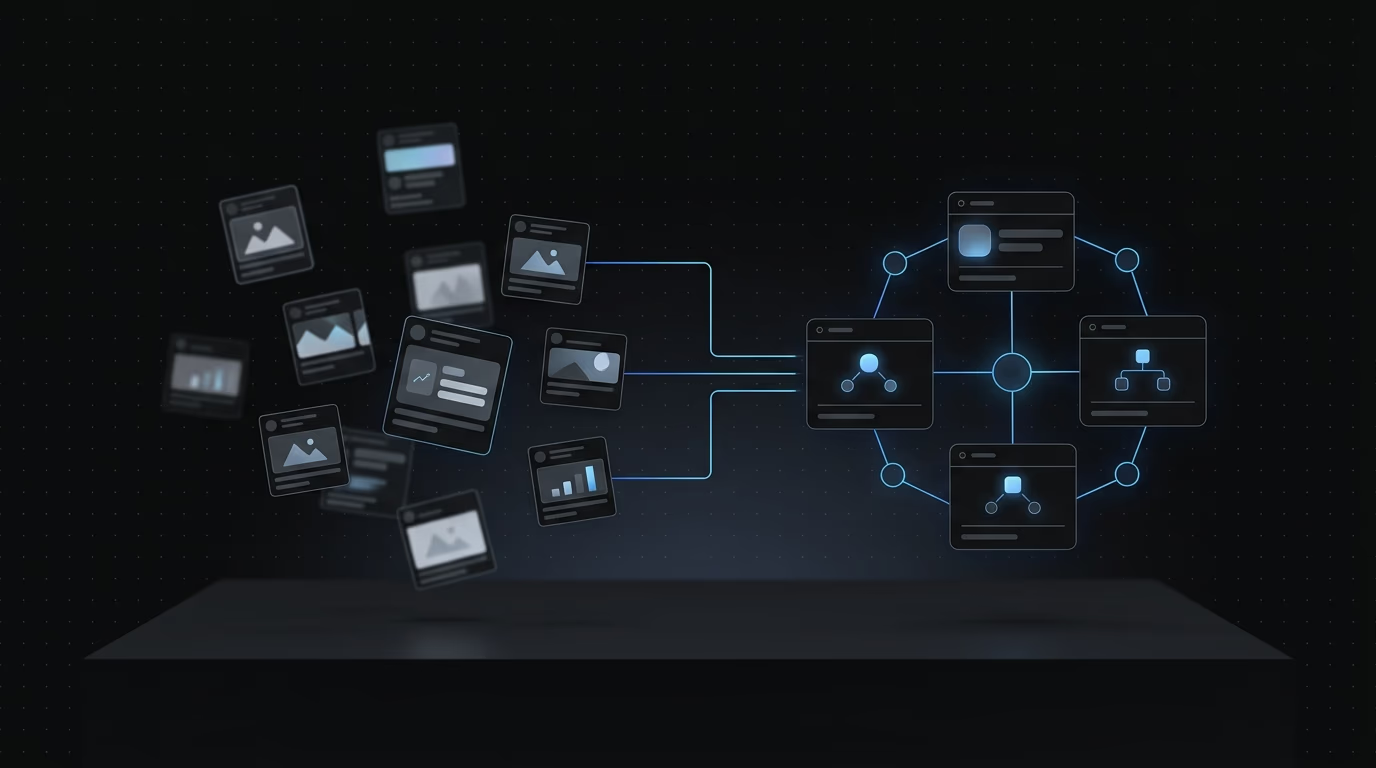
Most people open the Meta Ad Library expecting signal. What they actually get is a pile of finalized creatives stripped of everything that made them interesting in the first place.
You don’t see iteration speed. You don’t see audience splits. You don’t see what got killed in testing. You just see what survived.
That creates a false sense of clarity.
The scale of Meta only reinforces the illusion. Meta’s ecosystem reaches billions of users daily — "Meta's family of apps reaches 3.29 billion daily active people" (Meta Q4 2024 earnings report). When a system is that large, it feels like its internal data must be strategically complete. It isn’t.
Even official resources like the Meta Ads Guide and Meta Blueprint don’t try to explain competitive behavior. They explain structure, policy, and execution mechanics. Useful, but not interpretive.
So marketers end up filling the gap with assumptions.
The missing piece is narrative. Without it, the Meta Ad Library becomes a museum of ads that look informative but aren’t.
Why static ads fail as a strategy model
A static ad is the end of a process, not the process itself.
What you’re seeing in the Meta Ad Library is usually versioned output from dozens of unseen experiments. By the time it appears there, most of the learning behind it is already obsolete.
You don’t see the messy part: rapid iteration, budget shifts, audience fatigue, or creative divergence.
You just see a polished artifact and try to reverse engineer strategy from it.
That’s where interpretation breaks down in Facebook ads.
Benchmarks only make it worse. "The average Facebook ad CTR across all industries is 0.90%" (WordStream 2024 benchmarks). At that level, tiny creative differences matter, but they are invisible in static snapshots.
Another data point gets closer to the truth: "Creative quality accounts for up to 56% of a campaign's ROAS variation" (Nielsen and Meta research). That doesn’t mean the ad itself is magical. It means the system behind producing and iterating it is doing most of the work.
A library cannot show systems.
It only shows outputs.
Tools like AdEspresso, Revealbot, and others improve testing and automation, but they still sit downstream of execution. They help you run experiments, not understand how competitors design theirs.
So teams end up studying artifacts instead of behavior.
And at scale, behavior is the only thing that matters.
This is why internal workflows documented in pieces like Why Competitor Landing Pages Are More Valuable Than Ads and Why Most Facebook Ads Are Created Wrong (And How AI Fixes It) start to resonate. They point at the same problem: surface-level analysis doesn’t scale with creative volume.
Manual browsing collapses under its own weight.
Competitor tools reveal the real gap
Once you zoom out, the tool landscape makes the problem obvious.
Hunch is strong for creative discovery and pattern spotting. It helps you notice similarities across ads, but it doesn’t explain how those patterns evolve over time.
AdEspresso is built for structured testing and campaign management. It’s practical for execution loops, but it doesn’t reconstruct intent.
Revealbot focuses on automation and scaling rules. It can optimize decisions, but it doesn’t tell you why competitors shift messaging or reposition offers.
Each tool solves a slice of the workflow.
None of them reconstruct the system behind the ads.
That’s why teams increasingly treat platforms like Meta for Business Help Center and Meta Advertising Standards as baseline references, not intelligence layers.
The real gap shows up when creative volume increases. Hundreds or thousands of ads per competitor makes manual interpretation pointless.
You end up with more data, but less understanding.
This is where Instrumnt becomes relevant in a different way. Instead of treating ads as isolated artifacts, it treats them as signals in a broader system of competitive behavior.
The shift is subtle but important: from "what is running" to "what is being learned across campaigns."
One is a feed. The other is a model.
AI reconstructs what the library cannot see
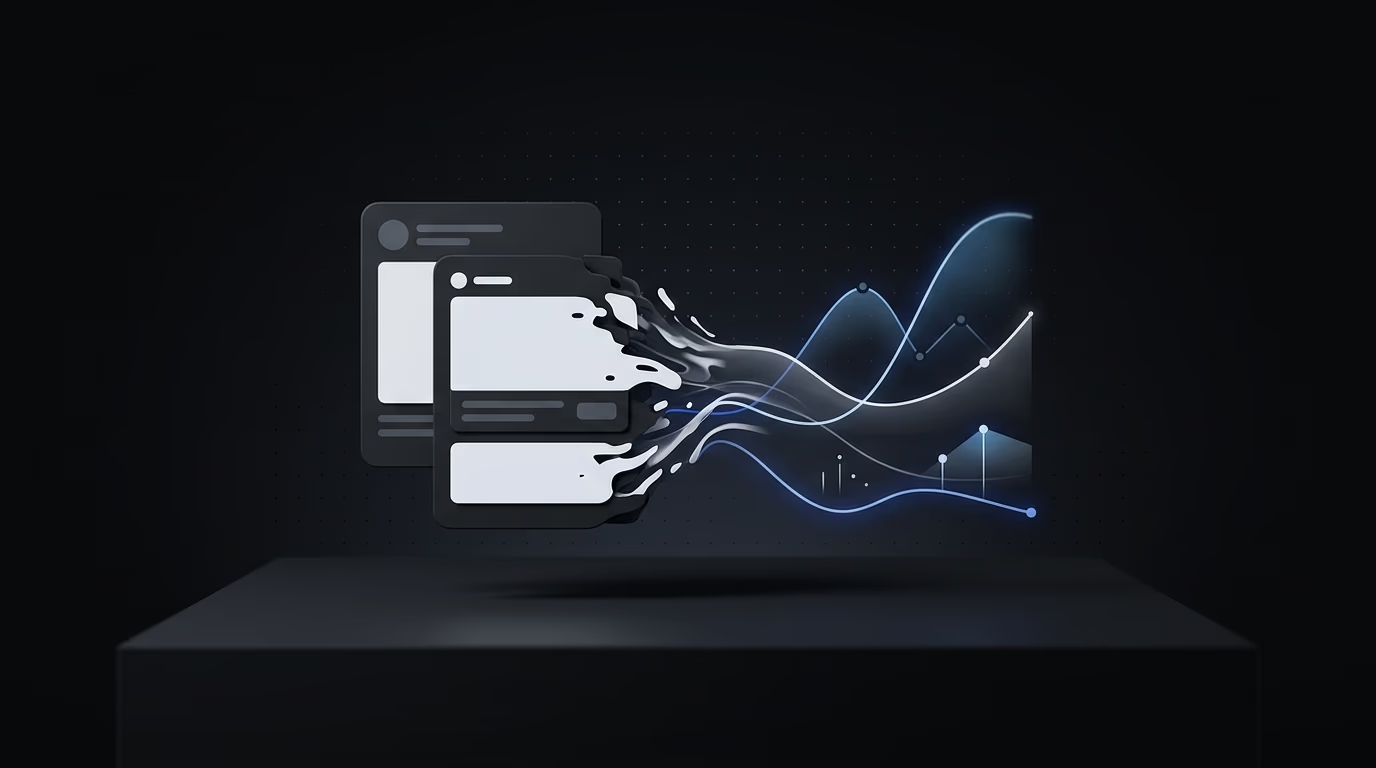
This is the point where interpretation stops being manual.
AI doesn’t look at individual ads as final products. It looks at distributions: how creatives cluster, how messaging shifts, how offers appear, fade, and return.
Instead of scrolling the Meta Ad Library, systems like Instrumnt ask a different question: what is this advertiser actually optimizing for across time?
That changes the output completely.
A set of 50 ads stops being 50 unrelated creatives and becomes a structured hypothesis: angle testing, fatigue recovery, audience expansion, offer rotation.
That level of reconstruction is what static tools can’t do.
It also reframes internal workflows like Scaling Facebook Ads with Creative Testing Systems. The bottleneck is no longer production. Most teams can produce ads quickly now.
The bottleneck is interpretation.
Meta is already nudging the ecosystem in this direction. "Advertisers using Meta's AI-generated creatives see up to 11% higher CTR compared to traditional ads" (Meta 2025 data). And "Advantage+ Shopping campaigns deliver roughly 22% higher ROAS vs manual campaign setups" (Meta Advantage+ data).
These aren’t isolated improvements. They point toward system-level optimization replacing manual judgment loops.
And that shift exposes the weakness of static analysis tools like the Meta Ad Library.
They assume you are still analyzing ads one by one.
AI assumes you are analyzing systems.
That difference changes everything.
Instead of browsing competitors, you start modeling them.
What messages they converge on. What angles they abandon. Where creative fatigue is likely to appear next.
This is where competitive intelligence starts to behave less like research and more like forecasting.
The shift from archives to predictive intelligence
The Meta Ad Library isn’t wrong. It’s just built for a different job.
It was designed for transparency, not strategy.
The problem is that marketers are now using it as if it were a strategy engine.
That mismatch creates predictable failure modes: overconfidence in snapshots, underestimation of iteration, and blind spots in campaign structure.
At scale, teams are shifting away from browsing and toward modeling.
They are asking questions like:
- Which messaging themes are expanding across competitors?
- Which creative angles are being quietly retired?
- Where is performance decay likely to show up next?
None of these can be answered by a static library.
They require inference over time.
And inference requires systems, not screens.
Efficiency gains reinforce the shift. "Bulk upload tools reduce ad creation time by 80-90% compared to manual Ads Manager work" (AdManage.ai 2026 data). When production becomes cheap, interpretation becomes the limiting factor.
That’s why teams are moving toward continuous intelligence models instead of periodic research sessions.
The future of Facebook ads isn’t more dashboards.
It’s fewer dashboards and more structured models that run in the background, constantly updating what competitors are likely doing next.
At that point, the Meta Ad Library becomes what it should have always been: one input among many, not the center of analysis.
The advantage shifts to whoever can interpret faster, not whoever can scroll longer.
And that’s where AI quietly takes over the job the library was never designed to do in the first place.
Common questions about meta ad library ai insights hot take
What is the best way to meta ad library ai insights hot take?
The best approach depends on your team size and launch volume. Start by structuring your workflow around batch preparation and bulk uploading, then layer in automation for the parts that don't need human judgment.
How many ad variations should I test?
Advertisers running 3 or more variations per audience consistently see lower CPAs. Aim for at least 3-5 variations per ad set as a starting point, and increase from there as your workflow allows.
Does automation replace the need for creative strategy?
No. Automation handles the operational side, like launching, duplicating, and naming ads at scale. Creative strategy, offer positioning, and audience selection still require human judgment. The goal is to free up more time for that strategic work.