
Introduction: Why Facebook Collection Ads Often Underperform
Facebook Collection Ads promise a high-converting, mobile-first storefront experience. In theory, they combine thumb-stopping creative with frictionless product discovery. In practice, many advertisers struggle to get meaningful results from this format.
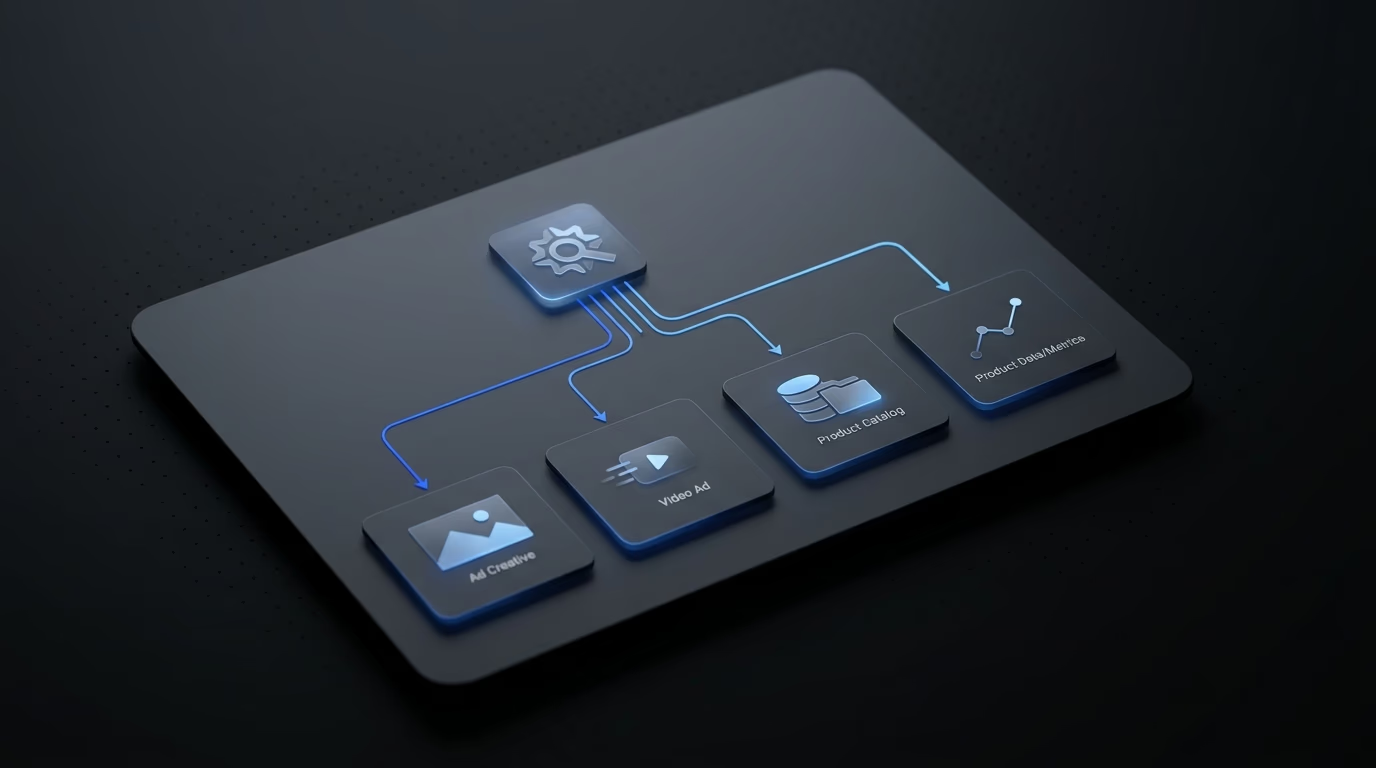
The core issue is structural: most teams treat Facebook ads as isolated units instead of systems. Collection Ads are not just creative—they are a combination of creative, product feed architecture, and delivery workflow.
Data highlights how fragile performance can be. According to WordStream, the average Facebook ads click-through rate (CTR) across industries is حوالي 0.90% (WordStream, 2024). Meanwhile, internal Meta benchmarks suggest that ecommerce Instant Experiences often see drop-off rates exceeding 50% before users engage with product tiles when poorly structured (Meta internal guidance, 2025). That gap between click and engagement is where most campaigns fail.
At the same time, creative fatigue is accelerating. Social Media Examiner reports that ad fatigue is happening up to 25% faster than in prior years due to increased competition and content saturation (Social Media Examiner, 2025). This means even well-performing Collection Ads degrade quickly if systems are not in place to refresh them.
To fix this, you need a diagnostic approach—not guesswork.
Diagnosing Creative and Product Feed Issues
Before scaling anything, identify where performance breaks. Collection Ads fail in predictable ways, and each failure maps to a specific system issue.
| Symptom | Common Fix | Why It Fails | Better Approach |
|---|---|---|---|
| High CTR, low conversions | Optimize landing page | Users drop inside Instant Experience | Fix product alignment inside IX |
| High IX bounce rate | Adjust CTA | CTA is rarely the issue | Align product grid with intent |
| Low CTR | Change audience | Misdiagnosis | Improve creative hook |
| Product errors | Manual fixes | Too slow | Automate feed syncing |
The biggest hidden issue is product mismatch. Many advertisers use broad catalogs like "All Products," assuming Facebook will optimize delivery. In reality, this reduces relevance.
Instead, segment your feed:
- Seasonal collections (e.g., "Winter Essentials")
- Price-based groupings (e.g., "Under $50")
- Intent-based bundles (e.g., "Starter Kits")
This aligns creative messaging with product visibility.
If your product feed structure is weak, no amount of creative iteration will fix performance. For deeper guidance, see Setting Up Dynamic Product Ads: A Facebook Strategy for 2026.
Optimizing the Facebook Ads Uploader Workflow

Most teams underestimate how much workflow affects performance. Even if you identify the right strategy, slow execution kills momentum.
Manual ad creation limits testing velocity. If launching variations takes hours, you simply cannot iterate fast enough to beat creative fatigue.
This is where a Facebook ads uploader becomes critical.
A Scalable Workflow System
-
Batch creative production
Create multiple formats at once: UGC, product demos, lifestyle shots, and offer-driven creatives. -
Predefined product sets
Build reusable collections mapped to specific intents. -
Bulk mapping via uploader
Use a Facebook ads uploader to pair creatives with product sets at scale. -
Automated Instant Experience generation
Remove manual IX building to eliminate bottlenecks.
Platforms like Instrumnt enable this workflow by compressing hours of setup into minutes. Instead of building ads one by one, you deploy structured variations instantly.
If you're still relying on manual workflows, you're operating at a structural disadvantage. For a deeper breakdown, explore Meta Ads Bulk Upload Workflow: A Step-by-Step Operations Guide.
Why Workflow Speed Matters
Speed is not just about efficiency—it directly impacts performance. Faster iteration leads to:
- More creative testing cycles
- Faster identification of winners
- Reduced impact of fatigue
In contrast, slow teams over-invest in underperforming creatives because they lack replacement velocity.
Design Strategies to Boost Engagement and Click-Through Rates
Creative still matters—but only when aligned with system design.
The Continuation Principle
Your top creative must seamlessly lead into the product grid. If the visual narrative breaks, users drop off.
Use:
- Motion cues
- Directional overlays
- Visual framing that previews product layout
The goal is continuity, not just attention.
Creative Diversity Wins
UGC-style creatives consistently outperform polished ads in many Facebook ads environments. Meta has repeatedly indicated that native-feeling content drives stronger engagement signals.
Testing diversity is key:
- UGC testimonials
- Problem-solution videos
- Quick product demos
- Offer-driven creatives
Relying on one format accelerates fatigue. Expanding formats increases longevity.
For more strategies, see Automate Creative Testing for Meta Ads.
Instant Experience Layout Selection
Choosing the right layout impacts how users engage:
- Storefront: Best for direct conversions
- Lookbook: Best for inspiration and discovery
- Customer acquisition: Best for storytelling
Lookbook formats often reduce bounce rates because they blend content with commerce more naturally.
Incorporating AI Tools for Creative Testing and Automation
AI is rapidly changing how advertisers manage Facebook ads. Instead of relying on intuition, teams can now use data-driven systems to guide decisions.
Claude Code plays a role here by analyzing performance patterns across campaigns. It can identify:
- Which hooks drive product views
- Which creatives fatigue fastest
- Which product categories pair best with specific formats
This transforms creative strategy from guesswork into a feedback loop.
The Closed-Loop System
- AI analyzes performance (Claude Code)
- Insights identify winning patterns
- Instrumnt deploys new variations instantly
- Data feeds back into the system
This loop enables continuous optimization without manual bottlenecks.
For a deeper dive, see Automated Facebook Ads Learning Loops with Instrumnt and Claude Code.
Why AI Changes the Game
Traditional workflows:
- Slow
- Manual
- Reactive
AI-driven workflows:
- Fast
- Scalable
- Predictive
The difference is not incremental—it is structural.
Testing, Iterating, and Measuring Conversion Success
Collection Ads require continuous iteration. Static campaigns fail quickly in competitive environments.
Key Metrics to Track
- CTR: Measures creative effectiveness
- Product view rate: Measures Instant Experience quality
- Conversion rate: Measures full funnel performance
A common failure pattern:
- High CTR
- Low product views
This indicates a disconnect between creative and product grid.
Another pattern:
- Strong engagement
- Weak conversions
This often points to poor product selection or pricing mismatch.
Refresh Cadence
Given faster fatigue cycles, high-spend campaigns should refresh creatives every 7–10 days.
According to Meta ecosystem studies, campaigns that refresh creatives regularly can maintain up to 30% higher engagement rates compared to static campaigns (Meta partner insights, 2025).
Iteration is not optional—it is required.
Competitor Workflow Comparison: What You Can Learn
Understanding how leading platforms approach Collection Ads reveals what high-performing systems look like.
Smartly.io
Smartly.io focuses on automation at scale. It reduces manual workload by generating and deploying creatives programmatically.
Key takeaway: automation enables volume.
AdManage.ai
AdManage.ai emphasizes real-time optimization. Campaigns are continuously adjusted based on performance data.
Key takeaway: speed of optimization matters as much as initial setup.
Hunch
Hunch focuses on structured creative pipelines. It ensures assets are organized, refreshed, and reused effectively.
Key takeaway: creative management prevents fatigue.
What This Means for You
All three competitors highlight the same principle: performance comes from systems, not isolated tactics.
If your workflow is:
- Manual
- Slow
- Unstructured
You will struggle regardless of creative quality.
Building a Repeatable Collection Ads System
To consistently improve results, combine everything into a single system:
- Structured product feeds
- High-velocity creative production
- Automated uploader workflows
- AI-driven insights
- Continuous iteration
This shifts your approach from campaign-based thinking to system-based execution.
For broader strategy context, see Why Most Facebook Ads Are Created Wrong (And How AI Fixes It).
Common Questions About Facebook Collection Ads
What makes Facebook Collection Ads different from other ad formats?
They combine a primary creative with a product grid inside an Instant Experience. This creates a mini storefront, meaning both creative and product feed must be optimized together.
How can I structure my product feed to maximize engagement in Collection Ads?
Use intent-based segmentation. Align product sets with the message of each ad rather than relying on broad catalogs.
Which AI tools can automate creative testing and improve Collection Ad performance?
Claude Code provides analytical insights, while platforms like Instrumnt execute large-scale testing and deployment, creating a continuous optimization loop.
Final Takeaway
Low engagement in Facebook Collection Ads is rarely caused by a single issue. It is the result of disconnected systems—creative, feed, and workflow operating independently.
Fixing performance requires integration.
When you align:
- Creative intent
- Product visibility
- Execution speed
Collection Ads become one of the most powerful formats in Facebook ads.
The difference is not in the format—it is in how you operate it.
For more context, see Meta Ads Guide.
For more context, see Nielsen.
For more context, see Madgicx.