
The campaign deadline that exposed the creative pipeline problem
A creative team can have strong ideas, talented designers, and experienced media buyers yet still miss a major Facebook ads launch deadline. The problem is often not a lack of creativity. It is the system connecting strategy, production, approvals, uploads, publishing, and learning.
Imagine a growth team preparing a Monday campaign launch. Designers finish multiple variations on Friday, copywriters update messaging later that day, compliance requests adjustments, and the media buyer discovers that approved assets are not organized correctly for publishing. Every person is working, but the workflow has no reliable operating system.
A Facebook ad creative pipeline solves this operational gap by creating a predictable path from concept to campaign. Instead of relying on conversations, scattered files, and last-minute checks, teams build a repeatable process where every asset, decision, and owner is visible.
The goal is not simply creating more ads. The goal is helping teams move valuable ideas into market faster while preserving quality and learning from results.
Where Facebook ad creative pipelines break
Most pipeline failures happen because individual tasks are optimized while the connections between tasks are ignored. A designer may deliver excellent creative, but the campaign can still fail if the approval process is unclear or the publishing package is incomplete.
Common breakdowns include:
- Creative briefs that do not define audience, testing goals, or required formats.
- Approval feedback spread across email, chat, and documents.
- Asset folders with unclear naming conventions and outdated versions.
- Media buyers discovering missing files during campaign setup.
- Testing priorities changing without updating production plans.
- Performance insights failing to influence future creative decisions.
According to Meta for Business, advertisers should test multiple creative approaches and consider creative quality, relevance, and audience response when improving ad performance. Source: Meta for Business creative guidance.
Independent benchmark data also shows why structured experimentation matters. WordStream's Facebook Ads Benchmarks report analyzed thousands of advertising campaigns and found that average click-through rates and costs vary significantly across industries, meaning advertisers cannot rely on one successful creative approach indefinitely. Source: WordStream Facebook Ads Benchmarks.
These statistics demonstrate why a pipeline matters. When performance changes, teams need the ability to quickly produce, approve, launch, and evaluate new creative variations.
The operational workflow that keeps campaigns moving
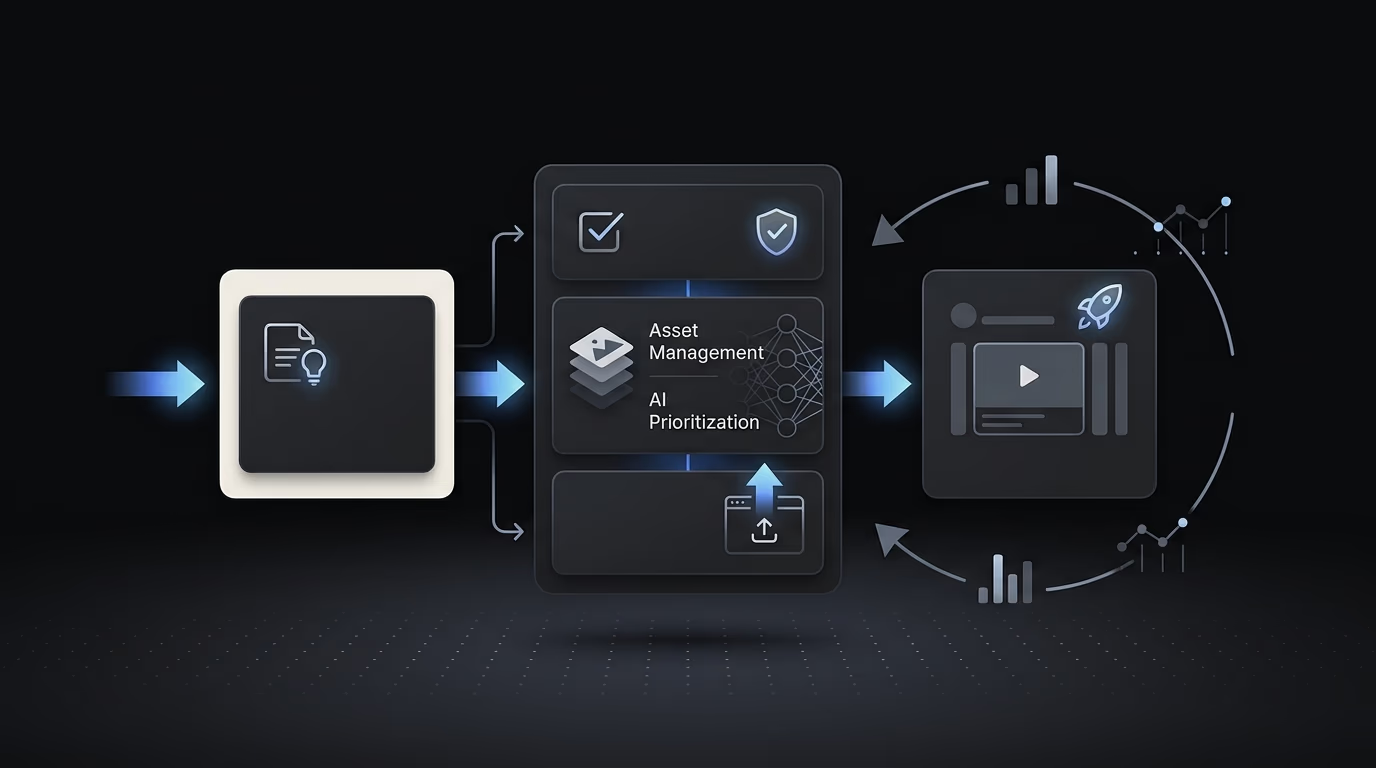
A strong Facebook ad creative pipeline treats publishing as one stage inside a larger operating system. The workflow begins before a designer creates an asset and continues after campaigns generate performance data.
1. Start with a structured creative brief
Every campaign should begin with a clear request containing the business objective, audience, offer, messaging angle, creative requirements, deadlines, owners, and measurement criteria.
A structured brief prevents production teams from guessing. It also makes creative testing more intentional because each asset has a defined purpose.
For example, a team testing a new product offer may create separate concepts for customer education, social proof, urgency, and product demonstration. Without a brief, these variations can become random instead of strategic.
2. Organize asset production before launch
Creative production becomes faster when teams agree on file structures, naming rules, dimensions, and version control before assets are delivered.
A reliable system should answer simple questions:
- Which campaign does this asset belong to?
- Which audience is it designed for?
- Is this the approved version?
- Who owns the next action?
This prevents media buyers from spending launch day searching through folders or asking whether a file is final.
3. Create approval checkpoints
Approvals should be designed as workflow stages, not random conversations. Brand teams, legal reviewers, and performance stakeholders should have a clear place to provide feedback.
A good approval system reduces unnecessary revisions while protecting campaign quality. It also creates accountability because every decision has an owner.
The Facebook ads uploader workflow that connects approval to launch
The Facebook ads uploader stage should be the final execution step, not the place where teams discover operational problems.
A prepared uploader workflow includes approved assets, campaign naming conventions, destination URLs, tracking parameters, audience details, and testing labels. When these elements are organized upstream, publishing becomes faster and less stressful.
Before uploading Facebook ads, teams should verify:
- Creative files match approved versions.
- Tracking links function correctly.
- Campaign objectives align with strategy.
- Audience settings are reviewed.
- Launch responsibilities are assigned.
A Facebook ads uploader workflow improves execution speed, but it cannot repair broken creative operations. Faster uploading does not solve unclear briefs, delayed approvals, or missing strategic decisions.
Teams should think of uploading as the bridge between creative operations and campaign deployment, not as the entire system.
The AI marketing idea: a creative operations assistant
Many conversations about AI focus on generating advertisements. Generation is useful, but the larger opportunity is improving coordination around creative work.
An AI assistant can help teams manage operational complexity by identifying blockers and organizing information across the pipeline.
Useful applications include:
- Detecting missing assets before launch.
- Summarizing approval delays.
- Creating campaign readiness checklists.
- Organizing creative testing ideas.
- Reviewing performance notes.
- Highlighting concepts that deserve another iteration.
AI should support human judgment rather than replace creative strategy. Experienced marketers still need to understand customers, positioning, and business goals.
For teams improving experimentation systems, resources like Scaling Facebook Ad Testing: Why AI Is the Key to Breaking Through Your Creative Bottleneck explain how stronger testing operations can increase learning velocity.
The best AI workflow combines automation with human decision-making. It removes repetitive coordination work so teams can spend more time on strategy.
Using Claude Code to build practical workflow automation
Technical marketers do not always need a large engineering department to improve their advertising operations. Claude Code can help teams create lightweight internal tools that solve specific workflow problems.
Examples include:
- Asset validation scripts that check required file formats.
- Naming generators that standardize campaign structures.
- Upload package builders for Facebook ads uploader workflows.
- Approval dashboards showing launch readiness.
- Reporting assistants that summarize campaign changes.
- Internal tools connecting testing priorities with production queues.
These tools do not replace advertising platforms. They connect disconnected steps and reduce manual coordination.
Combined with Instrumnt, lightweight automation can help teams connect creative research, testing decisions, workflow visibility, and publishing operations into a repeatable system.
Comparing workflow approaches

Different platforms solve different parts of advertising operations.
Smartly.io focuses on enterprise creative automation and workflow management. Large organizations with complex production requirements may benefit from its structured capabilities. However, smaller teams may need simpler systems focused on their specific bottlenecks.
Ads Uploader emphasizes bulk publishing efficiency and faster deployment. This approach can improve execution speed, but uploading faster does not solve upstream problems such as unclear ownership or inconsistent creative testing.
Hootsuite Ads approaches advertising through a broader social media management perspective. It can support campaign execution, while specialized Facebook ad creative pipeline workflows often require additional systems for approvals, testing, and production coordination.
The right operational approach depends on campaign volume, team structure, and how closely creative, media buying, and analytics teams collaborate.
Building a repeatable launch playbook
A reliable pipeline is created through simple rules repeated across every campaign.
Before launch, teams should confirm:
- Is the creative brief complete?
- Are all assets approved?
- Are testing priorities documented?
- Are Facebook ads uploader packages verified?
- Does every task have an owner?
- Are reporting expectations defined?
- Is a post-launch review scheduled?
A strong launch playbook turns advertising from a series of emergencies into a measurable operating process.
For additional workflow ideas, see Facebook Ad Creative Workflow: An Operational Playbook for Faster Launches and Better Cross-Team Execution.
The goal is not producing unlimited creative. The goal is building a system where good ideas move quickly into market, generate useful insights, and improve future decisions.
Common questions about Facebook ad creative pipeline
What is a Facebook ad creative pipeline?
A Facebook ad creative pipeline is the complete system that moves advertising ideas into live campaigns. It includes briefing, production, approvals, asset management, Facebook ads uploader preparation, publishing, reporting, and continuous optimization.
How can Facebook ads teams reduce creative approval and launch delays?
Teams can reduce delays by standardizing briefs, assigning approval owners, preparing upload-ready assets, automating repetitive checks, and reviewing blockers before launch day.
Can AI tools improve Facebook ad creative testing workflows?
Yes. AI can organize workflows, identify missing information, summarize results, recommend testing priorities, and coordinate repetitive operational tasks while humans maintain strategic control.
How can Claude Code be used for Facebook ads automation?
Claude Code can help marketers build internal utilities for asset validation, naming systems, workflow tracking, uploader preparation, and reporting summaries.
What is the difference between a Facebook ads uploader workflow and a complete creative pipeline?
A Facebook ads uploader workflow focuses on publishing execution. A complete creative pipeline starts with strategy and production, then continues through testing, reporting, and future improvements.
Meta provides additional advertising guidance through Meta for Business, including recommendations around creative quality, formats, and campaign performance considerations. Sources: Meta for Business creative guidance; Meta Blueprint learning resources.
For more context, see Meta for Business.
For more context, see Meta's creative fatigue recommendations.
For more context, see Meta Blueprint.