

If you think the Facebook Conversions API (CAPI) is just a backup for when your browser pixel fails, you’re already losing.
Most media buyers treat CAPI like a technical box to check off—something they hand to a developer or toggle on in Shopify and forget about. As long as the events are firing, they assume they’ve done their part. This is a catastrophic mistake in 2026. CAPI isn’t a backup. It’s the backbone of your ad account. Without solid, server-side signals, Meta’s machine learning can’t work its magic. Your ads are flying blind.
The reality is, most CAPI setups are broken. They suffer from poor event match quality, excessive deduplication errors, and a total lack of strategic depth. When your data’s messy, your ROAS plummets. No amount of “algorithm hacking” can fix a campaign built on bad signals.
The Pitfalls of Standard CAPI Implementation
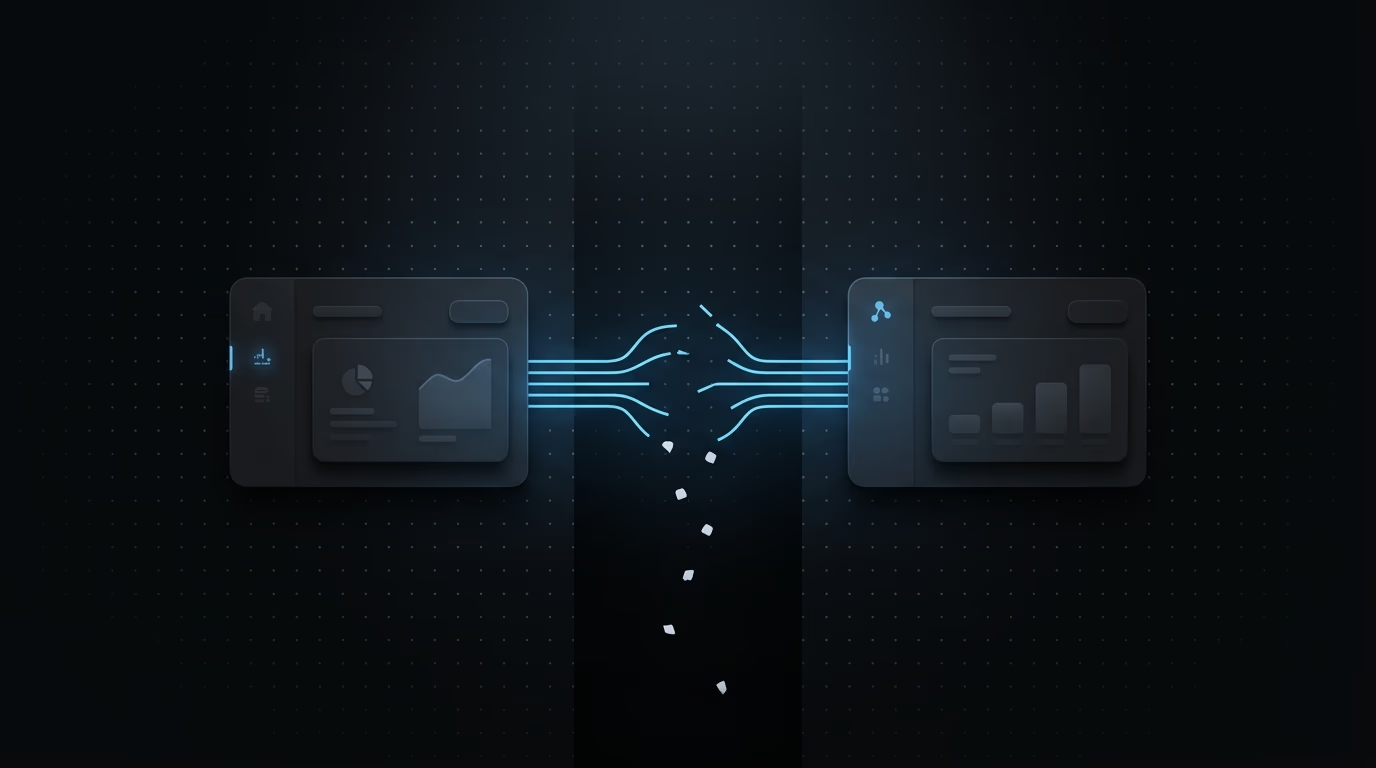
The biggest mistake I see is the “redundancy trap.” Marketers think that sending the same event from both the browser and the server doubles their chances of tracking a sale. But if you don’t have a solid deduplication strategy, you’re just muddying the waters. When Meta gets two signals for the same purchase and can’t figure out which one to trust, it either over-reports or, more likely, confuses the buyer’s identity.
Most setups ignore the Meta Marketing API documentation for advanced matching parameters. They send events but skip key identifiers like hashed emails, external IDs, or fbp/fbc cookies. Without these, Meta’s Match Quality score stays “Poor” or “Okay.”
A “Poor” match means Meta can only tie a conversion to a user about 20% of the time. You might see the conversion in Shopify, but Meta doesn’t know which ad led to it. The algorithm doesn’t learn. It keeps showing ads to the wrong people because it assumes the right people aren’t buying. This is how you end up in a death spiral: rising CPAs and falling reach.
Competitor Approaches and Common Mistakes
Let’s break down how other tools approach CAPI, and where they fall short.
Hootsuite Ads and similar legacy platforms focus on reporting. They’ll tell you that CAPI is active, but they provide no insight into the quality of your data. To them, CAPI is just a static utility. If it’s “Green,” they move on to creative tips. But creative quality accounts for up to 56% of a campaign’s ROAS variation (Nielsen and Meta research). And you can’t optimize creative when the feedback loop’s broken by poor CAPI matching.
Revealbot uses automation rules to scale or pause campaigns, but it’s just a Band-Aid. If your CAPI isn’t sending strong data, Revealbot might pause a winning ad because the conversion wasn’t attributed correctly. You’re automating bad decisions.
Madgicx does a better job analyzing creative performance, but it still focuses more on “what” won, rather than “how” data is flowing. The common flaw across all these tools is treating Facebook CAPI like a passive utility instead of an active data engine. At Instrumnt, we see the data signal as the lifeblood of creative testing. If you’re not feeding CAPI with the right signals, you’re not using it at all.
AI-Driven Attribution and the Death of the Browser Pixel
Browser-based tracking is dead. Between ITP, ATT, and declining cookie reliability, the browser pixel is now just a shadow of its former self. Success today requires a server-first mentality.
This is where AI changes everything. A strong CAPI setup lets you send more than just “Purchase” events. You can send offline conversions, qualified lead scores, and predicted LTV data. This gives Meta’s algorithm more information to go beyond simple conversion optimization and into true value-based optimization.
But that’s not easy. You need to be constantly diagnosing attribution issues. Are your server events hitting within the required window? Is the event_id consistent across both browser and server?
If you’re using a high-velocity Facebook ads uploader to push dozens of creative variations, fast feedback is everything. If it takes 24 hours for a CAPI event to be processed, your AI optimization tools are making decisions based on yesterday’s news. You need real-time, high-quality data to stay ahead of creative fatigue.
Real-World Impact on Campaign Performance
The gap between a mediocre CAPI setup and a solid one isn’t just a few percentage points; it’s the difference between scaling and stagnating.
Consider this: “Meta brands invested 68.31% of their total ad budget on Meta platforms in 2025” (Triple Whale 2025 data). When you’re spending that much on a single ecosystem, a 10% boost in attribution accuracy could massively impact profitability.
I’ve seen accounts where improving CAPI match quality from “4.2” to “8.5” instantly dropped CPA by 20%. Nothing else changed. The ads didn’t change, the audience didn’t change. The only change was that Meta finally understood who was buying. That’s when the Advantage+ algorithms started working. It’s no surprise that “In 2024, over 15 million ads were created using Meta's AI tools” (Meta 2024 earnings). These tools are only as good as the data you give them.
When we talk about Pixel vs CAPI, we’re talking about more than just tracking. We’re talking about the foundation of your business. If you’re not sending top-tier data, you’re donating ad spend to Meta without getting the “intelligence” in return.
The Strategic Fix: Moving Beyond 'Setup and Forget'
So, how do you fix this? It starts with ditching third-party “one-click” integrations that give you no control over your data.
You need to audit your Event Match Quality (EMQ) scores weekly. If your Purchase event’s EMQ is under 6.0, you’ve got a problem. Usually, it’s because you’re not sending enough customer data parameters. Send as much hashed data as possible—email, phone, city, state, zip, even browser user agent.
Next, integrate your CAPI strategy into your creative process. With tools like Instrumnt, the data from CAPI should guide your next move. If one creative is generating strong server-side leads but low browser-side clicks, the CAPI data is telling you that you’ve found a high-intent segment, even if it’s a smaller one.
Finally, stop treating CAPI like a developer’s issue. It’s a media buyer’s issue. If you don’t understand the Meta Marketing API, you can’t manage a modern ad account. You don’t need to code, but you do need to understand the data flow.
The future of Meta advertising belongs to those who own their data. The browser pixel is dying, and the era of “set and forget” CAPI is over. It’s time to treat your signal quality with the same obsession you bring to your ROAS. In 2026, they’re one and the same.
Related reading
If you want to keep reading without changing topic, these pages add more context:
- 5 Tips for Media Buyers to Work Faster and Scale Smarter
- Why Most Facebook Ad Management Platforms Are Doing It Wrong (And What You Should Do Instead)
For more context, see Meta for Business Help Center.
Common questions about facebook conversions api
What is the best way to facebook conversions api?
The best approach depends on your team size and launch volume. Start by structuring your workflow around batch preparation and bulk uploading, then layer in automation for the parts that don't need human judgment.
How many ad variations should I test?
Advertisers running 3 or more variations per audience consistently see lower CPAs. Aim for at least 3-5 variations per ad set as a starting point, and increase from there as your workflow allows.
Does automation replace the need for creative strategy?
No. Automation handles the operational side, like launching, duplicating, and naming ads at scale. Creative strategy, offer positioning, and audience selection still require human judgment. The goal is to free up more time for that strategic work.