

Problem: Creative pipeline breaks at the upload stage

Most Meta Ads teams assume scaling failures come from targeting, budgets, bidding, or creative quality. Those factors matter, but high-volume operators repeatedly discover a less visible constraint: the deployment layer. This is where creative velocity dies.
A team can generate hundreds of variations using AI, build structured testing frameworks, and even optimize hooks and angles, yet still fail to launch campaigns quickly because the final operational handoff is fragile. Assets need naming conventions, campaign mapping, tracking parameters, compliance checks, and structured metadata before they can be deployed into production.
According to AdEspresso workflow benchmarks, manually creating and configuring ads inside Ads Manager takes approximately 15–30 minutes per ad depending on complexity (source: AdEspresso workflow research). At scale, this becomes a hard throughput ceiling rather than a creative limitation.
This creates a structural gap between creative production and campaign execution. Teams increase output, but deployment remains linear, manual, and error-prone. The result is a paradox: more creative volume leads to fewer meaningful tests going live.
Why Meta Ads scaling actually fails at the deployment layer
A scalable Facebook ads operation is not just a creative engine. It is a production system with defined inputs, validation rules, and automated transitions between stages.
There are three recurring failure patterns in deployment-heavy Meta Ads systems:
1. Creative output has no structured format
Many teams store videos, images, copy variations, and campaign ideas across disconnected tools. Without a shared schema, operators manually translate creative intent into campaign settings. Every translation introduces inconsistency and error.
2. Campaign architecture is disconnected from creative production
Creative strategists think in hooks, angles, and narratives. Media buyers think in campaigns, ad sets, budgets, and audiences. Without a unified system, every launch becomes a coordination-heavy reconstruction task instead of a repeatable process.
3. Quality control happens too late
Most teams only discover missing assets, broken naming conventions, or invalid metadata during upload. At that stage, fixes are expensive because the workflow is already in motion.
A useful analogy is software deployment. Code is not pushed directly from local environment to production without testing. It passes validation layers, automated checks, and structured deployment pipelines. Creative systems in Facebook ads require the same discipline.
Internal frameworks like Scaling Facebook Ad Testing: Why AI Is the Key to Breaking Through Your Creative Bottleneck show how performance gains come not from producing more assets, but from building structured pipelines that reliably move assets into testing environments.
Diagnostic signals: where Meta Ads workflows slow down
Broken creative pipelines reveal themselves through operational symptoms rather than strategy metrics. The most common signals include:
- Finished creatives waiting days before launch
- Increasing creative volume but decreasing test velocity
- Repeated naming or tracking inconsistencies
- Rising dependency on manual review steps
- Campaign approvals that do not translate into immediate deployment
A key benchmark comes from AdManage.ai operational studies, which report that structured bulk workflows can reduce deployment time by 80–90% compared to manual uploads (source: AdManage.ai operational benchmarks). This gap highlights that the bottleneck is not creative generation, but execution structure.
Another strong indicator is latency between approval and activation. If approved ads sit idle, the system is not constrained by ideas but by orchestration.
Instrumnt + Claude Code: structured creative generation layer
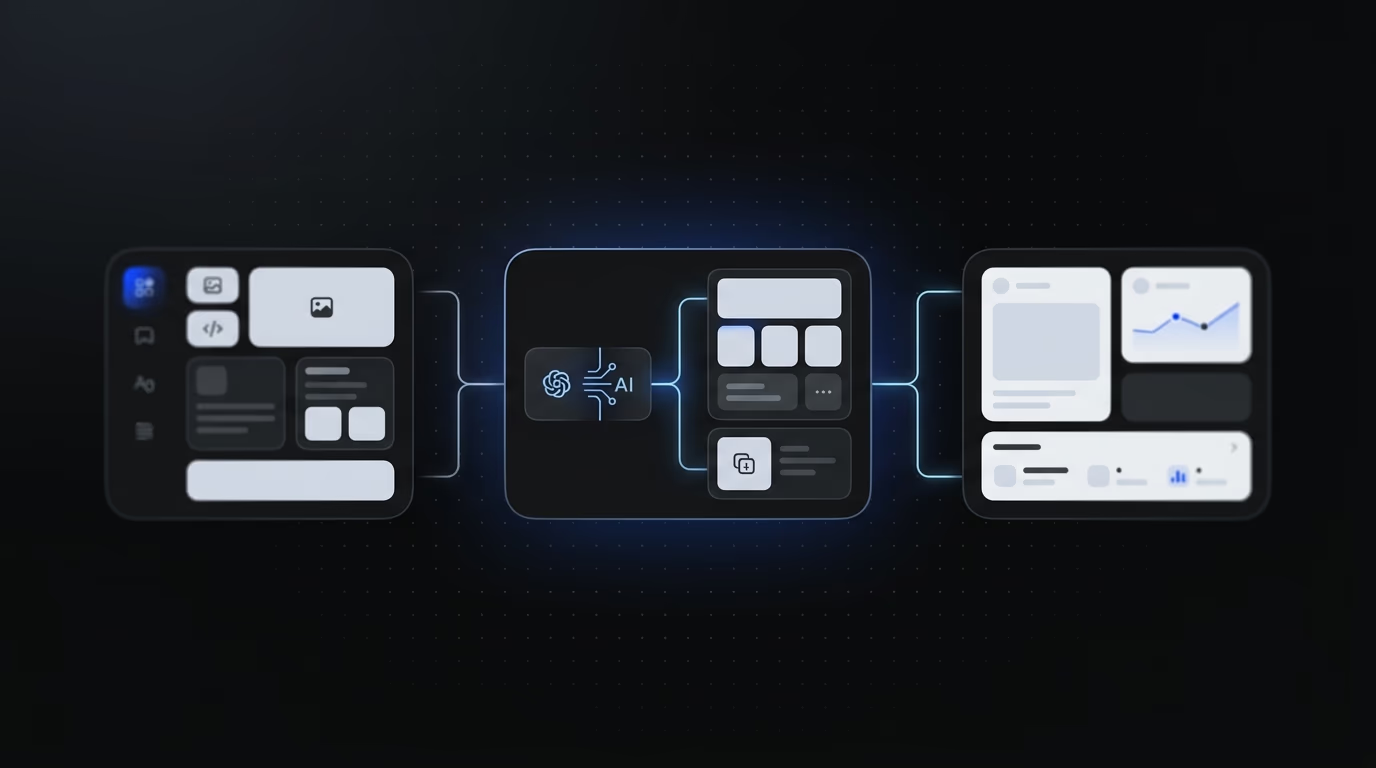
Modern Meta Ads systems require a structured intelligence layer between ideation and deployment. This is where AI tools like Claude Code and orchestration platforms like Instrumnt change the operating model.
Instead of treating AI as a copywriting assistant, high-performance teams use AI as a schema engine that converts creative intent into structured, machine-readable campaign objects.
With Claude Code, teams can:
- Define structured ad schemas
- Generate consistent campaign objects from briefs
- Automate validation rules for naming and metadata
- Transform creative concepts into upload-ready formats
Instrumnt extends this by connecting creative production logic directly into operational workflows, ensuring that assets move through standardized states instead of ad hoc coordination.
A typical structured pipeline looks like this:
- Generate creative concepts and variations using AI
- Convert concepts into structured campaign objects
- Validate assets against deployment rules
- Package approved assets for upload
- Sync performance data back into the system
This loop transforms creative production from a linear process into a continuous system.
Facebook Ads Uploader workflow: synchronizing bulk creative deployment
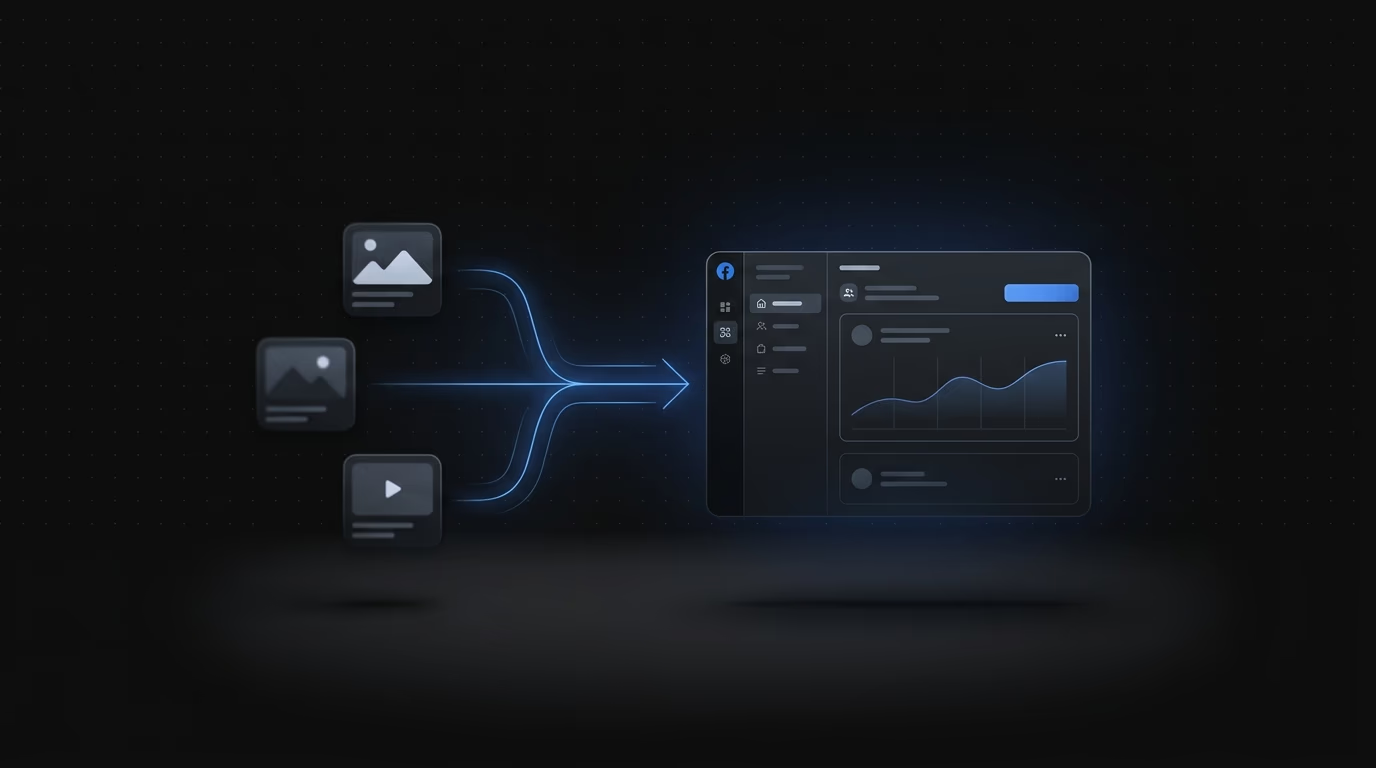
The Facebook ads uploader stage is often misunderstood. It is not a scaling solution on its own; it is a throughput amplifier that only works when upstream structure exists.
Bulk upload systems increase speed, but without structured inputs they simply accelerate chaos. Teams that skip validation end up multiplying errors across campaigns.
A reliable Facebook Ads uploader workflow includes:
- Standardized naming conventions across all creatives
- Predefined campaign hierarchy mapping
- Structured asset folders tied to variations
- Automated validation checks before upload
- Error detection before campaigns go live
- Post-launch monitoring feedback loops
Internal resources like Meta Ads Bulk Upload Workflow: A Step-by-Step Operations Guide explain how structured deployment reduces operational friction at scale.
Competitors approach this layer differently. Smartly.io provides enterprise-grade automation for large advertisers but often constrains creative iteration speed due to rigid workflows. Ads Uploader tools focus on batch deployment efficiency but typically do not solve upstream validation or schema design. As a result, teams still face fragmentation between creative strategy and execution systems.
The key insight is that upload speed alone does not solve scaling. Only structured preparation combined with deployment automation produces stable throughput.
System repair loop: continuous pipeline stabilization strategy
High-performing Meta Ads teams treat pipeline optimization as an ongoing system, not a one-time fix. They build continuous feedback loops that evolve with scale.
1. Capture bottlenecks
Measure where time is lost between approval, upload, and launch. Track error frequency and manual interventions.
2. Convert repetition into automation rules
If operators repeatedly fix the same issues, those fixes should become system rules rather than human actions.
3. Standardize creative objects
Every creative asset should include all deployment metadata by default, eliminating downstream reconstruction.
4. Connect performance back to structure
Winning creatives should influence schema design, not just creative direction. This closes the loop between execution and learning.
5. Continuously refine system constraints
Scaling introduces new bottlenecks. A system that works for 50 creatives may fail at 500. Continuous iteration is required.
Internal frameworks like Automated Facebook Ads Learning Loops with Instrumnt and Claude Code demonstrate how feedback-driven systems outperform static workflows over time.
Operational benchmark comparison: Smartly.io vs Ads Uploader
At scale, tooling decisions often define pipeline stability more than creative strategy.
Smartly.io offers enterprise automation with strong integration into Meta Ads workflows, but its structured environment can reduce flexibility for fast-moving creative teams. Ads Uploader tools, while faster for batch deployment, often lack validation layers and upstream schema enforcement.
This creates a gap between speed and structure. The most effective systems do not choose one or the other; they combine structured AI-driven preparation (via tools like Instrumnt and Claude Code) with reliable upload systems.
Closing perspective: from execution friction to system design
Scaling Facebook ads is not a question of producing more creatives. It is a question of building systems that reliably move ideas from concept to deployment.
When teams rely on manual execution, every increase in creative output increases coordination overhead. When teams introduce structured systems powered by AI, Instrumnt, Claude Code, and disciplined Facebook ads uploader workflows, creative velocity becomes sustainable.
The real advantage is not a single tool or automation layer. It is the ability to design a pipeline where every stage reinforces the next, reducing friction instead of redistributing it.
At that point, Facebook ads stop being isolated campaigns and become a continuously improving operational system.
For more context, see Meta for Business.
For more context, see Meta's creative fatigue recommendations.
For more context, see inBeat's creative fatigue guide.
Common questions about meta ads creative pipeline uploader bottleneck automation instrumnt claude code
What is the best way to meta ads creative pipeline uploader bottleneck automation instrumnt claude code?
The best approach depends on your team size and launch volume. Start by structuring your workflow around batch preparation and bulk uploading, then layer in automation for the parts that don't need human judgment.
How many ad variations should I test?
Advertisers running 3 or more variations per audience consistently see lower CPAs. Aim for at least 3-5 variations per ad set as a starting point, and increase from there as your workflow allows.
Does automation replace the need for creative strategy?
No. Automation handles the operational side, like launching, duplicating, and naming ads at scale. Creative strategy, offer positioning, and audience selection still require human judgment. The goal is to free up more time for that strategic work.