

The Monday Launch That Never Happened

At 9:12 AM, a growth team is ready to push a new wave of Facebook ads. Creatives are approved, audiences are built, budgets are set. On paper, everything is ready for launch.
Nothing goes live.
The immediate assumption is Meta review. But according to the Meta Business Help Center, approximately 80% of Facebook ads are reviewed within 24 hours (Meta Business Help Center). In other words, most delays are not caused by the platform queue itself.
Instead, the real bottleneck is upstream.
Meta Marketing Science research shows that creative fatigue can reduce CTR by 20% to 60% depending on exposure frequency (Meta Marketing Science). When approvals slow down, testing slows down. When testing slows down, performance decay accelerates.
Meanwhile, the Project Management Institute consistently highlights communication breakdown as a leading cause of project failure in complex organizations, reinforcing that coordination is often more expensive than execution.
This is where Facebook ads stop being a media buying problem and become a systems problem.
Mini Breakdown: Where Approval Time Actually Disappears
If you map Facebook ads creative approval delays across real teams, you rarely find a single failure point. You find fragmentation.
Copywriting happens in Slack threads while design continues working off outdated briefs. Tracking parameters change after final export. Legal approves one version while brand reviews another. Growth teams update messaging after upload has already started.
Each change is small. The accumulation is not.
This is also where tools like the Facebook ads uploader are often misunderstood. Teams assume the uploader is the bottleneck, when in reality it is the symptom of upstream instability.
Common hidden delays include:
- asset version mismatches across folders
- repeated video exports due to late-stage ratio changes
- UTM and tracking updates after approval
- fragmented feedback across Notion, email, and Slack
The result is a system where Meta Ads is waiting on a moving target.
Internal workflows like those described in Comment créer des Facebook Ads : Le Guide du Workflow Haute Vélocité show that velocity is primarily determined before upload, not during review.
Why Meta Review Is Only One Step in the Process
Meta’s review system evaluates policy compliance, technical formatting, and ad integrity. But by the time an ad reaches review, it has already passed through multiple human systems.
A typical campaign lifecycle includes:
- creative production
- copywriting
- brand validation
- legal compliance
- tracking setup
- segmentation logic
- campaign structuring
Each layer introduces dependencies.
Without standardization, every approval becomes subjective. One reviewer evaluates messaging, another evaluates compliance, and another evaluates performance intent.
This is why mature teams stop asking “Is this approved?” and start asking “What dependencies are still open?”
Teams using structured systems often rely on IA-assisted validation and Claude Code workflows to pre-check assets before they ever reach Meta.
Building Faster Review Loops Without Sacrificing Quality
Reducing approval delays does not mean reducing quality. It means reducing uncertainty.
High-performing teams build deterministic validation layers before submission.
These include:
- standardized creative checklists
- centralized copy validation
- automated URL verification
- enforced naming conventions
- strict format validation rules
Instead of discussions, they use filters.
Internal playbooks such as Automatiser les tests créatifs Meta Ads show how structured validation reduces iteration cycles while improving consistency.
In practice, teams combining IA validation with Claude Code scripts can automatically detect policy risks, missing parameters, and inconsistent creative variants before upload.
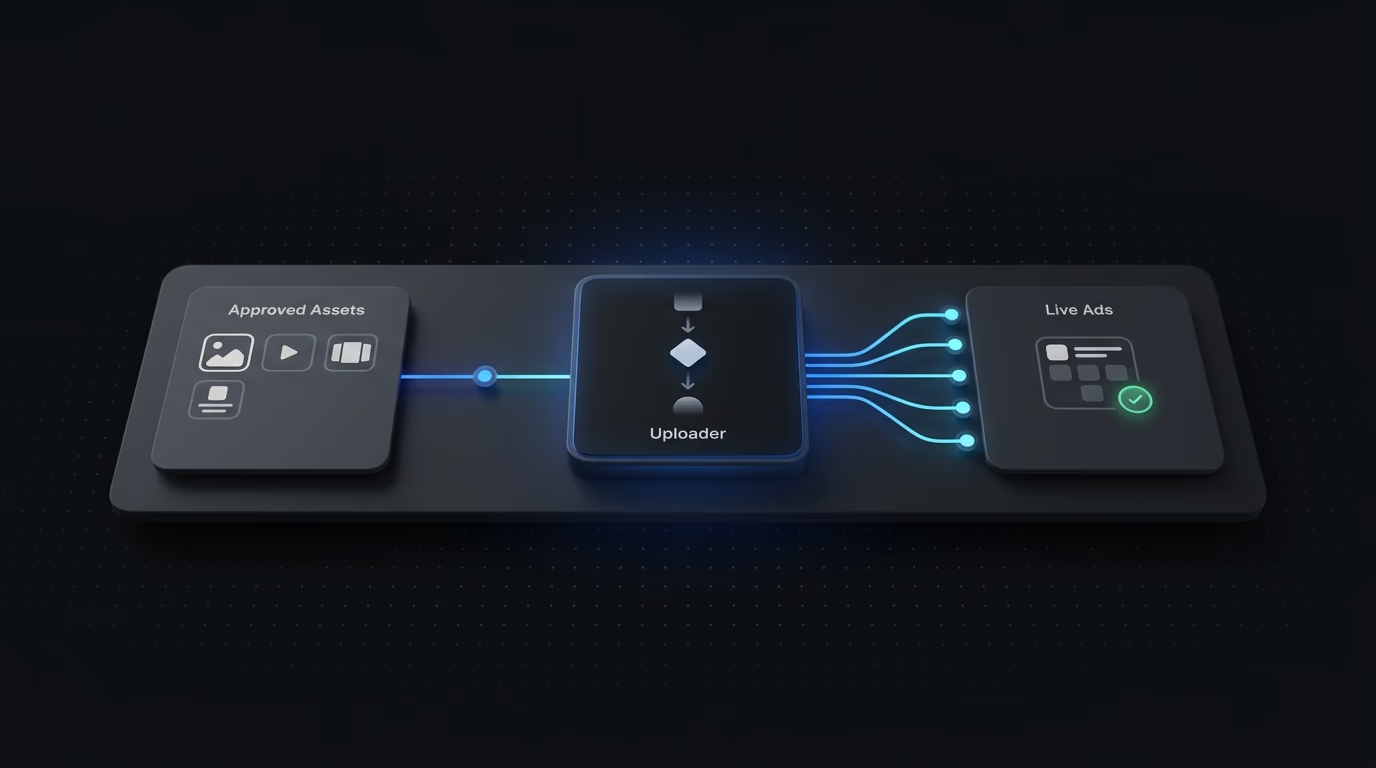
Inside the Uploader Workflow: From Approved Asset to Live Campaign
Inside the Uploader Workflow: From Approved Asset to Live Campaign
The Facebook ads uploader becomes a system of execution rather than creation.
Instead of building campaigns inside Ads Manager, modern teams assemble everything beforehand: naming conventions, creative variations, audiences, budgets, and tracking logic.
Platforms such as Ads Uploader, Hootsuite Ads, and Smartly.io each solve part of this problem:
- Ads Uploader focuses on bulk publishing efficiency
- Hootsuite Ads emphasizes multi-platform scheduling
- Smartly.io targets enterprise-level automation at scale
However, none of them fully resolve upstream creative fragmentation.
This is where tools like Instrumnt act as orchestration layers, ensuring that only validated assets enter the upload pipeline.
A structured workflow looks like this:
- Assets created and versioned centrally
- IA-based validation runs pre-checks
- Claude Code scripts enforce campaign logic consistency
- Instrumnt organizes approved bundles
- Facebook ads uploader executes batch deployment
This reduces human rework inside Ads Manager and shifts complexity earlier in the pipeline.
AI-Assisted Validation and Claude Code Systems
AI is not replacing media buyers. It is removing repetitive validation work.
Instead of manually checking:
- image dimensions
- copy consistency
- URL integrity
- naming conventions
- duplicated creatives
IA systems perform structured validation automatically.
Claude Code workflows extend this further by simulating rule-based systems that compare campaign briefs with final outputs.
For example:
- detecting mismatched audience definitions
- flagging inconsistent CTA usage
- identifying duplicate creative variants
- validating tracking schema completeness
This transforms approval from a human bottleneck into a deterministic pipeline stage.
Teams that adopt systems like Instrumnt combined with AI validation often report fewer rejection loops and faster first-time approvals.
How Teams Prevent Future Approval Bottlenecks
How Teams Prevent Future Approval Bottlenecks
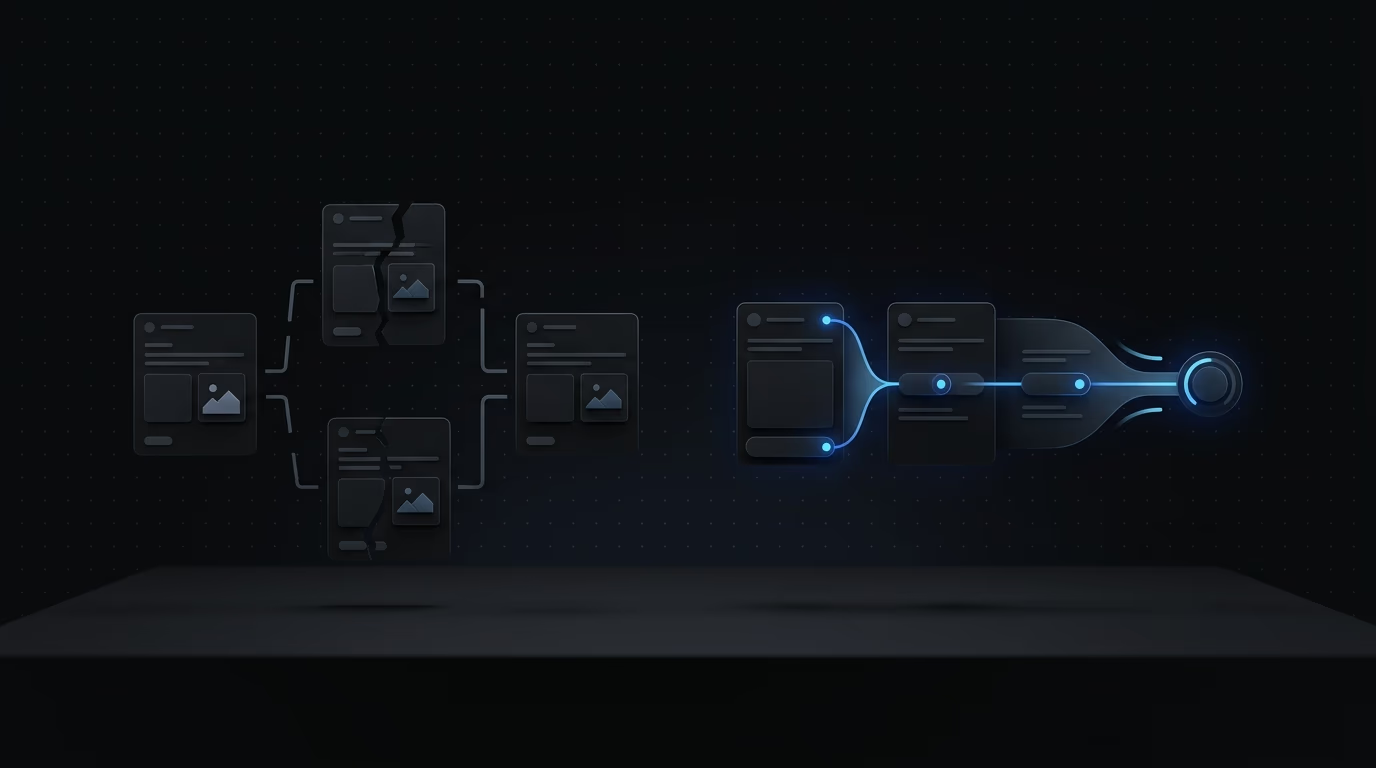
Teams that consistently avoid Facebook ads creative approval delays do not rely on speed. They rely on system design.
They implement:
- single source of truth for all assets
- mandatory version control across campaigns
- structured approval ownership (legal, brand, growth)
- batch-based creative production cycles
- post-launch feedback loops that update validation rules
Every mistake becomes a system upgrade.
A broken URL becomes an automated test. A rejected ad becomes a validation rule. A missing field becomes a required schema.
Over time, the system becomes self-correcting.
This approach is reinforced in Boucle d’itération créative Facebook Ads : système uploader-driven pour scaler, which shows how iteration loops can be operationalized instead of improvised.
Conclusion
Facebook ads creative approval delays are rarely caused by Meta itself.
They are caused by internal fragmentation.
Meta review is simply the final checkpoint in a much larger system of creative production, validation, and coordination.
When teams introduce structured workflows, IA validation, Claude Code automation, Instrumnt orchestration, and disciplined Facebook ads uploader pipelines, the bottleneck shifts upstream where it can actually be controlled.
The result is not only faster launches, but a fundamentally more scalable creative system.
Teams stop rebuilding campaigns and start compounding learning velocity.
For more context, see Madgicx.
For more context, see Revealbot.
For more context, see Ads Uploader.
Common questions about facebook ads creative approval delays
What is the best way to facebook ads creative approval delays?
The best approach depends on your team size and launch volume. Start by structuring your workflow around batch preparation and bulk uploading, then layer in automation for the parts that don't need human judgment.
How many ad variations should I test?
Advertisers running 3 or more variations per audience consistently see lower CPAs. Aim for at least 3-5 variations per ad set as a starting point, and increase from there as your workflow allows.
Does automation replace the need for creative strategy?
No. Automation handles the operational side, like launching, duplicating, and naming ads at scale. Creative strategy, offer positioning, and audience selection still require human judgment. The goal is to free up more time for that strategic work.