Why Traditional Competitor Analysis Fails

If your Facebook ads strategy starts with “let’s spy on competitors,” you’re already playing defense.
Scrolling the Meta Ad Library, saving screenshots, breaking down hooks—it feels productive. It creates the illusion of progress. But it rarely improves performance in any meaningful way.
I’ve watched teams build massive swipe files and still miss their targets. Not because they picked the wrong ads, but because they misunderstood what actually drives results.
Seeing what works is not the same as being able to reproduce it.
That gap is where most teams lose.
Facebook ads don’t reward observation. They reward volume and iteration. If you can’t turn insights into dozens of tests quickly, the insight doesn’t matter.
According to Meta’s internal research, campaigns with a higher number of creative variations had a 33% higher probability of outperforming competitors due to faster learning cycles and improved delivery optimization (Meta, 2023 Creative Diversification Study).
But most teams aren’t built for that.
They’re built for analysis.
Which is why traditional Facebook ads competitor analysis feels smart—but performs poorly.
Even worse, research from HubSpot shows that 61% of marketers say generating traffic and leads is their biggest challenge, yet most still rely on static research methods instead of iterative testing systems (HubSpot State of Marketing Report, 2023).
There’s also a deeper issue: time-to-execution. Nielsen research has shown that creative quality drives up to 49% of sales lift in advertising performance, making it the single most important factor in campaign success (Nielsen Marketing Mix Study).
Yet most teams spend more time analyzing ads than producing them.
That disconnect explains why competitor analysis alone rarely translates into growth.
The Advantage of Testing Ideas, Not Ads

The teams that consistently win don’t obsess over ads. They focus on ideas—and then they out-test everyone.
That distinction changes everything.
An ad is a finished asset. It’s already been filtered through someone else’s brand, audience, and timing. Copying it is guesswork.
An idea is raw material.
When you treat competitor ads as idea inputs instead of templates, your workflow stops being reactive and starts being generative.
Instead of asking:
“What is this ad doing?”
You ask:
“What’s the underlying angle here—and how far can I push it?”
Take a few common patterns:
- Before-and-after transformations
- Problem agitation hooks
- UGC-style testimonials
Most teams pick one and try to recreate it.
That’s the mistake.
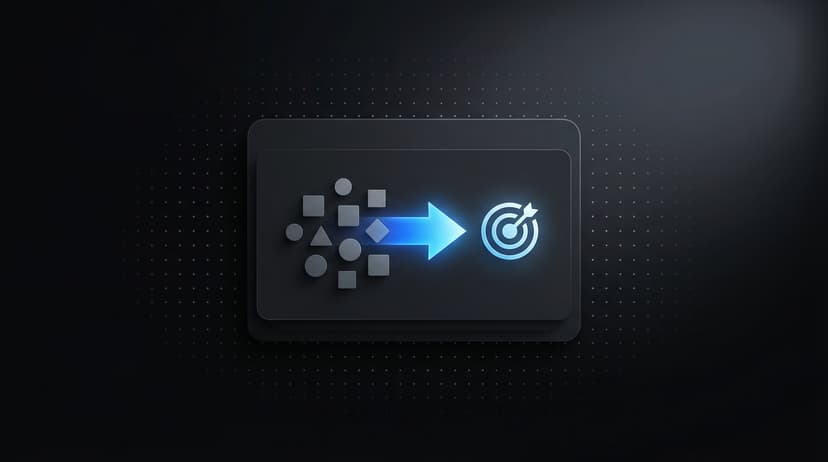
The better move is to take each concept and expand it into variations—different hooks, tones, formats, and visuals.
Ten variations. Twenty if you can.
Because Facebook ads today are a numbers game.
Only a small percentage of creatives actually perform. If you’re launching three or four ads per idea, you’re not testing—you’re hoping.
WordStream reports that advertisers who test multiple variations consistently can reduce cost per acquisition by up to 30% compared to those running limited creative sets (WordStream, Facebook Ads Benchmarks Report).
The takeaway is simple:
Stop trying to find the “best” competitor ad.
Start building a system that turns any decent idea into a batch of tests.
If you want a deeper breakdown of this shift, read Analyzing Competitor Facebook Ads Is a Waste of Time (Unless You Do This Instead).
Building a Competitor-Driven Idea Pipeline

Once you accept that analysis alone doesn’t drive performance, the next question becomes operational: how do you turn it into output?
You need a pipeline. Not a swipe file. Not a Notion board full of screenshots. A system that actually produces Facebook ads at scale.
Here’s a simple version that works:
- Input: competitor ads, landing pages, offers, messaging angles
- Breakdown: isolate hooks, formats, emotional drivers
- Expansion: generate variations with AI and Claude Code
- Execution: launch in bulk using a Facebook ads uploader
- Feedback: feed results back into the next round
Most teams never get past step two.
They collect. They categorize. They discuss.
And then they stall.
The expansion layer is where things change.
This is where AI stops being a buzzword and starts being operationally useful.
You’re no longer limited by how fast a human can write variations or build ads manually. With tools powered by Claude Code, you can generate dozens—or hundreds—of structured variations in minutes.
Then comes execution.
A Facebook ads uploader becomes critical. Without it, your production speed collapses. With it, you can push variations live in bulk without bottlenecks.
This is where Instrumnt becomes important.
Instead of separating idea generation from execution, Instrumnt connects them. You go from insight → variation → launch in one continuous workflow.
That’s the difference between a system and a process.
And the impact is measurable. In a WordStream survey, teams using bulk testing workflows improved performance 45% faster than those relying on manual builds (WordStream, 2022 Paid Media Trends Survey).
If you want to see exactly how this works in practice, read How to Build a Facebook Ads Bulk Testing System with Instrumnt and Claude Code.
Competitor Comparison: AdEspresso vs Hunch vs Paragone
Most tools in this space were built for a different era of Facebook ads.
They assume the problem is campaign management.
It’s not.
The real problem is generating and testing enough creative.
Let’s break it down.
AdEspresso
AdEspresso is strong for structured A/B testing. It gives you a clean interface to compare variations and manage experiments. But it assumes you already have creatives ready. It doesn’t help you generate more.
Hunch
Hunch leans heavily into automation, especially for ecommerce feeds and dynamic creatives. It’s powerful in catalog-driven environments. But for idea-driven testing outside predefined templates, it becomes restrictive.
Paragone
Paragone focuses on automation and campaign optimization for ecommerce brands. It improves efficiency, but it operates on existing inputs rather than expanding creative output.
There’s a pattern here.
These platforms help you organize and optimize what you already have.
They don’t help you dramatically increase what you can produce.
That’s the gap.
And right now, that gap matters more than anything else.
Because the limiting factor in Facebook ads isn’t targeting or budget anymore.
It’s creative throughput.
Instrumnt approaches the problem differently.
Instead of acting like a dashboard, it behaves like a system layer. You feed it inputs, it generates variations using AI, and pushes them into execution via a Facebook ads uploader.
Less clicking. More output.
That aligns with where Meta is heading: automation-first workflows, API-driven execution, and scalable creative testing.
For a broader perspective on where platforms fall short, see Why Most Facebook Ads Automation Tools Are Doing It Wrong (And How Instrumnt Does It Right).
From Analysis to Action: Turning Insights into Winning Campaigns
This is where most teams hesitate.
And to be fair, they’re not completely wrong.
You should understand your market. You should recognize patterns, offers, and creative formats.
But awareness is not a strategy.
Spending hours analyzing competitors doesn’t automatically translate into better campaigns.
In most cases, it slows you down.
Teams convince themselves they need “one more round of research” before launching.
Meanwhile, faster teams are already testing.
In a system where speed determines learning, that delay kills performance.
The goal isn’t to eliminate competitor analysis.
It’s to compress the time between insight and execution.
That’s the shift most teams haven’t made yet.
Conclusion: Embracing AI for Scalable Ad Success
Facebook ads competitor analysis isn’t useless.
It’s just incomplete.
On its own, it gives you awareness without action.
But when you plug it into a system—powered by AI, accelerated by Claude Code, and executed through a Facebook ads uploader—it becomes something far more valuable: a source of scalable testing inputs.
That’s the future.
Not better spying.
Better systems.
Because the teams that win in Facebook ads aren’t the ones with the best insights.
They’re the ones who can turn those insights into live tests faster than everyone else.
And increasingly, that’s not something humans can do alone.
It requires AI.
It requires automation.
And it requires platforms like Instrumnt that are built for creative velocity—not just campaign management.
Common questions about facebook ads competitor analysis
Why is traditional Facebook ads competitor analysis not enough?
Because it focuses on observation instead of execution. Without a system to turn insights into multiple ad variations quickly, analysis doesn’t translate into performance gains.
How can AI-powered testing improve my ad performance?
AI allows you to generate and test significantly more variations in less time. This increases your chances of finding high-performing creatives and accelerates learning cycles.
What tools should I use for bulk creative testing in Facebook ads?
You need a combination of AI generation (like Claude Code), a structured testing workflow, and a Facebook ads uploader. Platforms like Instrumnt connect these pieces into a single system that enables high-volume testing without operational bottlenecks.
For more context, see Meta Ads Guide.
For more context, see Meta Blueprint.
For more context, see Meta for Business Help Center.